
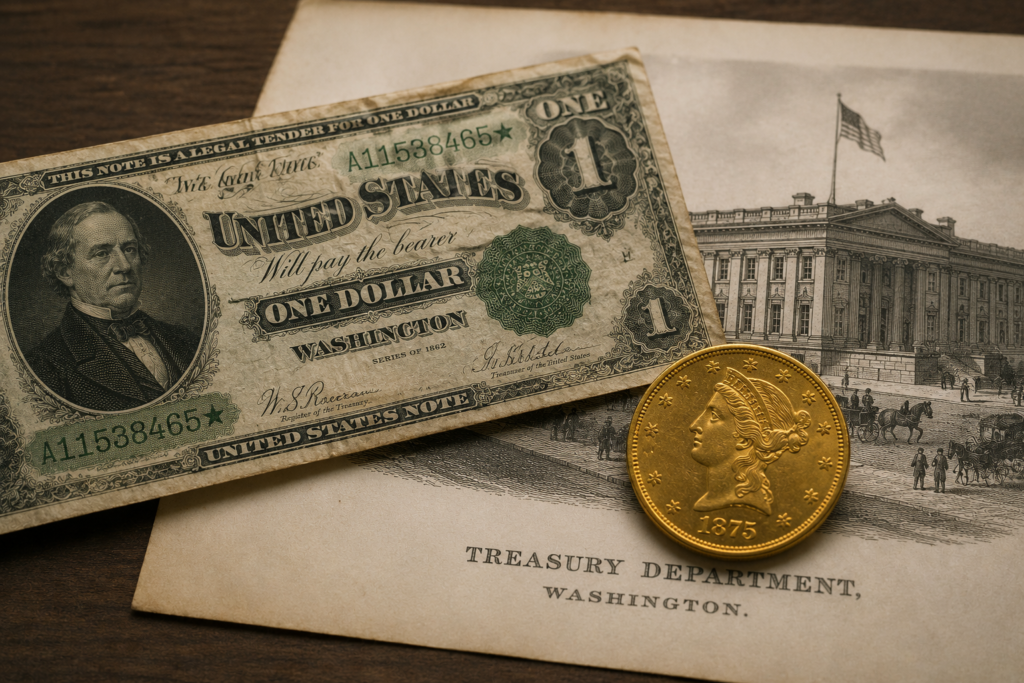
During the Civil War, the U.S. government ran out of gold and started printing paper money — greenbacks — that couldn’t be traded in for coin. For more than a decade, a dollar in paper was worth less than a dollar in gold, and the country argued bitterly over how to fix it.
The Specie Payment Resumption Act of 1875 was the answer, and this is how it worked.
This article is general historical information, not financial or investment advice. It describes monetary policy from the 1860s and 1870s and makes no claim about the value or direction of gold, silver, or the dollar today.
What the Specie Payment Resumption Act was
The Specie Payment Resumption Act of 1875 was a federal law, signed by President Ulysses S. Grant on January 14, 1875, that promised to redeem Civil War paper money (greenbacks) in gold on demand beginning January 1, 1879. It returned the United States to the gold standard.
A lame-duck Republican Congress passed the Act after losing the 1874 midterm elections, making it a parting effort to restore hard money. The word resumption is the key: the government was resuming a practice it had stopped during the war, redeeming paper dollars for gold or silver coin on request.
Setting a firm future date, rather than acting overnight, is what made the plan work.
What does “specie” mean?
Specie is money in the form of gold and silver coin, as opposed to paper currency. A promise of specie payment is a bank’s or government’s guarantee to hand over that coin in exchange for its paper notes on demand, so a paper dollar is a claim on real metal you can collect at any time.
When a government suspends specie payment, it stops honoring that promise, and its paper money floats free of any fixed metal value. That’s exactly what the United States did in 1862. Resuming specie payment meant restoring the guarantee, so a greenback would once again be worth a dollar in gold.
Why was the government on paper money in the first place?
To finance the Civil War, Congress authorized United States Notes in 1862 — the original greenbacks — and suspended gold redemption. The notes were legal tender by law but not backed by coin, so their value against gold rose and fell with the Union’s fortunes on the battlefield. By the war’s end, hundreds of millions of greenbacks were in circulation, worth less than their face value in gold.
Afterward the country split. Creditors, Eastern bankers, and hard-money advocates wanted to return to gold, which would make the dollar stronger and debts worth more. Farmers, many Westerners, and debtors wanted to keep or expand the paper supply, which kept money loose and prices up. The Panic of 1873 and the hard years that followed turned this into one of the fiercest political fights of the era.
The Panic of 1873 sharpened the stakes. A financial collapse that began with railroad overbuilding and bank failures dragged the country into a long depression, and prices fell year after year. To debtors, returning to gold on top of that felt like piling deflation onto deflation, which is why the timing of the 1875 Act drew such heat.
What the Act actually did
The Act’s central move was to name a date and commit the government to it. Alongside that promise, it made several practical changes to prepare for the return to gold, including retiring small paper notes in favor of coins struck by the U.S. Mint. In full, the law:
- Set the resumption date: Required the Treasury to redeem greenbacks in gold coin on demand on or after January 1, 1879.
- Built a gold reserve: Authorized the Treasury to accumulate gold, including through the sale of government bonds, to fund redemptions.
- Shrank the paper supply: Called for reducing greenbacks in circulation toward $300 million as coin came back into use.
- Replaced paper change with coin: Directed that small-denomination fractional paper notes be retired and replaced with silver coins.
- Dropped the coining charge: Abolished the fee the Mint charged to turn gold bullion into coin, encouraging gold into the system.
How did the return to gold succeed?
Treasury Secretary John Sherman spent the years before 1879 quietly stockpiling gold, largely through bond sales to European buyers and federal surpluses as prosperity returned after 1877. By the resumption date, he had assembled a redemption fund of roughly $133 million — enough to convince the public the government could actually pay.
The plan worked because confidence did the heavy lifting. As January 1, 1879, approached and everyone could see the gold was there, greenbacks rose to par, meaning a paper dollar was finally worth a dollar in gold. Once paper was as good as gold, almost no one bothered to redeem it, and the switch happened without the panic critics had feared.
Resumption also didn’t pull the greenbacks out of people’s pockets. After January 1, 1879, the paper dollars simply became convertible: you could spend a greenback or trade it for gold, and because the two were now equal, most people kept using the paper.
The dollar was back on gold without much of the currency actually changing hands.
The backlash and the Greenback Party
Not everyone welcomed the return to gold. Debtors and inflation-minded reformers saw a shrinking paper supply as a squeeze that helped bankers and hurt working farmers. They organized into the Greenback Party, which argued that a flexible paper currency served ordinary people better than a rigid gold-backed one.
Riding real electoral gains in 1878, the greenback forces pushed through a change to the law that stopped the government from retiring any more greenbacks, fixing the amount outstanding at about $347 million. So the country returned to gold, but it kept a permanent stock of the wartime paper money in circulation alongside it.
Why the Resumption Act still matters
The Resumption Act locked the United States onto gold at the very moment silver was losing its old monetary role, following the 1873 coinage law that silver’s defenders bitterly nicknamed the “Crime of ’73.” Together these set up the great money question of the late 1800s: gold, silver, or paper.
Our history of U.S. coinage traces that full arc.
The fight didn’t end in 1879. It ran through the free-silver movement, William Jennings Bryan’s 1896 “Cross of Gold” speech, and finally the Gold Standard Act of 1900, which made gold the sole standard by law. The 1875 Act was the hinge that started that chapter, a story our guide to the gold standard picks up in detail.
More broadly, the Resumption Act showed that a government could talk its way back onto hard money by making a credible promise rather than forcing an abrupt change. Economists still cite 1879 as a case study in how expectations, not just reserves, decide whether a currency holds its value.
Timeline of specie suspension and resumption
Table: Key dates in the suspension and resumption of specie payments.
| Year | Event |
| 1862 | Congress issues United States Notes (greenbacks) and suspends gold redemption to fund the Civil War. |
| 1873 | The Coinage Act ends free coinage of silver, later called the “Crime of ’73.” |
| 1874 | Democrats win the midterms; a lame-duck Republican Congress prepares the resumption bill. |
| 1875 | President Grant signs the Specie Payment Resumption Act on January 14, setting resumption for 1879. |
| 1878 | The Greenback Party gains seats and halts further retirement of greenbacks; the Bland-Allison Act revives limited silver coinage. |
| 1879 | On January 1, the Treasury resumes redeeming greenbacks in gold; paper reaches par and the switch succeeds. |
| 1900 | The Gold Standard Act makes gold the sole standard, ending the bimetallic era. |
Frequently asked questions
What did the Specie Payment Resumption Act of 1875 do?
The Specie Payment Resumption Act of 1875 committed the U.S. Treasury to redeem Civil War greenbacks in gold on demand beginning January 1, 1879, returning the country to the gold standard. It also authorized building a gold reserve through bond sales, called for shrinking the greenback supply, and replaced small paper notes with silver coins.
What does “specie” mean?
Specie means money in the form of gold and silver coin, as opposed to paper currency. A promise of specie payment is a guarantee to exchange paper notes for that coin on demand.
Why did the United States stop specie payments?
The United States stopped specie payments in 1862 to finance the Civil War, issuing paper greenbacks that were legal tender but not redeemable in gold. Suspending redemption let the government spend beyond its gold reserves during the wartime emergency.
Did the return to specie payments succeed?
Yes, resumption succeeded smoothly on January 1, 1879, because the Treasury had built a large gold reserve and public confidence pushed greenbacks up to par with gold. Once paper was worth as much as coin, few people bothered to redeem it, and no panic followed.
Who passed and signed the Specie Resumption Act?
A lame-duck Republican Congress passed the Specie Resumption Act, and President Ulysses S. Grant signed it into law on January 14, 1875. Treasury Secretary John Sherman later carried out the plan to resume gold payments.
How did the Resumption Act affect the gold standard?
The Resumption Act returned the United States to the gold standard in 1879 and, coming just after silver’s demonetization in 1873, helped set gold as the country’s monetary anchor. It set the stage for decades of debate that ended with the Gold Standard Act of 1900.
This article is for informational and educational purposes only. It describes historical monetary policy and isn’t financial or investment advice.
