
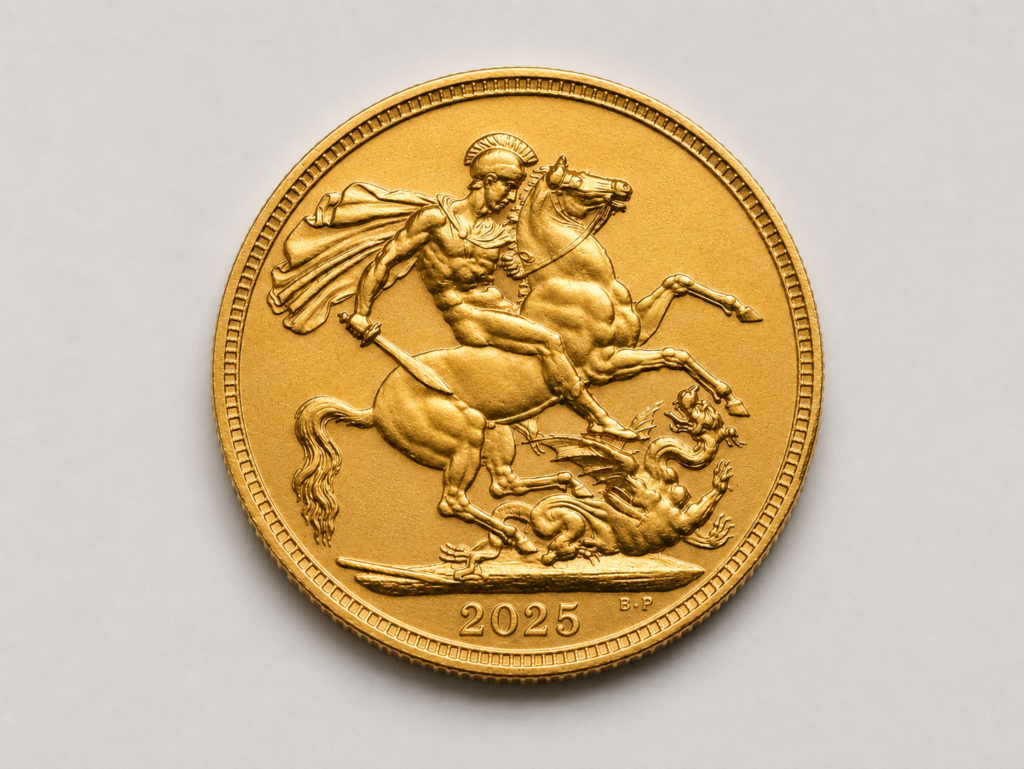
A British Gold Sovereign struck in 2026 carries the same 7.32 grams of fine gold as one struck in 1817, in 1887, in 1925, or in 1980. Same weight. Same 22-karat alloy. Same Pistrucci reverse on most issues. The portrait on the obverse is the only thing that changes — six monarchs, two centuries, and a 40-year production gap that ended in 1957.
That continuity makes the Sovereign the most historically loaded gold coin a US investor can buy at the smaller end of the denomination ladder, and it also makes a Sovereign listing harder to read than a current year Eagle or Maple. This guide covers what you are actually looking at when you buy one.
Specifications, fineness, and dealer pricing change. Verify against Royal Mint and dealer sources at the time of purchase. Tax treatment depends on your jurisdiction; route any tax-specific decision to a qualified professional.
What a British Gold Sovereign actually is
The British Gold Sovereign is the gold coin of the United Kingdom, issued by the Royal Mint under royal warrant. The modern Sovereign weighs 7.98 grams gross at .9167 fineness (22 karat), giving 7.32 grams — 0.2354 troy ounces — of pure gold content. It has been struck continuously, with one gap, since 1817.
The coin carries a one-pound face value, which is symbolic. It has not represented actual purchasing power since the gold standard ended. What matters is the metal content (7.32 g of fine gold) and the design lineage. A Sovereign struck this year and a Sovereign struck in 1887 hold the same gold; you are paying for the bullion plus, on older issues, a layer of historical premium that varies by date, mintmark, and condition.
1489 to 1817: how the modern sovereign got its name
Henry VII first struck a coin called the Sovereign in 1489 — a large gold disc, around 15 grams, depicting the king seated on a throne. The original Sovereign circulated, off and on, until the early 1600s, then disappeared from the coinage. For nearly two centuries the United Kingdom used the guinea as its principal gold coin.
The Tudor and Stuart Sovereigns are museum pieces. They’re not the coin a modern buyer is shopping for, and they aren’t what dealers mean when they list “Sovereigns.”
The modern Sovereign — the coin this guide covers — dates to the Coin Act of 1816 and was first struck in 1817. The Act fixed the specifications that have held ever since: 7.98 g gross weight, .9167 fineness, 22.05 mm diameter, milled edge. Sir Benedetto Pistrucci, the Italian engraver who had taken a post at the Royal Mint, designed the reverse.
Every Sovereign struck from 1817 forward sits on those specifications. The 1489–1604 Sovereign is a different coin; treat the two eras as separate genres.
Reading the obverse: six monarchs, 1817 to today
The obverse portrait identifies the reign. The reverse is mostly Pistrucci’s St. George across the entire series, with a few coat-of-arms exceptions noted below. Knowing the six obverse periods is enough to date any Sovereign within a 30-year window without consulting a reference.
George III and George IV (1817–1830)
The inaugural issues. George III sovereigns ran 1817–1820, George IV 1821–1830. Pistrucci’s St. George reverse on most issues; the George IV “bare head” portrait runs alongside a “laureate head” variant. Modest mintages by later standards, and usually encountered in circulated grades today.
William IV (1831–1837)
A short reign with correspondingly small mintages. The shield reverse appears on William IV issues, replacing Pistrucci’s St. George for this period. William IV sovereigns are scarcer than most pre-1900 issues and carry a corresponding premium.
Queen Victoria (1838–1901)
The longest reign in the series, divided into three portrait subtypes. Young Head ran 1838–1887 with the shield reverse to 1871 and St. George thereafter. Jubilee Head ran 1887–1893. Veiled or “Old” Head ran 1893–1901. The Victoria Sovereign is the most commonly available pre-1900 issue and the most heavily collected by reign-portrait subtype.
Edward VII (1902–1910)
A short, high-mintage reign. The standard Pistrucci reverse returns and remains. Edward VII sovereigns are widely available and trade close to bullion in circulated grades.
George V (1911–1932)
The last reign of the pre-1933 historical era. High mintages from 1911 to 1917; production at the London mint ended in 1917; branch-mint production continued at Melbourne, Sydney, Perth, Bombay, Ottawa, and Pretoria until 1932, varying by mint. The 1933–1956 production gap that followed covered Edward VIII (who abdicated before sovereigns bearing his portrait entered production) and the early George VI and Elizabeth II reigns.
Elizabeth II (1957–2022) and Charles III (2022–present)
The modern bullion era. Production resumed under Elizabeth II in 1957, initially as part of the bullion-trade reserve and increasingly as a collector and investor product. Five Elizabeth II portrait subtypes appeared between 1957 and 2022: 1957–1968 First Portrait, 1974–1984 Machin, 1985–1997 Third Portrait, 1998–2014 Rank-Broadley, and 2015–2022 Clancy. Charles III sovereigns from 2022 forward carry the new portrait by Martin Jennings.
Pistrucci’s St. George and the Dragon
Benedetto Pistrucci, an Italian gem engraver hired by the Royal Mint in 1815, designed the reverse of the 1817 Sovereign: a Greek-style figure of St. George on horseback driving a spear into a dragon. The composition draws on classical reliefs and on a cameo Pistrucci had carved for a private patron a year earlier. The Royal Mint adopted the design for the new Sovereign, and it has appeared, with periodic variation, on the vast majority of Sovereigns struck since.
A few periods deviated. William IV (1831–1837), Victoria Young Head through 1871, and several mid-twentieth-century commemorative years used a shield reverse — the Royal Arms inside a crowned garter. Modern Royal Mint sovereigns occasionally release commemorative reverses for jubilee years, coronations, and royal anniversaries. The default — the reverse you should expect to see — is Pistrucci.
When a Sovereign listing notes “shield reverse” or “commemorative reverse,” that variant is itself the dating clue.
Branch mints and mintmarks: London, Australia, India, Canada, South Africa
The Royal Mint in London struck Sovereigns under its own authority from 1817 forward. As the British Empire expanded, branch mints opened in Australia (Sydney in 1855, Melbourne in 1872, Perth in 1899), in India (Bombay, briefly, 1918), in Canada (Ottawa, 1908–1919), and in South Africa (Pretoria, 1923–1932).
Each branch mint struck Sovereigns to the same specifications under the same monarch’s reign. A Sydney 1880 Victoria Young Head sovereign holds the same 7.32 g of fine gold as a London 1880 Young Head.
Mintmarks identify the branch. They appear on the ground line under St. George on the reverse for most issues: S for Sydney, M for Melbourne, P for Perth, I for Bombay, C for Ottawa, and SA for Pretoria. London-struck Sovereigns carry no mintmark; the absence is itself the marker. The early Sydney 1855–1870 issues used a unique Sydney Mint shield reverse rather than St. George and are catalogued separately as a distinct issue type.
The branch-mint dimension matters because mintage figures vary widely between mints in the same year. A 1908-C Ottawa Sovereign was struck in tiny numbers (a few hundred to a few thousand depending on type) and trades at multiples of its bullion value. A 1908 London or Melbourne Sovereign of the same year trades close to bullion. A dealer listing that names only the year is incomplete; the mintmark is half the identification, and the Victoria and George V branch-mint years are where it matters most.
The sovereign family: quarter, half, full, double, and quintuple
The Sovereign is the central coin in a family of related gold denominations, all struck to the same 22-karat alloy and the same Pistrucci-design lineage. The five sizes differ in metal content, diameter, gross weight, and availability across reigns. Half sovereigns are nearly as common as full sovereigns in the secondary market; doubles and quintuples are modern Royal Mint specialty issues with a limited collector base in the US.
Quarter Sovereign
Face value: £0.25. Gross weight: 2.00 g at .9167 fineness. Fine gold content: 1.83 g (0.0588 troy oz). Diameter: 13.5 mm.
The Quarter Sovereign is a modern Royal Mint introduction, first struck in 2009. There are no historical pre-1933 issues. It is the smallest gold coin a US buyer can hold with sovereign-family provenance and the easiest entry point for someone looking to allocate small dollar amounts to gold on a regular cadence. Premium per troy ounce is the highest in the family because the fixed striking cost is spread across very little metal.
Half Sovereign
Face value: £0.50. Gross weight: 3.99 g. Fine gold content: 3.66 g (0.1177 troy oz). Diameter: 19.30 mm.
Struck across the same six reigns as the full Sovereign and supported by one of the strongest secondary markets of any half-denomination gold coin worldwide. Pre-1933 half sovereigns from Victoria, Edward VII, and George V are widely available and frequently trade close to the gold floor in average circulated grades. Modern half sovereigns are produced annually by the Royal Mint and are routinely the most-traded fractional gold sovereign coin in the UK and Commonwealth markets.
Sovereign
Face value: £1. Gross weight: 7.98 g. Fine gold content: 7.32 g (0.2354 troy oz). Diameter: 22.05 mm.
The reference coin of the family and the focus of this article. The Sovereign is the working denomination of the historical pre-1933 series and the central product of the modern Royal Mint bullion program. Premium structure depends heavily on era (modern bullion strike vs. pre-1933 semi-numismatic) and on the specific reign, mintmark, and condition, all of which are covered in the sections below.
Double Sovereign
Face value: £2. Gross weight: 15.98 g. Fine gold content: 14.63 g (0.4708 troy oz). Diameter: 28.40 mm.
Historically rare. The Double Sovereign was only struck in select years (1820, 1823, 1887, 1893, 1902, 1911, 1937, 1953) and then revived as a Royal Mint specialty issue from 1980 forward. Pre-1933 Doubles are uncommon at any US dealer; modern Doubles appear annually but carry a sizeable premium over the gold floor because they sit between the bullion ladder and the collector product range.
Quintuple Sovereign
Face value: £5. Gross weight: 39.94 g. Fine gold content: 36.60 g (1.1770 troy oz). Diameter: 36.02 mm.
The largest member of the family and similarly rare historically. Struck in 1820, 1839, 1887, 1893, 1902, 1911, 1937, and 1953, then revived as a modern specialty issue. Pre-1933 Quintuples are scarce; modern Quintuples carry significant numismatic premium and are typically purchased as collector pieces rather than as a bullion-allocation vehicle.
The 22-karat standard and why it puts sovereigns outside IRA eligibility
The Sovereign is struck at .9167 fineness — 22 parts gold to 2 parts copper, a specification known as “crown gold.” The alloy is hardness-driven: pure gold is soft enough that a circulating coin would wear visibly within a decade. The 22-karat standard hardens the surface enough to survive in the hand.
The British crown adopted crown gold in 1526 and has used it as the coinage standard ever since, with one brief experiment in .999 fineness in modern bullion-only issues that does not affect the standard Sovereign.
Under US tax law, gold held inside an IRA must meet either a fineness standard (.995 or higher under IRC §408(m)(3)) or qualify under a named statutory exception. The Sovereign at .9167 fails the default fineness rule, and there is no named exception. The only major sovereign-mint gold coin that holds an IRA-eligibility exception below the .995 threshold is the American Gold Eagle. The Krugerrand — also .9167 — is in the same not-eligible category as the Sovereign. A Sovereign cannot be placed inside a self-directed gold IRA.
Our gold IRA guide covers the full framework.
Note that bullion, as a category, is defined by value-from-metal-content, not by a fineness threshold. A .9167 Sovereign is bullion at the metal-content level even though it fails the IRS rule. The Sovereign’s strengths lie elsewhere: divisibility, historical depth, and a half-sovereign secondary market that few coins match.
Modern bullion sovereigns vs. pre-1933 historical sovereigns
The Sovereign market splits cleanly along the 1933–1956 production gap. Pre-1933 issues are catalogued and traded as semi-numismatic coins. Their pricing reflects both bullion content and date-mintmark-condition collector value. Post-1957 issues (the modern bullion era under Elizabeth II and Charles III) are traded primarily as bullion, with collector premium concentrated in the proof and BU (Brilliant Uncirculated) Royal Mint releases. The two eras do not compete; they serve different buyer needs.
For pre-1933 sovereigns, you are paying for the gold floor (0.2354 troy oz × live spot) plus a layer that depends on the specific coin. A common-date Victoria Veiled Head 1899 London-struck sovereign in average circulated condition trades close to bullion. A scarce-date branch-mint sovereign — say a 1908-C Ottawa or an 1879-S Sydney Young Head — trades at multiples of bullion.
A high-grade Edward VII or George V common-date in BU condition trades above bullion but below the scarce-date numismatic tier. Dealer listings name the date, the mintmark, and the condition; learn to read all three.
For modern sovereigns, you are paying for the gold floor plus a Royal Mint premium that varies by year, by finish (bullion strike vs. BU vs. proof), and by collector demand for the design subtype. Current-year bullion-strike sovereigns from the Royal Mint trade at modest premiums comparable to current Eagles or Maples at the fractional-size scale. Special-issue commemorative reverses (jubilee years, coronation years) carry larger premiums.
For pure bullion exposure, common-date pre-1933 circulated sovereigns often deliver more gold per dollar than current-year modern issues.
What you pay above the gold floor
For any Sovereign listing, start from the gold floor: 0.2354 troy oz of fine gold × the current gold spot price. That is what the metal content is worth. Anything above that is premium, and the premium layer has three components: dealer markup (refining, distribution, profit), numismatic value on pre-1933 issues (date, mintmark, condition), and finish premium on modern Royal Mint issues (bullion strike vs. BU vs. proof). The three components combine differently on different coins.
As a working rule for a US-based buyer, a common-date circulated Victoria or Edward VII sovereign trades at 5 to 15 percent over the gold floor. A current-year Royal Mint bullion-strike sovereign trades at 8 to 18 percent over. BU and proof modern sovereigns trade at 25 to 60 percent over depending on the specific issue. Scarce branch-mint pre-1933 issues trade at multiples of the gold floor that are no longer in bullion territory.
These ranges move with the market — our premium over spot guide covers the framework, and our gold spot price page routes to current live pricing.
Authentication: the most counterfeited gold coin in the world
The Gold Sovereign has been counterfeited at a scale no other major gold coin matches. The series ran for two centuries across many mints, so the reference space is vast and not every owner is familiar with every issue. The 22-karat alloy is widely available and can be cast or struck convincingly with modest dies.
And from the 1930s through the 1970s, southern European workshops (Italy and Lebanon in particular) produced large quantities of “tourist gold” Sovereigns to feed a market for gold by weight rather than by coin authenticity — some of those still circulate as fakes today, often with correct gold content but unauthorized strike origin.
Counterfeit categories to know
Cast fakes have lower weight, soft details, and a mushy reeded edge. Plated fakes have correct dimensions but wrong density and can be revealed by water displacement or by Sigma Verifier. “Tourist” gold sovereigns have full gold content but unauthorized strike origin, sometimes detectable only by reverse-die comparison against known Royal Mint specifications.
Pre-1933 sovereigns purchased from non-specialist sources carry the highest counterfeit risk; current-year Royal Mint sovereigns purchased from major US dealers carry the lowest. Our how to spot a fake gold coin guide covers the full authentication framework.
Red flags to check before paying
Run these checks on any Sovereign before money changes hands. A digital jewelry scale, calipers, and a strong magnet handle the first pass; a Sigma Verifier or XRF handles the second.
- Weight: Must hit 7.98 g (±0.02 g for circulation wear). A digital jewelry scale catches most cast fakes.
- Diameter: Must hit 22.05 mm (±0.05 mm). Calipers required.
- Edge: Must be milled with a clean reeded pattern, not smooth or mushy.
- Sound: A Sovereign rung against a hard surface produces a clear high tone; a plated fake rings dull.
- Magnetic Check: Gold is non-magnetic; a Sovereign that responds to a strong magnet is not gold.
- Density: Gold is 19.3 g/cm³. Water-displacement testing reveals plated tungsten fakes. A Sigma Verifier or XRF reading is the dealer-grade verification path.
- Source: Pre-1933 Sovereigns from major US dealers, authenticated by grading service slabs (PCGS, NGC), carry the lowest counterfeit risk. Estate-sale and online-marketplace sovereigns carry the highest.
Where the Gold Sovereign fits in a US gold portfolio
The Gold Sovereign earns its place in a US gold portfolio on three dimensions: divisibility (0.2354 troy oz per coin is a workable fractional position), historical depth (a coin you can buy in Victoria-era and Charles III-era issues from the same dealer), and global liquidity (Sovereigns trade actively in the UK, EU, Middle East, and Commonwealth markets, which a US holder can tap when selling at scale).
It’s not an IRA position; it’s not a competitor to the American Gold Eagle for retirement-account placement. It’s a taxable-account holding that adds something the Eagle and Buffalo do not.
A Sovereign position tends to mix reigns, mintmarks, denominations, and conditions — a few common-date Victoria sovereigns, a current-year Charles III bullion strike, perhaps a half sovereign or two, perhaps a scarce branch-mint issue at a premium. Cost basis varies coin to coin. Premium spend varies coin to coin.
The position-level picture — total fine gold, total cost basis, current value against live spot, premium spent across the mix — is the thing most spreadsheets and dealer apps cannot show cleanly.
Gold Silver Ledger is built for that visibility. The Sovereign catalog includes the five denomination sizes with metal weight baked in; year, reign, and mintmark go on the per-item reference label so a Victoria 1899-M Melbourne and a Charles III 2024 London read as distinct items in the same view. Holdings views sort, search, and filter by reign or by mint. The Custody Statement shows where each coin sits. Analytics shows premium spend across the position.
Frequently asked questions
How much gold is in a Gold Sovereign?
A standard British Gold Sovereign contains 7.32 grams, or 0.2354 troy ounces, of pure gold inside a 7.98-gram coin struck at .9167 fineness. The fine-gold figure is the working number for melt-value math; the 7.98-gram gross weight is what you read on a scale during authentication.
Why is a Sovereign only 22 karat instead of 24 karat?
Sovereigns are 22 karat because pure gold is too soft to survive circulation without visible wear. The 22-karat alloy (called “crown gold”) adds copper to harden the surface. The British crown set the standard in 1526 and has held it ever since for general coinage. Modern .9999 bullion coins like the Maple Leaf and Britannia were designed for storage rather than circulation, which is why they can be struck softer.
Are Gold Sovereigns IRA-eligible?
No. Gold Sovereigns are not eligible for a US self-directed IRA. The .9167 fineness fails the IRS default minimum of .995 for gold under IRC §408(m)(3), and there is no statutory exception covering the Sovereign. The only sub-.995 gold coin with an IRA carve-out is the American Gold Eagle.
What is the difference between a Sovereign and a half sovereign?
A half sovereign is exactly half the metal of a full Sovereign at the same .9167 fineness. The half holds 3.66 g (0.1177 troy oz) of fine gold inside a 3.99-gram coin; the full holds 7.32 g inside 7.98 grams. Both have been struck across the same six reigns and share the Pistrucci St. George reverse on most issues.
How can I tell if a Gold Sovereign is fake?
A genuine modern Sovereign weighs 7.98 grams (±0.02 g for wear) and measures 22.05 mm in diameter, with a clean milled reeded edge and a clear high tone when struck. A digital scale, calipers, and a magnet catch most cast and plated fakes. Density and XRF tests catch tungsten-core forgeries. Pre-1933 sovereigns purchased from major US dealers in PCGS or NGC slabs carry the lowest authentication risk.
Are pre-1933 Sovereigns worth more than modern ones?
Sometimes, but not by default. A common-date Victoria, Edward VII, or George V sovereign in average circulated condition trades close to the gold floor — often at less premium than a current-year Royal Mint bullion strike. Scarce-date branch-mint pre-1933 sovereigns and high-grade BU pre-1933 issues trade above the modern coins. Date, mintmark, and condition decide each listing individually.
Do all Sovereigns have the same Pistrucci St. George design?
Most do, but not all. Benedetto Pistrucci’s St. George and the Dragon appears on the reverse of the vast majority of Sovereigns struck from 1817 forward. Exceptions include William IV (1831–1837), Victoria Young Head sovereigns through 1871, and several Royal Mint commemorative years that use a shield reverse or a special design. The default is Pistrucci; a non-Pistrucci reverse is itself a dating clue.
Should I buy a Gold Sovereign or a Gold Eagle for divisibility?
For pure divisibility, the Sovereign at 0.2354 troy oz is roughly equivalent to a quarter-ounce Gold Eagle (0.25 troy oz). The Eagle wins on IRA eligibility and on US dealer inventory depth; the Sovereign wins on historical optionality (six monarchs to choose from) and on global resale liquidity outside the US. A portfolio can hold both — they solve different problems.
This article is for general information only and is not investment, tax, or legal advice. Specifications, mintage figures, dealer pricing, and IRS rules can change. Verify against primary sources at the time of decision and consult a qualified professional for tax-specific or retirement-account questions.
