
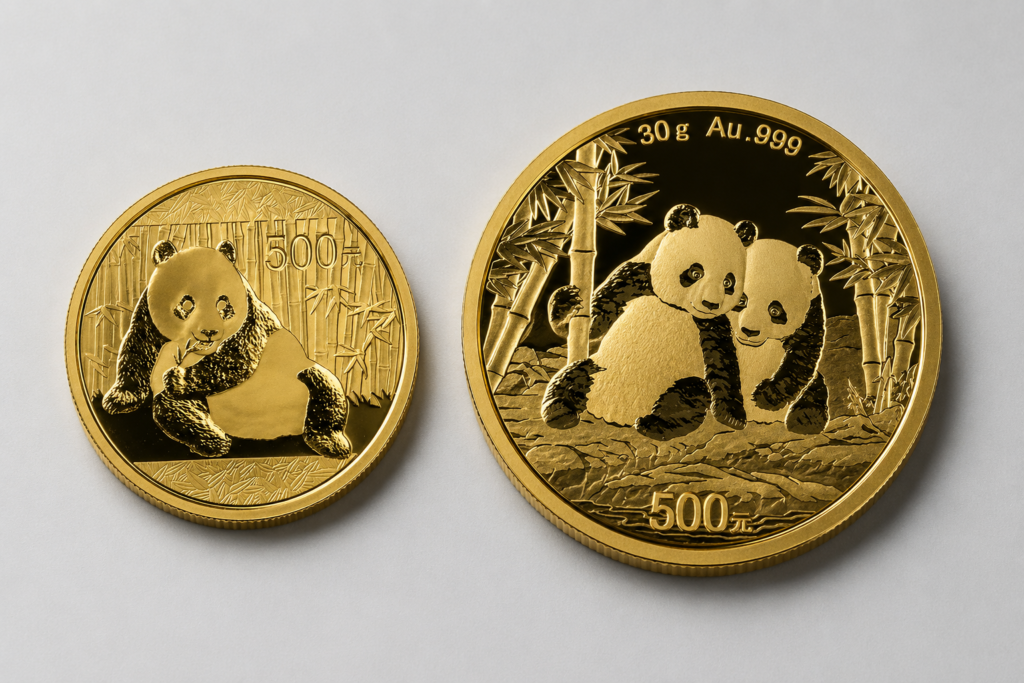
The Chinese Gold Panda has been the People’s Republic of China’s flagship gold bullion coin since 1982, struck every year at .999 fineness by the People’s Bank of China and produced across four state mints. It is the only major sovereign gold bullion program where the reverse design changes every year – a deliberate program-design principle that has held since the first issue.
In 2016, the People’s Bank converted the program from troy ounce sizes to metric weights, so a 2015 Panda and a 2016 Panda are not interchangeable on a one-for-one basis at spot. This guide covers what the coin is, how it has evolved, what you pay above spot, how IRA eligibility works, and how to track a Panda position correctly.
Premium figures and dealer prices move daily; the numbers in this guide are durable framing rather than current quotes. Tax treatment is informational and not professional advice. For the silver companion in this program, see our Chinese Silver Panda complete buyer’s guide.
What is the Chinese Gold Panda?
The Chinese Gold Panda is the People’s Republic of China’s flagship gold bullion coin, produced annually since 1982 under the authority of the People’s Bank of China. Production is divided across four mints – Shanghai, Shenyang, Shenzhen Guobao, and Beijing – and the program has been .999 fine from its first issue.
The reverse design changes every year (with one exception in 2002), while the obverse depicts the Hall of Prayer for Good Harvests at the Temple of Heaven in Beijing. The 1 troy ounce Gold Panda (1982 through 2015) contains one troy ounce (31.103 grams) of pure gold and carries a 500 yuan face value.
Beginning in 2016, the program transitioned from troy ounce sizes to metric sizes. The 30-gram issue replaced the 1 troy ounce as the program’s flagship, with the same 500 yuan face value but 30 grams (0.9645 troy ounces) of gold per coin. Both eras are IRA-eligible by default IRS rules under IRC section 408(m)(3).
History – the 1982 launch, annual design tradition, and the 2016 metric transition
The Gold Panda launched in 1982 – the same year the Royal Canadian Mint introduced the .9999 Gold Maple Leaf and four years before the United States Mint introduced the American Gold Eagle. The 1982 issues were struck in four sizes (1, 1/2, 1/4, and 1/10 troy ounce) at .999 fineness, and a 1/20 troy ounce size was added shortly after.
The decision to rotate the reverse design every year was set as a program-design principle from the first issue – every coin a different panda image, no repeating designs across the series. That principle held for nineteen consecutive years.
In 2002, the China Gold Coin Corporation broke the rotation and reused the 2001 reverse design – the only repeat in the program’s history. Collector pushback was sharp enough that the mint formally resumed annual design changes in 2003 and has not repeated a design since. Across the 1980s, 1990s, and 2000s, the program also issued larger sizes (5 oz, 12 oz, 1 kg) on a more limited basis, primarily as collector strikes.
The defining structural milestone arrived in 2016, when the People’s Bank of China converted the Gold Panda from troy ounce sizes to metric sizes. The 1 troy ounce coin (31.103 g) was replaced by a 30 gram coin (30.000 g exactly). The 1/2 oz became 15 g, the 1/4 oz became 8 g, the 1/10 oz became 3 g, and the 1/20 oz became 1 g.
Face values were preserved across the transition, and the .999 fineness did not change. The transition was driven by the People’s Bank of China’s preference for metric weight standards consistent with domestic Chinese commerce, and was implemented at the program level without notice to international markets.
Specifications – pre-2016 1 troy oz and post-2016 30 gram
The Gold Panda lives in two specification eras: the original troy ounce era (1982 through 2015) and the metric era (2016 through current issue). The same fineness, the same 500 yuan face value, and the same four-mint production structure carry across both eras. The change is in the metal content per coin and a small diameter adjustment.
Pre-2016 1 troy oz specifications
The pre-2016 1 troy oz was the program’s flagship from 1982 through 2015 and remains the most commonly held variant in U.S. portfolios.
- Metal content: 1 troy oz (31.103 g) of pure gold
- Purity: .999 fine (24-karat), unchanged since 1982
- Gross weight: 31.103 g (pure-metal-content gross weight – no hardening alloy)
- Diameter: 32.05 mm
- Edge: Reeded
- Face value: 500 yuan (CNY)
- Issuing authority: People’s Bank of China
- Mints: Shanghai, Shenyang, Shenzhen Guobao, Beijing (mintmarks rarely present)
- First minted: 1982
- Last 1 troy oz issue: 2015
- IRA-eligible: Yes, by default .995 rule, every issue since 1986 (the year the U.S. statutory change that allowed bullion in IRAs took effect)
Post-2016 30 gram specifications
The post-2016 30 gram is the current program flagship and the variant in most active dealer distribution today.
- Metal content: 30 grams (0.9645 troy oz) of pure gold
- Purity: .999 fine (24-karat), unchanged from launch
- Gross weight: 30.000 g (pure-metal-content gross weight)
- Diameter: 32.00 mm
- Edge: Reeded
- Face value: 500 yuan (CNY)
- Issuing authority: People’s Bank of China
- Mints: Shanghai, Shenyang, Shenzhen Guobao, Beijing (mintmarks rarely present)
- First minted in metric: 2016
- IRA-eligible: Yes, by default .995 rule
How the two eras compare
The metric transition reduced the gold content per flagship coin by about 3.55 percent, from 31.103 grams to 30 grams, without changing the face value or the fineness. A 2015 Panda and a 2016 Panda are not interchangeable on a one-for-one basis at spot: the 2016 contains 0.9645 troy oz of gold where the 2015 contains a full 1.000 troy oz.
Track each era separately at the catalog level, not as a notes-field label. Cost-per-ounce math, the gold-content floor that supports any valuation, and any one-for-one swap planning all depend on the correct gold content per coin.
Design – the Temple of Heaven obverse and the annual panda reverse
Every Gold Panda since 1982 carries the same obverse: the Hall of Prayer for Good Harvests at the Temple of Heaven, a Ming-dynasty religious compound in south-central Beijing completed in 1420. The Hall served as the imperial venue for harvest-prayer ceremonies and is one of the most recognized buildings in Chinese architectural heritage.
The obverse inscription names the issuer (Zhonghua Renmin Gongheguo, People’s Republic of China) and the year of issue. The imagery and the inscription layout have remained constant across every year and every size in the program.
The reverse depicts a giant panda – Ailuropoda melanoleuca, the national animal of China – in a different scene every year. Designs have ranged from a single adult panda standing or seated, to mother-and-cub compositions, to pandas eating bamboo or climbing.
Each year’s design is the work of a credited Chinese mint artist. The reverse inscription names the metal content and fineness (for example, 30 g Au .999) and the face value (500 yuan). The reverse design changes every year without exception, except 2002, when the 2001 reverse was reused.
The annual design rotation is the Panda’s defining program characteristic and the single feature that distinguishes the series from every other major sovereign bullion coin. The Maple Leaf, Philharmonic, Britannia, and Krugerrand all carry a constant design across decades; the American Gold Eagle and Buffalo carry essentially constant designs since launch.
The Gold Panda is the only major sovereign gold bullion program where each year is a distinct numismatic artifact. That rotation is part of why the Panda trades at a higher premium than the Maple Leaf or Philharmonic on a like-for-like fineness basis, and it shapes secondary-market behavior in ways the next sections address.
The People’s Bank of China and the four-mint production structure
The Gold Panda is issued under the authority of the People’s Bank of China (PBoC), the central bank of the People’s Republic of China, founded in 1948. China Gold Coin Inc., a People’s Bank subsidiary, serves as the official distributor and manages international sales through authorized purchasers. Pandas are legal tender within China at the face value printed on each coin – 500 yuan for the 1 oz or 30 g flagship.
Production is divided across four mints: Shanghai Mint, Shenyang Mint, Shenzhen Guobao Mint, and Beijing Mint. Each mint produces a share of the annual mintage, and the four mints occasionally produce subtle die variations within the same year’s design.
Unlike most sovereign bullion programs, the Gold Panda rarely carries a visible mintmark. Collector-grade attribution to a specific mint usually requires examination of die-variety details rather than a stamped mark. For bullion buyers, the four-mint structure does not change what the coin is – every Panda from every mint is .999 fine at the published weight.
Sizes – the gold fractional ladder before and after 2016
The Gold Panda ships in one of the most complete fractional ladders of any major sovereign gold program – five standard sizes in each era. Pre-2016 issues run from 1 troy oz down to 1/20 troy oz; 2016-and-later issues run from 30 g down to 1 g. As with every sovereign program, per-ounce premium rises as the size falls.
Pre-2016 1 troy oz (500 yuan face value)
The workhorse Bullion strike from 1982 through 2015. The center of the gold program for thirty-four years, the tightest dealer premium per ounce in the pre-metric era, and the variant accepted by every IRA custodian for in-program holdings. Sold sealed in mint mylar.
Pre-2016 1/2 troy oz (200 yuan face value)
A common fractional choice for mid-sized portfolios across the 1982 to 2015 run.
Pre-2016 1/4 troy oz (100 yuan face value)
Available since the 1982 launch. A common gifting and smaller-position choice.
Pre-2016 1/10 troy oz (50 yuan face value)
A small fractional size; per-ounce premium runs notably above the 1 troy oz.
Pre-2016 1/20 troy oz (20 yuan face value)
The smallest of the pre-2016 fractionals; per-ounce premium is the highest in the pre-metric ladder.
Post-2016 30 g (500 yuan face value)
The flagship from 2016 forward. Contains 0.9645 troy oz of pure gold – less than the 1 troy oz it replaced. Sold sealed in mint mylar; the tightest dealer premium of the post-2016 ladder.
Post-2016 15 g (200 yuan face value)
The mid-size replacement for the prior 1/2 oz. Contains 0.4823 troy oz of pure gold.
Post-2016 8 g (100 yuan face value)
The replacement for the prior 1/4 oz. Contains 0.2572 troy oz of pure gold.
Post-2016 3 g (50 yuan face value)
The replacement for the prior 1/10 oz. Contains 0.0965 troy oz of pure gold.
Post-2016 1 g (10 yuan face value)
The smallest post-2016 fractional. Contains 0.0322 troy oz of pure gold; per-gram premium is the highest in the post-metric ladder.
Choosing a size
For a gold-allocation position, the 30 g – or the pre-2016 1 troy oz – is the cost-efficient choice. The fractional ladder is appropriate for position-sizing flexibility and gifting, with the per-ounce-premium tradeoff that applies across every sovereign fractional program.
Compare gold content per coin directly; do not equate a 30 g to a 1 troy oz at face value.
Premium over spot – the collector-dimension surcharge
The Gold Panda usually trades at a higher premium over spot than the Canadian Maple Leaf, the Vienna Philharmonic, the post-2013 Britannia, and the American Gold Buffalo on a like-for-like fineness basis. Three structural reasons place the Panda above the .999 and .9999 sovereign peer group.
First, the People’s Bank of China’s annual mintage allocations are not always large relative to demand, especially for current-year issues in the first weeks after release. Supply tightness in the launch window often pushes premiums to their annual high.
Second, the annual design rotation creates a collector-dimension demand layer on top of the bullion floor. Some buyers want the current year’s design specifically, and certain back-year designs – early 1980s issues, limited-mintage years, and individual designs that collector communities have favored – trade at meaningful premiums above generic Panda pricing.
Third, the factory-sealed mylar packaging is the secondary-market norm and adds a verification dimension that supports tighter resale spreads but a wider buy-side premium. For a position that values the annual-design dimension and Asian sovereign exposure, the premium is part of what you are paying for.
IRA eligibility – default rule, 1986 effective floor
Every Gold Panda from 1982 forward meets the IRS fineness rule under IRC section 408(m)(3): the .999 fine gold clears the .995 default threshold. The 2016 metric transition did not change the fineness; both eras qualify.
The practical IRA-custodian floor is 1986, the year the U.S. statutory change that permitted bullion to be held in IRAs took effect. Custodians do not typically hold pre-1986 issues because the legal framework did not allow IRA bullion holdings before that date, not because the 1982 through 1985 Pandas fail the fineness rule.
IRA-held Pandas must be stored at an IRS-approved depository; home storage of IRA gold is not permitted. Most IRA custodians require IRA-held coins to be purchased new and remain in original mint packaging, which aligns with the Panda’s standard mint-distribution format – the factory-sealed mylar sleeve.
Our gold IRA guide walks through the full default-rule framework and the named-exception list. For quick reference, comparable IRA-eligible sovereign gold options under the default rule include:
- Canadian Gold Maple Leaf: .9999 since 1982, default rule, the original .9999 sovereign
- American Gold Buffalo: .9999 since 2006, default rule
- Austrian Vienna Philharmonic: .9999 since 1989, default rule
- British Britannia: .9999 since 2013, post-2013 issues only, default rule
- American Gold Eagle: .9167 fine, named statutory exception, not the default rule
- The Krugerrand: .9167 fine, the most prominent globally recognized gold bullion coin that is not IRA-eligible at any vintage
How to buy, authentication, and the mint-packaging norm
The Gold Panda is sold at every major U.S. gold bullion dealer (APMEX, JM Bullion, Money Metals Exchange, SD Bullion, Provident Metals, Hero Bullion), at major European dealers, and at coin dealers across both markets. China Gold Coin Inc. distributes Pandas through authorized purchasers who resell to the international retail market; the mint does not sell direct to U.S. consumers.
Current-year issues are widely stocked at the 1 oz or 30 g size; back-year issues are available in varying depth depending on the year and the dealer. The 1 g and 1/20 oz fractionals are available at fewer outlets and tend to carry the widest premium spread.
Authentication on a Panda relies on the published specifications – 1 troy oz / 31.103 g for pre-2016 issues, 30.000 g for post-2016 issues, a 32.05 mm or 32.00 mm diameter depending on era, and .999 fineness across both eras – and on the factory-sealed mylar sleeve that is the standard mint-distribution format. The sealed sleeve carries the year, denomination, and mint information, and breaking the seal removes the verification dimension and can affect resale value.
A handheld Sigma Verifier reads the .999 gold conductivity signature in a way that distinguishes a real Panda from base-metal counterfeits. The ping test confirms a struck precious-metal profile against base metal.
Panda counterfeits exist, especially for high-premium back-year issues. Side-by-side comparison with a known-genuine reference coin is the practical buyer-side check; the intricate panda reverse designs are difficult to counterfeit cleanly at scale.
Storage, resale, and the secondary-market collector dimension
Storage choices include a home safe rated for fire and theft, a bank safe deposit box, a private depository (Brink’s, Loomis, Delaware Depository), or an IRA-custodian-held depository for IRA positions. IRA-held Pandas must be stored at an approved depository; home storage of IRA gold is not permitted under IRS rules.
Taxable positions can be held anywhere – home safe, depository, or bank box – at the holder’s choice. The factory-sealed mylar sleeve provides storage protection on top of the chosen holding medium, and many holders keep Pandas in the mint sleeves indefinitely to preserve resale value.
Resale at any major U.S. or European dealer is straightforward for current-generation issues. Bullion-grade Pandas trade at the same bid-ask convention as other major .999 sovereigns.
The Panda differs from the Maple Leaf or Philharmonic in that the year-design combination affects resale. A generic back-year Panda trades at bullion-plus-premium, while certain higher-demand designs and lower-mintage years can carry meaningful collector premium above generic Panda pricing. Sealed mylar typically commands a small premium over a broken-seal coin of the same year.
Document the sale carefully for tax purposes. U.S. capital gains on physical gold are taxed as collectibles – up to 28% on long-term gains rather than the standard 15 to 20% long-term capital gains rate. The collector-grade dimension does not change the tax treatment: a Panda sold above bullion floor for collector reasons is still taxed under the collectibles rule for the full gain.
Frequently asked questions
What is a Chinese Gold Panda coin?
A Chinese Gold Panda is the People’s Republic of China’s flagship gold bullion coin, struck annually since 1982 by the People’s Bank of China at .999 fineness. The reverse design changes every year (with one repeat in 2002), and the obverse depicts the Hall of Prayer for Good Harvests at the Temple of Heaven in Beijing. Pre-2016 issues are 1 troy ounce; 2016-and-later issues are 30 grams.
Are Chinese Gold Pandas IRA-eligible?
Yes, every Chinese Gold Panda meets the IRS default fineness rule under IRC section 408(m)(3), which requires gold held in an IRA to be at least .995 fine. The Panda is .999 fine. The practical custodian floor is 1986, the year U.S. law first allowed bullion to be held in IRAs. The 2016 metric transition did not change eligibility.
When did the Chinese Gold Panda launch?
The Chinese Gold Panda launched in 1982, the same year the Royal Canadian Mint introduced the Gold Maple Leaf. The 1982 issues were struck in four sizes – 1, 1/2, 1/4, and 1/10 troy ounce – at .999 fineness. A 1/20 ounce size was added shortly after, completing the original five-size pre-metric ladder.
What is the difference between a pre-2016 1 oz Panda and a post-2016 30 gram Panda?
A pre-2016 1 oz Panda contains 31.103 grams of pure gold; a post-2016 30 gram Panda contains 30.000 grams. The face value (500 yuan) and the fineness (.999) did not change in 2016, but the gold content per coin dropped by about 3.55 percent. The two are not interchangeable at spot, and any one-for-one comparison ignores the actual gold-content difference.
Why did the Chinese Gold Panda switch from troy ounces to grams in 2016?
The People’s Bank of China switched to metric weights to align the program with domestic Chinese commerce, which uses the metric system. The change was made at the program level for both the Gold Panda and the Silver Panda in the same year. International markets adopted the metric specifications without disruption to dealer distribution, though the smaller gold content per flagship coin shifted per-coin pricing math.
Do Chinese Gold Pandas have a mintmark?
Chinese Gold Pandas rarely carry a visible mintmark. The four producing mints – Shanghai, Shenyang, Shenzhen Guobao, and Beijing – share annual production, and attribution to a specific mint typically requires examination of die-variety details rather than a stamped mark. For bullion buyers, the mint of origin does not change the coin’s metal content or fineness.
What sizes does the Chinese Gold Panda come in?
The Chinese Gold Panda has been struck in five standard sizes per era. Pre-2016 issues run 1 troy oz, 1/2 oz, 1/4 oz, 1/10 oz, and 1/20 oz, with face values from 500 yuan down to 20 yuan. Post-2016 issues run 30 g, 15 g, 8 g, 3 g, and 1 g, with face values from 500 yuan down to 10 yuan. Larger collector-format sizes (5 oz, 12 oz, 1 kg) have been issued in select years on a limited basis.
Track your Chinese Gold Pandas in Gold Silver Ledger
A Gold Panda position is unusually layered for sovereign bullion. Every year brings a different reverse, two eras carry different gold content per coin, certain back-year designs trade well above bullion floor, and most holdings end up straddling IRA and taxable sleeves. The combination is more than a spreadsheet was built to carry.
Gold Silver Ledger holds each of those distinctions at the position level – the pre-2016 troy ounce and post-2016 metric eras stay properly separated, cost basis is locked at purchase, and current value renders against the live gold spot price as it moves. The IRA-versus-taxable split is handled by storage location, so a 28% collectibles total only counts the disposals that actually owe tax.
That is the difference between a record that loses fidelity year by year and a portfolio view that holds up across a multi-decade Panda accumulation. Start your trial at the Gold Silver Ledger pricing page.
This guide is informational only and is not investment, tax, or legal advice. Confirm current specifications against the People’s Bank of China and current premium and tax treatment with a qualified professional before acting.
