
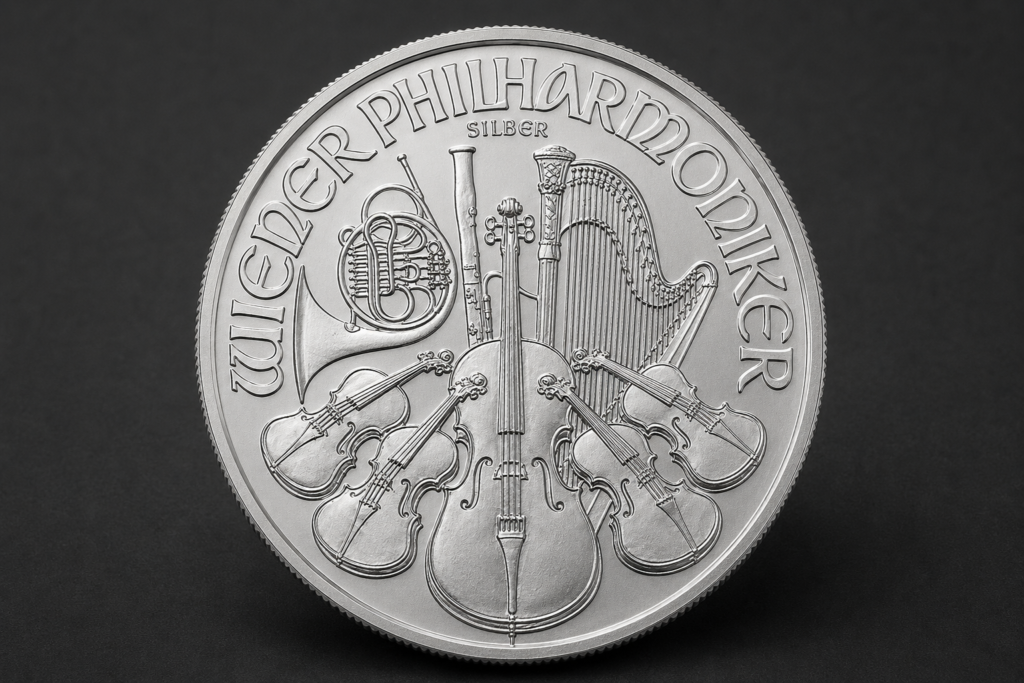
The silver Vienna Philharmonic arrived in February 2008, nearly two decades after the gold program had established the design and the secondary market. It debuted in the middle of the post-2007 silver demand surge that pulled the American Silver Eagle, the Canadian Silver Maple Leaf, and other sovereign silver issues to record sales, and it became the first silver bullion coin in the world denominated in euros.
Today it sits alongside the Silver Eagle and Silver Maple Leaf as one of the most universally recognized one-ounce sovereign silver options, with particularly deep secondary markets in the eurozone.
This guide covers what the coin is, where it sits among silver sovereigns, how IRA eligibility works, and how to track an accumulating silver position.
The premiums, dealer prices, and tax thresholds in this guide are durable framing rather than live numbers – verify any quote at purchase. Nothing here is professional tax or investment advice. For the gold program that established the design and built the Austrian Mint’s bullion-coin brand, see our gold Vienna Philharmonic complete buyer’s guide.
What is the silver Vienna Philharmonic?
The silver Vienna Philharmonic is a one troy ounce bullion coin struck by Münze Österreich at the Austrian Mint in Vienna. Every issue since the February 1, 2008 debut has been .999 fine – the standard sovereign silver bullion fineness shared with the American Silver Eagle, Canadian Silver Maple Leaf, and post-2013 silver Britannia.
The coin measures 37 millimeters across and 3.2 millimeters thick – the same 37 mm diameter as the gold Philharmonic but noticeably thicker because silver’s lower density requires more physical metal to reach the one troy ounce target. It contains exactly one troy ounce (31.103 grams) of pure silver, carries a 1.50 euro face value as Austrian legal tender, and trades at metal-content value plus dealer premium rather than at face value. It is IRA-eligible by the default IRS rule on silver, with no vintage-driven complications.
Why the Austrian Mint launched a silver Philharmonic in 2008
For nineteen years, between October 1989 and February 2008, the Vienna Philharmonic existed only in gold. The Austrian Mint had built the program as a sovereign gold offering, won four World Gold Council best-selling-gold-coin designations through the 1990s and 2000s, and added fractional gold sizes through 1991 and 1994. A silver counterpart was not part of the original program design.
The silver program debuted on February 1, 2008, and came in a specific market moment. Silver had run from roughly $7 per ounce in 2003 to above $20 per ounce by early 2008, retail demand for one-ounce sovereign silver had surged in tandem, and U.S. Mint allocations of the American Silver Eagle ran short repeatedly through 2008 and into 2009 as the financial crisis deepened.
The Austrian Mint launched the silver Philharmonic into that demand window, drawing on the gold program’s existing dealer network, brand recognition, and design heritage. The 1.50 euro face value made the coin the first silver bullion coin in the world denominated in euros – a denomination first that paralleled the gold program’s 2002 currency transition six years earlier.
In 2016, the Austrian Mint added a platinum Philharmonic line, completing the modern three-metal program. The silver issue has remained centered on the one-ounce size in continuous annual production since 2008, with a few larger commemorative sizes issued in select years. The Pesendorfer design transferred from gold to silver unchanged in 2008 and has stayed constant since.
Specifications – the 1 oz silver Philharmonic
The 1 oz Bullion strike is the only size in continuous production, and its specifications have held constant since the 2008 debut. The 1.50 euro face value is symbolic Austrian legal tender – the silver-content floor sits well above it at any plausible silver spot price, and the coin trades on silver content plus dealer premium in practice.
- Metal content: 1 troy oz (31.103 g) of pure silver
- Purity: .999 fine – the standard sovereign silver bullion fineness
- Alloy: 99.9% silver; trace alloy required for striking
- Gross weight: 31.103 g (pure-metal-content gross weight)
- Diameter: 37.00 mm – identical to the gold Philharmonic for design parity
- Thickness: 3.2 mm – thicker than gold because silver is less dense
- Edge: Reeded
- Face value: 1.50 EUR (Austrian legal tender)
- Issuing mint: Munze Osterreich (the Austrian Mint), Vienna
- First minted: February 1, 2008
- Standard size in production: 1 oz; commemorative larger sizes issued in select years
- IRA-eligible: Yes, by the default .999 silver rule, every issue since 2008
The shared Pesendorfer design
The silver Philharmonic carries the same design Thomas Pesendorfer created for the gold Philharmonic in 1989. The Mint did not commission a separate silver design when it launched the silver program in 2008; the existing composition simply scaled to silver dies. That choice keeps the program visually unified across gold and silver issues, which matters for portfolio investors who hold both metals and want a coherent visual record of the Austrian Mint position.
On the obverse, the Great Organ of the Wiener Musikverein’s Golden Hall is rendered at silver scale, framed by the inscription identifying the issuing republic, the year of issue, the metal content, the fineness, and the 1.50 euro face value. On the reverse, the orchestra ensemble – Vienna horn, bassoon, harp, four violins, cello – appears with the WIENER PHILHARMONIKER legend.
The arrangement is the program’s defining visual identity across all three metals. Our gold Vienna Philharmonic guide covers the original 1989 design intent and the cultural references in depth.
Because the design never rotates and the silver program has no separate monarch-portrait timeline, a 2008 first-issue silver Philharmonic and a current-year silver Philharmonic look virtually identical – only the year of issue distinguishes them on the obverse. That continuity is unusual in sovereign silver bullion. The American Silver Eagle introduced an entirely new reverse in 2021. The British silver Britannia has carried annual rotating reverses since 2014. The silver Philharmonic does not change.
How the silver Philharmonic compares to other sovereign silver bullion
The silver Philharmonic competes against four main sovereign silver options at the one-ounce level. Each carries the same .999 fineness and the same one troy ounce of pure silver – the differences are mint origin, design heritage, face value, IRA-eligibility nuance, and U.S. retail availability.
American Silver Eagle
The U.S. Mint flagship and the highest-volume sovereign silver bullion coin in the world. Carries a 1 USD face value, the named statutory exception status in IRC section 408(m)(3) (still IRA-eligible at .999), and the highest U.S. retail premium of the major sovereigns because of domestic demand. The Philharmonic typically trades below the Silver Eagle on a premium per ounce.
Canadian Silver Maple Leaf
The Royal Canadian Mint silver flagship at .9999 fineness since 2014 (.999 from 1988 to 2013). Carries a 5 CAD face value and the radial-line / micro-engraved security features the RCM added in 2014. Premium typically tracks close to the silver Philharmonic.
Silver Britannia
The UK Royal Mint silver flagship at .999 fineness since 2013 (.958 before that). Pre-2013 issues are not IRA-eligible because they sit below the .999 default rule; post-2013 issues clear it. The silver Philharmonic carries no such vintage split. See our silver Britannia complete buyer’s guide for the program details.
Silver Krugerrand and other newer sovereigns
The South African Mint added a silver Krugerrand in 2017, the Royal Australian Mint runs silver Kangaroo and Koala lines, and the Perth Mint runs the silver Kookaburra and other series. These carry varying premiums and U.S. retail availability. The silver Philharmonic typically sits in the middle of this group on price and the upper tier on dealer network depth.
Premium over spot – where the silver Philharmonic sits
The .999 silver Philharmonic typically trades at a premium over spot in line with the Canadian Silver Maple Leaf and the post-2013 silver Britannia, slightly below the American Silver Eagle (which carries U.S. domestic premium), and slightly above the silver Krugerrand at most U.S. dealers. Three factors set the premium tier.
The Austrian Mint’s per-coin production cost on the .999 alloy is the floor. The Munze Osterreich brand premium adds a modest layer in the U.S. retail market, comparable to the Royal Canadian Mint and Royal Mint premiums and noticeably below the U.S. Mint domestic premium. The deep European secondary market – particularly in Germany and Austria – supports tight dealer bid-ask spreads in the U.S. through arbitrage and steady cross-Atlantic flow.
Premium tiers shift daily with dealer inventory and silver spot moves; pull a fresh quote at purchase.
IRA eligibility – the default .999 silver rule from launch
Every silver Vienna Philharmonic since the 2008 debut is eligible for a self-directed precious metals IRA by the default IRS rule. IRC section 408(m)(3) requires silver held in an IRA to be at least .999 fine; the Philharmonic launched at .999 and has stayed there, clearing the threshold for every issue. No specific statutory exception is required.
There is no vintage-driven split of the kind that excludes pre-2013 silver Britannia issues. Every silver Philharmonic from the first 2008 strike forward qualifies, which makes the IRA story simpler than the Britannia’s pre/post-2013 framework. A custodian will accept any year-of-issue silver Philharmonic for an IRA deposit.
The silver IRA guide walks through the full custodian-and-depository workflow. The IRA-eligible silver sovereign field at the one-ounce tier:
- American Silver Eagle (.999, named statutory exception)
- Canadian Silver Maple Leaf (.9999 since 2014, .999 1988-2013, default rule)
- Silver Britannia (.999 since 2013, post-2013 issues only, default rule)
- Silver Kangaroo and Australian Kookaburra series (.999, default rule)
- Mexican Libertad in select sizes (.999, default rule)
How to buy, and how to handle a .999 silver coin
The silver Philharmonic is sold at every major U.S. silver bullion dealer (APMEX, JM Bullion, Money Metals Exchange, SD Bullion, Provident Metals, Hero Bullion), at major European dealers, and at most local coin shops. Loose tubes of 20 coins and Mint-direct Master Boxes of 500 are the standard accumulating-position formats; loose ones are common at coin shops and smaller dealers.
Two handling notes apply to .999 silver specifically. First, silver tarnishes – the alloy reacts with airborne sulfur compounds over time and develops surface toning that ranges from straw-yellow to deep blue-black depending on exposure conditions.
Tarnish does not affect silver content but does affect resale value if the coin trends toward a collector buyer. Keep coins in tubes, capsules, or Master Boxes with intact seals; avoid setting loose coins against each other; and avoid storage in cardboard or paper holders that off-gas sulfur.
Second, silver is softer than gold’s standard 22-karat hardening alloys, and the Philharmonic carries no copper hardening fraction – handle by the edges, and treat fingerprint contact as a permanent surface event because the chloride content of skin oils etches into the silver.
Our how to buy silver guide covers the broader buying framework.
Authentication, storage, and resale
Authentication on a silver Philharmonic relies on standard specification verification – the Austrian Mint did not add a proprietary security-feature layer of the post-2013 Britannia type. The buyer-side check is the published specifications: 31.103 g gross weight, 37.00 mm diameter, 3.2 mm thickness, reeded edge. A Sigma Verifier reads the .999 silver conductivity signature in a way that cleanly separates the Philharmonic from base-metal counterfeits and from .900 fine pre-1965 U.S. silver coinage.
The ping test confirms the struck-silver acoustic profile – silver’s distinctive ring is one of the clearest signals against a base-metal core.
Storage typically defaults to one of four options depending on position size and IRA status: a fire-and-theft-rated home safe, a bank safe deposit box, a private depository (Brink’s, Loomis, Delaware Depository), or an IRS-approved depository under a custodian for IRA holdings. Home storage of IRA-held silver is not permitted under IRS rules, so any silver Philharmonic in an IRA position lives at an approved depository.
Taxable positions face a silver-specific consideration: silver is roughly half as dense as gold (10.5 g/cc vs. 19.3 g/cc), so a one-ounce silver coin takes more shelf and box space than a one-ounce gold coin, and the storage volume math compounds quickly at scale.
Selling a silver Philharmonic into the major U.S. dealer network rarely surfaces any friction beyond the standard buyback spread. The coin’s brand recognition runs deep across Germany, Austria, Japan, and the U.S. dealer bid prices generally reflect that cross-Atlantic demand.
Keep a clear sale record for tax filing – the IRS classifies physical silver as a collectible, which means long-term gains are taxed at up to 28% rather than the 15-20% rate that applies to most other long-term capital gains. A qualified tax professional should sign off before filing. Our guide to selling precious metals covers the broader resale picture.
Frequently asked questions
What is a silver Vienna Philharmonic coin?
A silver Vienna Philharmonic coin is a .999 fine one troy ounce bullion coin struck by the Austrian Mint and issued continuously since February 1, 2008. It carries Thomas Pesendorfer’s Great Organ obverse and orchestra-instruments reverse – the same design used on the gold Philharmonic since 1989 – and a 1.50 euro face value as Austrian legal tender. It trades at silver-content value plus dealer premium on the international market and was the first silver bullion coin in the world denominated in euros.
Is the silver Vienna Philharmonic IRA-eligible?
Yes, the silver Vienna Philharmonic qualifies for a self-directed precious metals IRA at its standard .999 fineness, which sits exactly on the silver minimum in IRC section 408(m)(3) and needs no separate statutory exception. The eligibility applies to every annual issue from the 2008 debut forward without any vintage carve-out of the kind that excludes pre-2013 silver Britannia strikes.
When did the silver Vienna Philharmonic launch?
The silver Vienna Philharmonic launched on February 1, 2008, nineteen years after the gold program debuted in October 1989. The Austrian Mint introduced the silver issue during the post-2007 silver demand surge that pulled the American Silver Eagle and other sovereign silver coins to record sales. The silver Philharmonic was the first silver bullion coin in the world denominated in euros.
What is the difference between a silver Vienna Philharmonic and a silver American Eagle?
Both are .999 fine one troy ounce sovereign silver bullion coins and both are IRA-eligible, but the Eagle carries the named statutory exception in IRC section 408(m)(3) while the Philharmonic clears the default .999 silver rule. The practical differences for a U.S. buyer are mint origin (Austrian vs. U.S.), design (Pesendorfer’s orchestra-instruments arrangement vs. the U.S. Mint’s heraldic eagle reverse and 2021 onward redesign), face value (1.50 euros vs. 1 USD), and U.S. retail premium – the Eagle typically carries a higher premium because of U.S. domestic demand pressure.
Why does the silver Vienna Philharmonic carry the same design as the gold?
The silver Philharmonic carries the same Pesendorfer design because the Austrian Mint did not commission a separate silver design when it launched the silver program in 2008 – the existing 1989 gold composition scaled to silver dies. The choice keeps the program visually unified across gold, silver, and platinum issues and supports the brand identity Munze Osterreich built around the Vienna Philharmonic Orchestra cultural reference.
What size does the silver Vienna Philharmonic come in?
The silver Vienna Philharmonic is centered on the 1 troy ounce size with a 1.50 euro face value, which is effectively the only standard size in continuous annual production. The Austrian Mint has issued a few larger commemorative sizes in select years – a 250 gram and a 1 kilogram have appeared at program anniversaries – but those are collector-tier products rather than standard bullion. There is no silver fractional ladder of the kind the gold Philharmonic offers.
Does the silver Vienna Philharmonic tarnish?
Yes, .999 fine silver reacts with airborne sulfur compounds over time and develops surface toning that ranges from straw-yellow to deep blue-black depending on exposure. The Philharmonic tarnishes the same way every other .999 silver bullion coin tarnishes; the design and the alloy are not unusually resistant. Store coins in tubes, sealed Master Boxes, or inert capsules, and avoid cardboard or paper holders that off-gas sulfur. Tarnish does not affect silver content but does affect resale value if the coin moves toward a collector buyer.
This article is educational and is not investment, financial, or tax advice. Silver spot, dealer premiums, and tax brackets shift independently; verify any number you intend to act on. For tax filings tied to physical-silver disposals, work with a qualified tax professional.
