
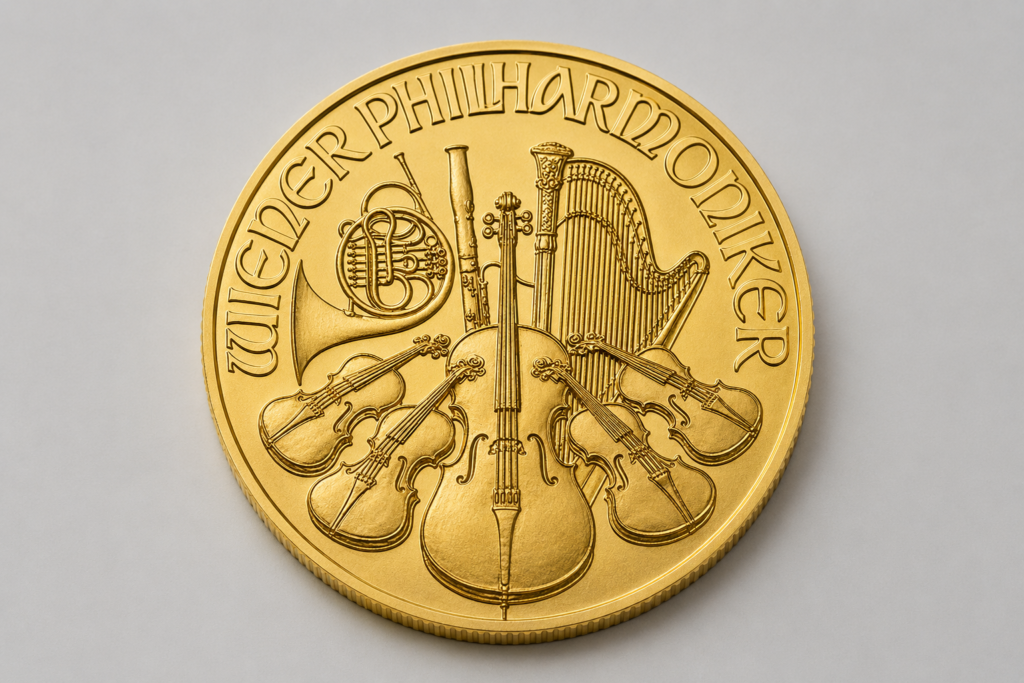
The gold Vienna Philharmonic has been the Austrian Mint’s flagship bullion coin since October 1989, when it launched as the first European sovereign gold coin struck at .9999 fineness. It became the first gold bullion coin in the world denominated in euros after Austria’s 2002 currency transition.
The World Gold Council named it the best-selling gold coin on the planet in four separate years across the 1990s and 2000, and it remains a portfolio mainstay across Europe, Japan, and North America today.
This guide covers what the coin is, what changed in 2002, where the premium sits, how IRA eligibility works, and how to track a multi-year position.
Premium figures and dealer prices move daily; the numbers in this guide are durable framing rather than current quotes. Tax treatment is informational and not professional advice. For the silver companion to this program, see our silver Vienna Philharmonic guide.
What is the gold Vienna Philharmonic?
The gold Vienna Philharmonic is a one troy ounce (and fractional) bullion coin struck by Munze Osterreich, the Austrian Mint, at its Heumarkt facility in central Vienna. Every issue since the October 10, 1989 launch has been .9999 fine – 24-karat purity by international convention – and every issue carries the same Thomas Pesendorfer design across both sides.
The 1 troy ounce coin measures 37 millimeters across, is 2 millimeters thick, and contains exactly one troy ounce (31.103 grams) of pure gold with no copper or silver hardening alloy fraction. It carries a 100 euro face value as Austrian legal tender, redenominated from the original 2,000 Austrian schilling face value when Austria adopted the euro in 2002. Like every modern bullion coin, it trades at metal content value plus dealer premium rather than at face value. It is IRA-eligible by the default IRS rule, with no vintage-driven complications to navigate.
History – the 1989 launch and the 2002 euro transition
The Austrian National Council authorized the gold Philharmonic program by act in November 1988, clearing Munze Osterreich to enter the international sovereign-bullion market that the Krugerrand had effectively created in 1967. The first coins were struck for October 10, 1989 release – three years after the American Gold Eagle, two years after the British Britannia, and seven years after the Canadian Gold Maple Leaf had established the .9999 fine standard.
The Philharmonic launched at that same .9999 standard from issue number one, which made it the first European sovereign gold coin at four-nines fineness and set the template every later European program (gold Britannia from 2013, gold Sovereign updates) would eventually match. The 1989 release offered two sizes: the 1 troy ounce flagship and a 1/4 troy ounce fractional.
The Mint expanded the gold ladder twice in the early 1990s – the 1/2 ounce arrived in 1991, and the 1/10 ounce followed in 1994, completing what was the most flexible sovereign fractional range of its era. Throughout that decade and into the 2000s, the coin built the reputation that produced its World Gold Council best-selling gold coin designations in 1992, 1995, 1996, and 2000. Demand in Germany, Austria, the rest of the eurozone, Japan, and the U.S. supported the kind of secondary-market depth that even older sovereign programs took longer to develop.
The program’s defining external milestone arrived on January 1, 2002, when Austria retired the schilling and adopted the euro. The 1 troy ounce face value was redenominated from 2,000 ATS to 100 EUR, and the fractional face values were redenominated proportionally.
The Philharmonic became the world’s first gold bullion coin denominated in euros – a market-positioning fact more than a buying-decision fact, since the Pesendorfer design itself was unchanged and the metal content was unchanged. Only the obverse currency text was updated. In 2014, the Mint added the 1/25 ounce size at a 4 euro face value to mark the program’s 25th anniversary, completing the modern five-size gold ladder.
Specifications – the 1 oz gold Philharmonic
The 1 oz Bullion strike is the workhorse variant in the program. Its specifications have held constant since 1989 with the one exception of the currency redenomination on the obverse.
- Metal content: 1 troy oz (31.103 g) of pure gold
- Purity: .9999 fine (24-karat), unchanged since 1989
- Alloy: 99.99% gold; trace alloy required for striking
- Gross weight: 31.103 g (pure-metal-content gross weight – no copper or silver hardening fraction)
- Diameter: 37.00 mm
- Thickness: 2.00 mm
- Edge: Reeded
- Face value: 100 EUR; 2,000 ATS for issues dated 1989 through 2001
- Issuing mint: Munze Osterreich (the Austrian Mint), Vienna
- First minted: October 10, 1989
- Standard fractional sizes: 1 oz, 1/2 oz, 1/4 oz, 1/10 oz, 1/25 oz
- IRA-eligible: Yes, by the default .995 rule, every issue since 1989
The 100 euro face value (and the 2,000 schilling face value on older issues) is nominal Austrian legal tender. In practice, the coin always trades at its gold-content value plus dealer premium – the gold floor sits well above the face value at any plausible spot price.
Design – the Great Organ and the orchestra instruments
Thomas Pesendorfer, Chief Engraver at the Austrian Mint, designed both faces of the Philharmonic in 1989 around a single cultural reference: the Vienna Philharmonic Orchestra and its home concert hall. The obverse depicts the Great Organ of the Wiener Musikverein’s Golden Hall – the orchestra’s permanent residence since 1870 and the venue of the New Year’s Concert broadcast worldwide each January 1.
The inscription names the issuing republic (REPUBLIK OSTERREICH), the year of issue, the metal content and fineness, and the face value in the currency of the day.
The reverse depicts an ensemble of orchestra instruments arranged as if mid-performance: a Vienna horn, a bassoon, a harp, and four violins centered on a cello. The inscription WIENER PHILHARMONIKER names the orchestra.
The arrangement is the coin’s defining visual identity and is the reason the Philharmonic sits in a distinct cultural niche among sovereign bullion – most major sovereign coins are anchored to a national symbol (the South African springbok on the Krugerrand, the eagle on the American Eagle, the maple leaf on the Canadian Maple, the standing Britannia on the UK piece). The Philharmonic is anchored to an artistic institution instead.
The same Pesendorfer composition has appeared on every gold issue since 1989, every silver issue since 2008, every platinum issue since 2016, and every fractional size. There is no rotating-reverse program of the kind the British Britannia introduced in 2014 or the Australian Kangaroo runs annually.
There is no monarch-portrait timeline of the kind that the Britannia and the Maple Leaf carry. Buy a 1 oz gold Philharmonic dated any year between 1989 and the current issue, and the only design difference you will find is the obverse currency text – schilling on pre-2002 issues, euro after.
The Austrian Mint – eight centuries of striking authority
Munze Österreich is one of the oldest continuously operating mints in the world. The mint traces its origin to 1194, when Duke Leopold V of Austria used the silver paid as ransom for Richard the Lionheart of England to fund a new minting operation in Vienna.
The mint has operated continuously since, struck Habsburg-era coinage for more than seven centuries through the Austro-Hungarian Empire and the Republic, and is today wholly owned by the Oesterreichische Nationalbank, the central bank of the Republic of Austria.
That ownership matters for an investor: the Philharmonic is sovereign-backed at the central-bank level, not at a private-mint level. Munze Österreich strikes both the circulating euro coinage for Austria and the sovereign bullion program. The 1988 enabling act tied the Philharmonic to that sovereign authority and made the coin Austrian legal tender at face value, with the full backing of the Republic.
Sizes – the gold fractional ladder
The Philharmonic ships in five standard fractional sizes – one of the most complete sovereign gold ladders in production. Per-ounce premium rises as the size falls, which is the same tradeoff every major fractional program carries.
Gold 1 oz (100 euro face value)
The workhorse Bullion strike. Tightest per-ounce premium in the ladder and the variant every IRA custodian accepts without question. Sold loose, in Austrian Mint tubes of 10, or in Master Boxes of 250 for larger positions.
Gold 1/2 oz (50 euro face value)
Added in 1991. A mid-sized fractional that carries a premium gap above the 1 oz but stays accessible for medium portfolios.
Gold 1/4 oz (25 euro face value)
Available since the 1989 launch. The most common gifting and smaller-position choice.
Gold 1/10 oz (10 euro face value)
Added in 1994. Per-ounce premium runs notably above the 1 oz. Often used as an entry-level Philharmonic or as a divisible position-sizing tool.
Gold 1/25 oz (4 euro face value)
Added in 2014 for the program’s 25th anniversary. The smallest standard fractional, carrying the highest per-ounce premium in the ladder. Available at fewer U.S. dealers than the other four sizes.
Premium over spot – where the gold Philharmonic sits among .9999 sovereigns
The .9999 fine gold Philharmonic typically trades at a premium over spot in line with the Canadian Gold Maple Leaf and the post-2013 gold Britannia, below the American Gold Buffalo, and noticeably below the American Gold Eagle. The Krugerrand sits below the Philharmonic at the cost-leader tier of the major sovereign options.
Three structural factors place the Philharmonic where it does. First, the Austrian Mint’s per-coin production cost on the .9999 alloy is real but supported by the program’s scale across all five fractional sizes. Second, the Philharmonic carries an Austrian Mint brand premium that is modest in the U.S. retail market – comparable to the Royal Canadian Mint premium on the Maple Leaf and the Royal Mint premium on the Britannia, lower than the U.S. domestic premium that lifts the Eagle and Buffalo.
Third, sustained European and Japanese demand has supported tight secondary-market spreads for decades; the World Gold Council bestseller designations in 1992, 1995, 1996, and 2000 are upstream of that depth.
IRA eligibility – the default .995 rule from launch
Every gold Vienna Philharmonic coin since the 1989 launch is eligible for a self-directed precious metals IRA by the default IRS rule. IRC section 408(m)(3) sets the bar that gold held in an IRA must be at least .995 fine. The .9999 fine Philharmonic clears that bar with margin to spare, and no specific statutory exception is required to admit it. This is true for every fractional size from 1/25 ounce through 1 ounce.
Unlike the gold Britannia, where pre-2013 .917 fine issues are not IRA-eligible and create a vintage-driven split inside the same coin name, the Philharmonic has no such complication. Every issue from 1989 forward qualifies. The 2002 euro currency transition did not change fineness.
The 2014 addition of the 1/25 ounce size did not change fineness. Any gold Philharmonic, schilling-era or euro-era, 1/25 ounce or 1 ounce, clears the IRS default. This is one of the simplest IRA-eligibility stories in the sovereign-bullion category.
Our gold IRA guide covers the full framework. Comparable 1 oz sovereign gold options eligible for the IRA:
- Canadian Gold Maple Leaf (.9999 since 1982, the original .9999 sovereign, default rule)
- American Gold Buffalo (.9999 since 2006, default rule)
- Gold Britannia (.9999 since 2013, post-2013 issues only, default rule)
- Australian Gold Kangaroo (.9999, default rule)
- American Gold Eagle (.9167 fine, named statutory exception)
How to buy, and how to handle a .9999 gold coin
The Philharmonic is sold at every major U.S. bullion dealer – APMEX, JM Bullion, Money Metals Exchange, SD Bullion, Provident Metals, Hero Bullion – and at major coin dealers and local coin shops across both the U.S. and European markets. The Austrian Mint distributes Bullion strikes through a network of authorized purchasers who resell into the retail channel, and also sells some product direct via muenzeoesterreich.com.
The 1 oz Bullion is the most widely stocked size in U.S. inventory; the 1/10, 1/4, and 1/2 ounce fractionals are common at the major dealers; the 1/25 ounce is the rarest of the five at U.S. retail and tends to carry the widest premium spread.
Two handling notes are specific to .9999 fine gold. First, the surface is meaningfully softer than a 22-karat coin like the Gold Eagle or the Krugerrand – the Philharmonic carries no copper or silver hardening alloy. Handle by the edges, keep coins in Austrian Mint tubes or inert capsules, and avoid setting loose 24-karat coins against each other. Surface marks do not change the gold content but can affect resale value if the coin moves toward a collector buyer.
Second, the Philharmonic ships without an assay card or sealed plastic carrier of the Maple Leaf or Kangaroo type – the Mint relies on the design itself and the standard specifications for buyer verification. Our how to buy gold guide covers the broader buying framework.
Authentication, storage, and resale
Authentication on a Philharmonic relies on standard specification verification. The Austrian Mint did not add a proprietary security-feature layer of the 2013 Britannia type, so the buyer-side check is the published specifications: 31.103 g pure-metal-content gross weight for the 1 oz, 37.00 mm diameter, 2.00 mm thickness, and the reeded edge. A handheld Sigma Verifier reads the .9999 gold conductivity signature in a way that cleanly distinguishes a real Philharmonic from base-metal counterfeits and from other sovereign coins of different fineness.
The ping test confirms the struck precious-metal acoustic profile. Pesendorfer’s intricate Great Organ obverse – pipe spacing, ornament detail, lettering – is itself difficult to counterfeit cleanly at scale, and a side-by-side comparison with a known-genuine reference coin reveals most deceptive copies.
Storage options include a home safe rated for fire and theft, a bank safe deposit box, a private depository (Brink’s, Loomis, Delaware Depository), or an IRA-custodian-held depository for IRA positions. IRA-held Philharmonics must be stored at an approved depository – home storage of IRA gold is not permitted under IRS rules. Taxable positions can sit wherever the holder prefers.
Resale at any major U.S. or European dealer is straightforward. The Philharmonic is one of the most universally recognized .9999 fine gold bullion coins in the world, with particularly deep secondary markets in Germany, Austria, and Japan. The 1 oz trades at tight dealer bid-ask spreads in line with other .9999 sovereigns.
Document the sale for tax purposes: U.S. capital gains on physical gold are taxed as collectibles, up to 28% on long-term gains rather than the standard 15-20% long-term capital gains rate. Consult a qualified tax professional before filing. Our guide to selling precious metals covers the full resale framework.
Frequently asked questions
What is a gold Vienna Philharmonic coin?
A gold Vienna Philharmonic coin is a bullion coin produced by Munze Osterreich (the Austrian Mint) and issued continuously since October 10, 1989. Every issue has been .9999 fine, the 24-karat international convention, and every issue carries Thomas Pesendorfer’s Great Organ obverse and orchestra-instruments reverse. The 1 troy ounce coin carries a 100 euro face value (2,000 Austrian schillings for issues dated 1989 through 2001), is legal tender in Austria at face value, and trades at gold-content value plus dealer premium on the international market.
Is the gold Vienna Philharmonic IRA-eligible?
Yes, every gold Vienna Philharmonic since the 1989 launch is IRA-eligible by the default IRS rule. The .9999 fineness clears the .995 minimum set by IRC section 408(m)(3) with no statutory exception required. Every fractional size from 1/25 ounce through 1 ounce qualifies, and there is no vintage-driven split of the kind that excludes pre-2013 gold Britannia issues – schilling-era and euro-era Philharmonics qualify identically.
When did the gold Vienna Philharmonic launch?
The gold Vienna Philharmonic launched on October 10, 1989, after the Austrian National Council authorized the program by act in November 1988. The launch came three years after the American Gold Eagle, two years after the British Britannia, and seven years after the Canadian Gold Maple Leaf had established the .9999 fine sovereign standard. Munze Osterreich has issued the coin continuously since.
What is the difference between a gold Vienna Philharmonic and a Canadian Gold Maple Leaf?
Both are .9999 fine 1 troy ounce sovereign gold bullion coins, both clear the .995 IRA default rule, and both trade at similar premium tiers among the major .9999 sovereigns. The practical differences are mint origin (Austrian vs. Canadian), design (Pesendorfer’s Great Organ and orchestra vs. the Royal Canadian Mint’s single maple leaf reverse with a rotating monarch obverse), face value (100 euros vs. 50 Canadian dollars), and fractional ladder (the Philharmonic offers 1/25 oz as its smallest standard fractional; the Maple Leaf offers 1/20 oz). The Maple Leaf has been .9999 fine since 1982 – seven years before the Philharmonic – so it predates the Philharmonic at that fineness tier.
Why is the gold Vienna Philharmonic denominated in euros?
The gold Vienna Philharmonic is denominated in euros because Austria adopted the euro as its national currency on January 1, 2002, replacing the Austrian schilling. The 1 oz face value redenominated from 2,000 schillings to 100 euros at that point, and every issue since 2002 has carried euro face values. The Philharmonic was the first gold bullion coin in the world denominated in euros and remains the highest-profile sovereign gold bullion coin in that currency.
Are schilling-era gold Philharmonics worth more than euro-era issues?
As bullion, no – a schilling-era 1 oz Philharmonic and a euro-era 1 oz Philharmonic contain the same one troy ounce of .9999 fine gold and trade at the same metal-content floor plus dealer premium. The only physical difference is the obverse currency text. Some schilling-era issues do carry a modest collector premium because of the historical denomination, but that varies by year, dealer, and condition and is a collector dimension rather than a bullion-investment dimension.
What sizes does the gold Vienna Philharmonic come in?
The gold Vienna Philharmonic ships in five standard sizes: 1 oz (100 euro face), 1/2 oz (50 euro face), 1/4 oz (25 euro face), 1/10 oz (10 euro face), and 1/25 oz (4 euro face). The 1 oz and 1/4 oz launched in 1989; the 1/2 oz arrived in 1991, the 1/10 oz in 1994, and the 1/25 oz in 2014 for the 25th anniversary. Per-ounce premium rises as the size falls across the ladder.
Track your gold Philharmonics in Gold Silver Ledger
Design stability across decades is the defining structural fact about a Philharmonic position. A 1989 issue and a current-year issue carry the same Pesendorfer design, the same .9999 fineness, and the same one troy ounce of pure gold – only the year and the obverse currency text distinguish them. That uniformity is unusual in sovereign bullion, and it changes how a multi-year accumulation actually behaves.
Gold Silver Ledger keeps separate catalog items for the 1 oz gold Philharmonic and each fractional size (1/2, 1/4, 1/10, 1/25).
This guide is for informational purposes and does not constitute financial, investment, or tax advice. Premium figures, spot prices, and dealer quotes move daily; verify current numbers before any purchase or sale. Consult a qualified tax professional before filing on physical-bullion disposals.
