
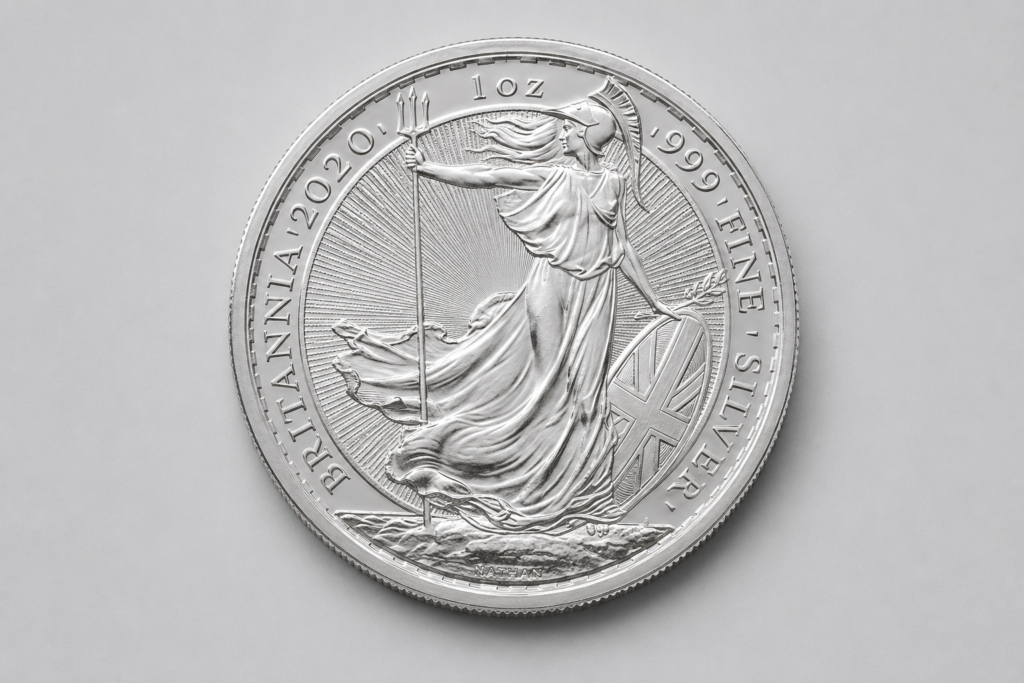
The Silver Britannia is the UK Royal Mint’s flagship silver bullion coin, introduced in 1997 as the silver complement to the established gold program. In 2013, the Royal Mint refined the silver alloy from the traditional .958 Britannia silver standard to .999 fine, bringing it into line with the silver standard used across the American Silver Eagle, the Canadian Silver Maple Leaf, and the Austrian Silver Philharmonic.
Post-2013 Silver Britannias are IRA-eligible by default IRS rule, carry a 2-pound face value, and inherit the same Philip Nathan standing-Britannia design that has defined the program since the gold launch a decade earlier. This guide covers every dimension a Silver Britannia buyer needs.
Premium figures and dealer prices move daily; the numbers in this guide are durable framing rather than current quotes. Tax treatment is informational and not professional advice. The UK Capital Gains Tax exemption for British legal currency applies to UK-resident holders only and has no bearing on U.S. tax treatment.
What is the Silver Britannia?
Britain’s primary investment-grade silver coin is the Silver Britannia, struck in Wales at the Royal Mint’s Llantrisant facility. Coins minted from 2013 onward use a .999 fine silver alloy; the 1997-through-2012 issues used the historic .958 Britannia silver standard — a sterling-plus alloy that traces back to Charles II’s 1697 coinage reform and takes its name from the Britannia figure itself.
Each 1 troy ounce Silver Britannia contains one troy ounce (31.103 grams) of pure silver, weighs 31.21 grams gross on post-2013 issues, measures 38.61 millimeters in diameter, and carries a 2-pound face value as legal tender in the UK. Post-2013 issues clear the IRS default rule for silver of .999 fineness or higher and are accepted by every self-directed precious metals IRA custodian; pre-2013 .958 issues sit below the default threshold and have no IRA path at any custodian.
The 1997 launch and the 2013 fineness refresh
The Silver Britannia entered the Royal Mint catalogue in 1997, ten years after the gold program launched. The 1997 alloy choice was .958 fine — the traditional UK Britannia silver standard, a sterling-plus alloy with copper hardening that dates back to the late seventeenth century. That standard was historically distinctive but sat below the .999 fine alloy that the American Silver Eagle (1986), the Canadian Silver Maple Leaf (1988), and the Austrian Silver Philharmonic (2008) all used.
The 2013 program-wide refresh repositioned the silver Britannia on the global .999 sovereign silver convention. The .958 Britannia silver standard, distinctive but non-conforming, gave way to the .999 alloy that every major sovereign silver program had been using for years. The shift also unlocked IRA eligibility for the first time — pre-2013 .958 stock sits below the IRS .999 default and was never on the IRA menu, but post-2013 .999 issues clear the default rule cleanly without needing a named statutory exception.
The 2013 redesign also brought the signature security-feature suite that distinguishes modern Britannias: a radial-line surface texture across the reverse field, microscopic DECUS ET TUTAMEN inscriptions, and a latent image embedded in the design. From 2014 onward, the Royal Mint has issued annual rotating reverse designs on the Bullion Britannia line, applied across both metal programs. The 2023 obverse change to Martin Jennings’s King Charles III portrait, replacing the Jody Clark Queen Elizabeth II portrait that had run since 2015, applies equally to current silver issues.
Specifications of the 1 oz Silver Britannia
The specifications below describe the 1 oz Bullion strike, the center of the silver program. The 5 oz, 10 oz, and 1 kg silver issues released in select years share the same fineness and design heritage but scale up dimensions and face value.
| Specification | Value |
| Silver content | 1 troy oz (31.103 g) |
| Purity (current) | .999 fine – post-2013 |
| Purity (1997-2012) | .958 fine (Britannia silver standard) |
| Gross weight (post-2013) | 31.21 g |
| Diameter | 38.61 mm |
| Thickness | ~3.0 mm |
| Edge | Reeded |
| Face value | 2 GBP |
| Issuing mint | The Royal Mint, Llantrisant, Wales |
| First minted | 1997 (.958); .999 since 2013 |
| Standard sizes | 1 oz primary; 5 oz, 10 oz, 1 kg in select years |
| IRA-eligible (post-2013) | Yes – by default .999 silver rule |
| U.S. capital gains treatment | Collectible (28% max long-term rate) |
Every 1 oz sovereign silver coin — the Silver Britannia, the American Silver Eagle, the Canadian Silver Maple Leaf, the Vienna Philharmonic — contains the same one troy ounce of pure silver. The differences live in the alloy, the issuing mint, the design, and the face value. The implication for valuation is direct: a Silver Britannia’s floor value is the live silver spot price multiplied by one troy ounce, before any premium considerations.
Design: Philip Nathan’s Britannia on a silver strike
The Silver Britannia carries Philip Nathan’s standing Britannia reverse design — the same reverse art the gold program has used since 1987, applied to the silver program from its 1997 launch. Britannia stands in profile holding a trident in her right hand, and a shield emblazoned with the Union Flag in her left, with an olive branch and the BRITANNIA inscription wrapping the figure.
The classical personification of the British Isles, Britannia, has been a defining motif of UK coinage since Charles II’s halfpenny of 1672 and traces to Roman-era coins of the second century CE under Hadrian and Antoninus Pius.
Like the gold side, the silver Bullion strike has carried annual rotating reverse designs alongside the Nathan classic from 2014 onward. Each year’s silver Bullion rotates through a contemporary artist’s interpretation of the Britannia figure, often with allegorical accompaniments — a lion, a wave motif, a wind-blown flag — refreshed across both metals at the same time. The Nathan standard reverse continues in parallel as the program’s perennial design language.
Obverse portraits track the reigning monarch through each era of the program. Ian Rank-Broadley sculpted the Queen Elizabeth II portrait used on early Silver Britannia issues, Jody Clark’s QEII portrait succeeded it from 2015 through 2022, and Martin Jennings’s King Charles III portrait has been in use since 2023. A long-running Silver Britannia accumulation can pull together three or four distinct portraits across its years, which becomes a real tracking dimension once the collection spans more than a decade.
The 2013 security-feature suite on silver
The 2013 redesign brought the four-feature security suite to both metals at once. Every post-2013 Silver Britannia carries the same anti-counterfeit features as the gold side, applied to the silver coin’s larger 38.61 mm reverse field.
Radial-line surface texture
The micro-engraved radial-line pattern across the reverse field is the most visible of the four features and the one most easily verified in hand. The lines reflect light distinctively at the right angle and are extremely difficult to reproduce on counterfeit dies. The Royal Canadian Mint’s 2013 Silver Maple Leaf redesign added a comparable radial-line feature in the same year — both major mints made the same security investment in the same window.
Micro-text inscription
Microscopic DECUS ET TUTAMEN text, the historic British coinage motto meaning an ornament and a safeguard, runs around the design. The inscription is visible only under magnification and references a security convention on British coinage edges going back to the seventeenth century.
Latent image
A directional latent image is built into the design and reveals itself as the coin tilts under light. The feature is most prominent on certain annual rotating reverses where the artist works the latent element into the composition explicitly.
Standard specification verification
The proprietary security features are layered on top of standard specification checks that every Silver Britannia must pass. Gross weight, diameter, thickness, and reeded-edge profile all match the published spec sheet on a calibrated scale and caliper. Conductivity testing via a Sigma Verifier returns a distinct .999 silver reading that separates current production from the pre-2013 .958 issues, and separates real Britannias from silver-plated or base-metal lookalikes.
Silver Britannia size variants
The Silver Britannia program is centered firmly on the 1 oz Bullion strike — unlike the gold program’s full fractional ladder, the silver side does not split into 1/2 oz, 1/4 oz, 1/10 oz, or smaller sizes on the standard schedule. The Royal Mint has issued larger silver Britannias in select years (5 oz, 10 oz, and 1 kg) primarily as collector or large-position products rather than standard yearly stock.
1 oz (2-pound face value)
The 1 oz size is the workhorse Silver Britannia and the center of the silver program. It carries the line’s tightest dealer premium per ounce, every IRA custodian accepts post-2013 issues, and it is the default buy for almost any silver-allocation use case. Royal Mint tubes hold 25 coins; dealers also sell singles loose or in mint-sealed monster boxes for larger orders.
5 oz, 10 oz, and 1 kg issues
Larger silver Britannia formats released in select years, sometimes pegged to specific anniversaries or annual rotating-reverse themes. Per-ounce premium varies meaningfully by issue; treat as collector territory or as efficient large-position vehicles for buyers who prefer fewer pieces in storage. Mintage volumes are lower than the 1 oz Bullion line and resale liquidity is correspondingly tighter.
Premium over spot: where the Silver Britannia sits among .999 sovereigns
The post-2013 Silver Britannia trades at a premium over spot in line with the Canadian Silver Maple Leaf and the Austrian Silver Philharmonic on a typical same-day basis in the U.S. retail market. The American Silver Eagle sits noticeably above the Silver Britannia because of the U.S.-domestic-mint premium that has lifted the Eagle through every retail cycle since the 2010s.
The structural reason the Silver Britannia sits where it does is the Royal Mint’s foreign-sovereign positioning in the U.S. market. The Royal Mint brand premium is modest compared to the U.S.-domestic premium on the Eagle, and the 2013 security-feature investment adds a small structural cost reflected in the per-coin spread. Production scale across the .999 silver Bullion line keeps the per-coin cost in line with the other major .999 sovereigns.
The older .958 issues trade at a small discount against the current .999 production. Three factors drive that gap: the pre-2013 coins lack the security-feature suite, they fall outside IRA eligibility, and the buyer pool for non-standard-fineness silver is thinner than the pool for current .999 stock. For live pricing context, check dealer quotes at the time of purchase — our premium over spot guide explains the framework that drives those numbers, and our silver spot price guide carries the live spot reference.
IRA eligibility by vintage
From 2013 onward, the Silver Britannia is structurally eligible for a self-directed precious metals IRA. The IRS rule on silver — codified at IRC section 408(m)(3) — sets a .999 minimum fineness for any silver held inside an IRA. The Silver Britannia’s post-2013 .999 alloy lands exactly on that threshold, which puts it inside default eligibility without needing the kind of named statutory exception that admits coins like the .9167 American Gold Eagle.
The pre-2013 .958 issues are excluded from IRAs across the board. They fall under the .999 default silver threshold and never received an explicit statutory carve-out from Congress. The cutoff runs along the 2013 fineness boundary rather than along the coin name itself, which means a custodian sorting deposits will accept current stock and turn away the older .958 issues even though both wear the Silver Britannia label. Filter for post-2013 vintage when sourcing for an IRA position.
Our silver IRA guide covers the full framework. Other commonly held 1 oz silver bullion coins eligible for the IRA:
- American Silver Eagle (.999 fine — default rule)
- Canadian Silver Maple Leaf (.9999 fine — default rule)
- Austrian Silver Philharmonic (.999 fine — default rule)
- Australian Silver Kookaburra and Koala (.9999 fine — default rule)
- Mexican Libertad silver (.999 fine — default rule)
How to buy, and how to handle a .999 silver coin
The Silver Britannia is sold at every major U.S. silver bullion dealer (APMEX, JM Bullion, Money Metals Exchange, SD Bullion, Provident Metals, Hero Bullion), at Royal Mint authorized purchasers, at major UK and European dealers, and at coin dealers across both markets. The Royal Mint sells some Silver Britannia product direct via royalmint.com, particularly the annual rotating reverse releases and Proof issues; standard Bullion strikes flow primarily through the authorized-purchaser network.
Handling a .999 silver coin requires more care than handling the pre-2013 .958 alloy or the .9999 .999 silver coins from other mints — silver is softer than gold and shows fingerprints, surface oxidation, and edge marks more readily. Handle by the edges, keep coins in Royal Mint tubes or inert holders, and avoid setting loose .999 silver coins against each other in storage.
Silver oxidation darkens the surface over time but does not affect the silver content; some buyers tolerate toning, and some prefer pristine surfaces, with the resale-market implications running both directions depending on the buyer.
Royal Mint marketing leans heavily on the UK Capital Gains Tax exemption that British legal currency enjoys, but that exemption is jurisdictional — UK residents benefit, U.S. holders do not. A Silver Britannia sold by a U.S. holder falls under the same federal collectibles treatment as any other physical silver, capping long-term gains at 28% rather than the standard long-term capital gains rate.
Treat CGT-exempt marketing copy as background context, not a U.S. buying factor. Our how to buy silver guide covers the broader buying framework.
Authentication, storage, and resale
Authentication on a post-2013 Silver Britannia is supported by the four-feature security suite layered on top of the standard specifications. The published 31.21 g gross weight, 38.61 mm diameter, ~3.0 mm thickness, and reeded edge are the buyer-side specification check. The radial-line micro-engraving on the post-2013 reverse field is the easiest visual confirmation under proper lighting.
The micro-text and latent image require magnification and angle-shift, respectively. A Sigma Verifier reads the .999 silver conductivity signature cleanly, and the ping test confirms a struck silver coin profile against base metal or silver-plated counterfeits.
Storage falls into four broad categories. The first is at-home in a fire- and theft-rated safe, suitable for smaller positions. The second is a bank safe deposit box, which trades self-custody for institutional security. The third is a private depository — Brink’s, Loomis, Delaware Depository, and others operate insured allocated-storage facilities.
The fourth is an IRA-custodian-held depository, which is mandatory for any post-2013 issues held in a self-directed precious metals IRA. Home storage of IRA silver is explicitly disallowed by IRS rules. Note that silver takes up substantially more physical space per dollar of value than gold, so a six-figure silver position has very different storage logistics than a six-figure gold position.
Resale liquidity for the Silver Britannia is solid at any major U.S. or UK dealer. The coin is one of the most recognized .999 silver sovereigns in the world, and post-2013 issues trade at dealer bid-ask spreads comparable to the Silver Maple Leaf and Silver Philharmonic. Pre-2013 .958 issues trade at a modest discount.
Keep clean records on every Silver Britannia disposal — federal treatment classifies physical silver as a collectible, which lifts the long-term capital gains ceiling to 28% versus the standard 15-20% bracket that applies to most other long-term assets. A qualified tax professional is the right partner for the actual filing. The mechanics of selling — dealer choice, timing, documentation — are walked through in our guide to selling precious metals.
Frequently asked questions
What is the Silver Britannia?
Britain’s primary silver bullion coin, the Silver Britannia has been minted by the UK Royal Mint at Llantrisant in Wales since 1997. The current alloy is .999 fine silver, set in the 2013 redesign and IRA-eligible under default IRS rules; earlier issues from 1997 through 2012 used the historic .958 Britannia silver standard and fall outside IRA eligibility. The 1 troy ounce coin carries a 2 pound face value as British legal currency, with occasional 5 oz, 10 oz, and 1 kg issues released in select years.
Are Silver Britannias IRA-eligible?
Silver Britannias minted in 2013 or later qualify for self-directed precious metals IRAs because the .999 fineness clears the IRC section 408(m)(3) default silver threshold; issues from 1997 through 2012 do not qualify because the .958 alloy falls below that threshold and Congress never named the coin as a statutory exception. The label on every Silver Britannia reads the same, but a custodian sorts them by vintage — a 2014 issue clears, a 2010 issue gets rejected. Build IRA positions exclusively from post-2013 stock.
What changed with the Silver Britannia in 2013?
The 2013 redesign upgraded the silver alloy from .958 fine (the traditional Britannia silver standard) to .999 fine and added a four-feature security suite — radial-line surface texture, DECUS ET TUTAMEN micro-text, a latent image, and the standard specifications verification layer. The fineness upgrade flipped the program into IRA-eligible status for post-2013 issues while pre-2013 issues remain excluded. The same security-feature suite was added to the gold side of the program in the same redesign cycle.
What is the difference between a Silver Britannia and a Silver Maple Leaf?
Both are 1 troy ounce sovereign silver bullion coins, both clear the .999 IRA default silver rule for post-2013 Silver Britannia issues, and both are widely accepted at U.S. dealers and IRA custodians — the differences are fineness, mint, design, and the vintage consideration. The Silver Britannia is .999 fine (post-2013) from the UK Royal Mint with the Philip Nathan standing-Britannia reverse; the Silver Maple Leaf is .9999 fine from the Royal Canadian Mint with the single-maple-leaf reverse and has been .9999 fine since launch in 1988 with no vintage break. Premium tends to run comparable between the two on a same-day basis.
Are Silver Britannias exempt from Capital Gains Tax?
UK residents pay no Capital Gains Tax on Silver Britannia disposals because British legal currency at face value is CGT-exempt under UK tax law — that exemption is jurisdictional and does not follow the coin across borders. A U.S. holder selling a Silver Britannia falls under federal collectibles treatment with long-term gains capped at 28%, identical to the rate that applies to a Silver Eagle, a Silver Maple Leaf, or any other physical silver coin in U.S. hands. The CGT angle is genuinely meaningful for UK residents and largely invisible in U.S. portfolios.
Do pre-2013 .958 Silver Britannias sell at a discount?
Pre-2013 .958 Silver Britannias trade at a modest discount to current .999 production because they lack the post-2013 security features, because they are not IRA-eligible, and because the .958 fineness sits outside the standard .999 sovereign silver pool that most U.S. buyers default to. The discount is real but not large at most major dealers, and pre-2013 .958 Silver Britannias remain legitimate silver bullion at their full silver-content floor of 1 troy oz times the live silver spot price. They simply trade as taxable-sleeve-only stock at slightly tighter dealer margins.
What sizes does the Silver Britannia come in?
The Silver Britannia is centered on the 1 troy ounce size on the standard production schedule, with larger 5 oz, 10 oz, and 1 kg issues released in select years as collector or large-position products. The silver side does not have the full 1/2 oz / 1/4 oz / 1/10 oz / 1/20 oz / 1/40 oz fractional ladder that the Gold Britannia carries — silver Britannia buying is built around the 1 oz Bullion strike and scaled-up issues for larger positions.
Track your Silver Britannias in Gold Silver Ledger
A Silver Britannia position usually carries a vintage-driven IRA-eligibility split — pre-2013 .958 issues are taxable-sleeve-only while post-2013 .999 issues can sit in either sleeve. The coin reads as Silver Britannia on every dealer invoice regardless of vintage, so the .958 versus .999 distinction has to be captured at the catalog-row level for the IRA status to read correctly downstream.
Gold Silver Ledger handles this with separate catalog items for the pre-2013 .958 Silver Britannia and the post-2013 .999 Silver Britannia. The larger 5 oz, 10 oz, and 1 kg issues sit as their own catalog items, where you hold them. Cost basis is locked at purchase per item, and the storage location set at purchase determines whether the item is treated as taxable or IRA-held.
Live silver spot drives the current-value rendering on every Silver Britannia in the position, refreshed continuously. View filters let you slice the silver Britannia sleeve by vintage or by year on its own, or fold it back into a combined silver view alongside Silver Eagles, Silver Maples, and the rest. The Custody Statement breaks holdings down by storage location, with per-location cards that collapse and expand for quick scanning.
Analytics surfaces premium spend across the Silver Britannia ladder across vintages and years, with the per-ounce premium gap between pre-2013 and post-2013 issues becoming visible as a real cumulative number on the position. The Tax Report excludes disposals of IRA-held post-2013 Silver Britannias from taxable totals automatically.
This guide is for informational purposes and does not constitute financial, investment, or tax advice. Premium figures, spot prices, and dealer quotes move daily; verify current numbers before any purchase or sale. The UK Capital Gains Tax exemption referenced applies to UK-resident holders only and does not transfer to U.S. holders. Consult a qualified tax professional before filing on physical-bullion disposals.
