
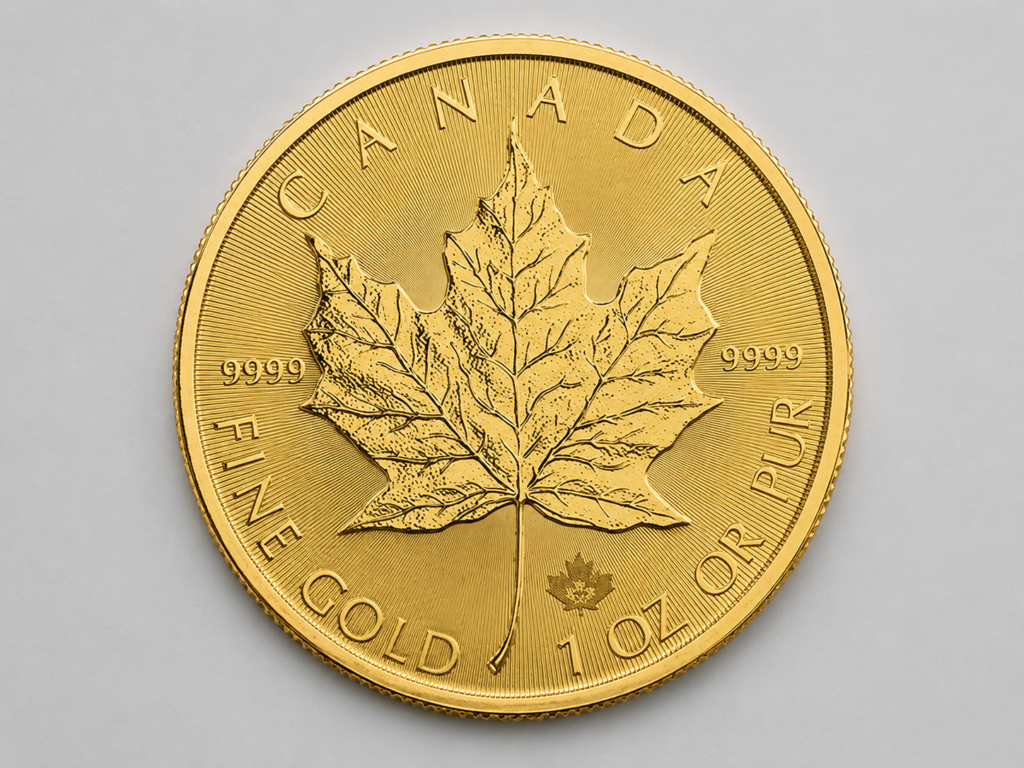
The Canadian Gold Maple Leaf is the Royal Canadian Mint’s flagship gold bullion coin and the first .9999 fine gold coin produced by a major sovereign mint at scale. Launched in 1979 at .999 fineness and upgraded to .9999 in 1982, the Maple Leaf set the global standard for 24-karat sovereign gold that every later major program eventually matched.
The 1 troy ounce coin contains one troy ounce of pure gold, carries a $50 Canadian face value, is IRA-eligible by default IRS rule, and ships in a complete fractional ladder. This guide covers every dimension a Maple Leaf buyer needs.
Premium figures and dealer prices move daily; the numbers in this guide are durable framing rather than current quotes. Tax treatment is informational and not professional advice. For the U.S. Mint’s .9999 fine answer launched in 2006, see the American Gold Buffalo complete buyer’s guide; for the .9167 fine U.S. flagship, see the American Gold Eagle complete buyer’s guide.
What is the Canadian Gold Maple Leaf?
The Canadian Gold Maple Leaf is the Royal Canadian Mint’s flagship gold bullion coin. The 1 troy ounce coin contains one troy ounce (31.103 grams) of pure .9999 fine gold, weighs 31.103 grams gross, measures 30.0 millimeters in diameter, and carries a $50 Canadian face value despite trading at gold-content value.
At .9999 fineness, the gross weight and the pure gold content are functionally identical, because the trace alloy added for striking is too small to register.
The Maple Leaf launched in 1979 at .999 fineness and was upgraded to .9999 in 1982 — the first sovereign-mint gold bullion coin at that purity standard. The 1 oz Bullion strike is the workhorse production coin. A complete fractional ladder (1/2, 1/4, 1/10, 1/20 oz, plus the 1 g Maplegram series) ships on the standard production schedule, and a .99999 “five nines” collector variant has been produced in limited mintages since 2007.
The Maple is IRA-eligible by the default IRS rule for gold of .995 fineness or higher — no specific statutory exception is required.
History — 1979 launch, 1982 .9999 upgrade, and the global standard
The Royal Canadian Mint launched the Gold Maple Leaf in 1979, during the late-1970s gold bull market. Canada was one of the first Western sovereign mints to compete directly with the Krugerrand (in production since 1967) for the new bullion-coin market. The first Maples were .999 fine — the prevailing 24-karat standard at the time — and shipped in 1 oz only.
In 1982, the Royal Canadian Mint upgraded the Maple Leaf to .9999 fineness, making it the first .9999 fine gold bullion coin produced by a major sovereign mint at scale. The fineness milestone reset the global standard.
Every other major sovereign mint that later launched a 24-karat program followed the .9999 spec: the U.S. Mint’s Gold Buffalo in 2006, the Royal Mint’s redesigned Britannia in 2013, the Perth Mint’s Gold Kangaroo, the Austrian Mint’s Vienna Philharmonic. The Krugerrand and the American Gold Eagle remain on the older .9167 (22-karat) hardened-alloy approach by statute and tradition.
The Royal Canadian Mint added two major security redesigns. In 2013, the reverse was re-cut to include a precision radial-line pattern micro-engraved across the field — a feature visible under proper lighting and difficult to counterfeit. In 2015, a microscopic laser-engraved “DNA” mark was added inside the smallest leaf of the reverse design, paired with the Bullion DNA Anti-Counterfeiting verification system for participating dealers.
The .99999 “five nines” collector Maple was introduced in 2007 as a separate limited-mintage product, not a replacement for the .9999 Bullion strike. King Charles III replaces Queen Elizabeth II on the obverse from 2023 onward.
Specifications and the .9999 fineness
The Maple Leaf ships in a full fractional ladder, but the specifications below describe the 1 oz Bullion strike — the workhorse Canadian gold bullion coin and the variant most positions are built around.
| Specification | Value |
| Gold content | 1 troy oz (31.103 g) |
| Purity | .9999 fine (24-karat) |
| Alloy | 99.99% gold, with trace alloy required for striking |
| Gross weight | 31.103 g |
| Diameter | 30.0 mm |
| Thickness | 2.87 mm |
| Edge | Reeded, with interrupted serrations on post-2013 issues |
| Face value | $50 CAD |
| Issuing mint | Royal Canadian Mint |
| First minted | 1979 (.999 fine); .9999 since 1982 |
| Standard sizes | 1 oz, 1/2 oz, 1/4 oz, 1/10 oz, 1/20 oz, 1 g Maplegram |
| IRA-eligible (Bullion) | Yes — by default .995 rule |
The Maple Leaf’s gross weight and pure gold content read the same on a scale at .9999 fineness, which simplifies the gold-content floor every Maple sits on: metal weight times the live gold spot price. By contrast, the .9167 fine American Gold Eagle and the .9167 fine Krugerrand both weigh more than their gold content because of the silver-copper hardening alloy that surrounds the gold.
The pure gold per 1 oz coin is identical across all three; what differs is what is wrapped around it.
Design — the single maple leaf and the monarch’s portrait
The reverse is a stylized single sugar maple leaf in high relief — Canada’s national symbol — surrounded by the inscriptions CANADA, the fineness mark (FINE GOLD 1 oz OR PUR), and the year. The maple leaf was sculpted by Walter Ott for the 1979 launch and has remained the program’s defining motif across every redesign since.
The 2013 security re-cut added the radial-line micro-engraving across the field around the maple leaf; the 2015 redesign added the laser-engraved DNA mark inside the smallest leaf node.
The obverse carries the reigning Canadian monarch’s portrait. Arnold Machin’s Queen Elizabeth II portrait appeared on early issues, Dora de Pédery-Hunt’s mature QEII portrait ran from 1990 to 2004, Susanna Blunt’s QEII portrait ran from 2005 through 2022, and Steven Rosati’s King Charles III portrait has appeared since 2023.
The portrait change is a real collecting and tracking dimension on long-running positions — the same coin can carry four different monarch portraits depending on the year of mintage. The face-value inscription ($50 for the 1 oz) sits below the portrait.
Security features — the 2013 and 2015 redesigns
The Royal Canadian Mint added the most extensive anti-counterfeit features of any major sovereign gold bullion coin in two redesigns. Some features are visible only with the right lighting; others require dealer-side verification hardware. All of them sit on top of the standard specifications you can verify yourself.
Radial lines (2013 onward)
A precision-machined radial-line pattern is micro-engraved across the entire reverse field surrounding the maple leaf. The pattern reflects light distinctively and is extremely difficult to replicate on counterfeit dies. The radial lines also appear on the post-2013 obverse around the monarch’s portrait.
Laser DNA mark (2015 onward)
A microscopic textured mark is laser-engraved inside the smallest leaf node on the reverse. The mark is visible only under high magnification and is registered to the Royal Canadian Mint’s Bullion DNA Anti-Counterfeiting database, which participating dealers can scan against when buying coins back.
Interrupted-serration reeded edge (post-2013)
The reeded edge alternates serration depth on a pattern designed to break standard counterfeit-die replication.
Standard specification verification
Beneath the proprietary security layer, every Maple still matches its published gross weight, diameter, thickness, and reeded-edge profile. A handheld Sigma Verifier reads the .9999 conductivity signature in a way that cleanly distinguishes the Maple from a .9167 fine Krugerrand or Gold Eagle and from base-metal counterfeits.
Sizes: the full fractional ladder
The Maple Leaf is the only major .9999 fine sovereign gold bullion coin produced in a complete fractional ladder on the standard production schedule. The fractional sizes give you position-sizing flexibility — useful for smaller portfolios, for gifting, for liquidity at smaller transaction sizes, and for buyers who want to accumulate gold below the cost of a full 1 oz coin.
The tradeoff is per-ounce premium: smaller coins cost more per ounce of gold content than the 1 oz, sometimes meaningfully more.
1 oz ($50 CAD face value)
The workhorse Bullion strike. The center of the program, the tightest dealer premium per ounce, and the variant accepted by every IRA custodian. Sold loose or in Royal Canadian Mint tubes of ten.
1/2 oz ($20 CAD face value)
A common fractional choice for mid-sized portfolios. Per-ounce premium sits above the 1 oz by a meaningful gap.
1/4 oz ($10 CAD face value)
A common gifting and smaller-position choice.
1/10 oz ($5 CAD face value)
The smallest of the traditional struck fractional sizes. Per-ounce premium can run substantially above the 1 oz.
1/20 oz ($1 CAD face value)
The smallest struck fractional. Per-ounce premium is the highest in the struck-coin ladder; primarily a gifting and entry-level product.
1 g Maplegram series: Card-mounted 1 g .9999 fine gold rectangles sold in 25-card MapleGram25 sheets. Branded as Maple Leafs but produced as small rectangular gold pieces rather than struck coins. Per-gram premium is high; the product targets gifting and ultra-small-position accumulation.
For a portfolio investor sizing a gold allocation, the 1 oz Bullion is the cost-efficient choice; the fractional ladder is the right buy for position-sizing flexibility and gifting, with the understanding that per-ounce premium rises as size falls.
Premium over spot — where the Maple sits among the sovereign options
The Gold Maple Leaf typically carries a lower premium over spot than the American Gold Buffalo, and sits at or near the American Gold Eagle on a same-day basis in the U.S. retail market. The Krugerrand generally trades at the lowest premium of the major 1 oz sovereign options.
Three structural reasons place the Maple where it does. The Royal Canadian Mint’s per-coin production cost on the .9999 alloy is real but partially offset by the mint’s scale across the full fractional ladder. The Maple does not carry the U.S.-domestic-brand premium that lifts both the Eagle and the Buffalo in the U.S. retail market.
And the Maple competes globally against the other .9999 fine sovereigns (Britannia, Philharmonic, Kangaroo), so the premium tier reflects that competitive layer.
The Maple vs. Buffalo comparison is the most useful one if you’re sizing the IRA sleeve, because both clear the .995 default rule and both are accepted by every IRA custodian. The Buffalo’s U.S. Mint provenance and Fraser design lineage carry a durable premium that the Maple does not, so if you’re prioritizing pure gold-allocation cost-efficiency at .9999 fineness, the Maple is usually the lower-cost route.
Live premium figures move daily, so check current dealer pricing at purchase. See the premium over spot guide for the framework and the spot price guide for the live-data layer.
IRA eligibility — the .9999 default rule, no exception required
The Canadian Gold Maple Leaf is eligible for self-directed precious metals IRAs by default under the IRS rule. IRC §408(m)(3) sets the rule that gold held in an IRA must be at least .995 fine. The Maple is .9999 fine and clears the threshold by 0.49%. No specific statutory exception is required, unlike the .9167 fine American Gold Eagle, which sits below the default threshold and qualifies only because the statute names it as an explicit exception.
For the IRA-focused investor, the Maple shares the cleanest possible statutory path with the Gold Buffalo, the Britannia, the Philharmonic, and the Kangaroo — all .9999 fine, all clear by default, all accepted by every IRA custodian. The .99999 “five nines” collector Maple is IRA-eligible on the same default-rule basis. Other 1 oz gold bullion coins eligible by the .9999 default rule include:
- American Gold Buffalo (.9999 since 2006)
- Austrian Gold Philharmonic (.9999 since 1989)
- Australian Gold Kangaroo / Nugget (.9999)
- British Gold Britannia (.9999 since 2013)
- Chinese Gold Panda (.999 since 2016; pre-2016 Pandas were .999 in troy-ounce sizes, and the 2016 spec change moved the Panda to a metric weight system)
- The Krugerrand (.9167 fine) is the most prominent globally recognized gold bullion coin that is NOT IRA-eligible — it sits below the default threshold and is not named in the statute. See the gold IRA guide for the full framework.
How to buy, and how to handle a 24-karat coin
The Maple Leaf is sold at every major U.S. gold bullion dealer (APMEX, JM Bullion, Money Metals Exchange, SD Bullion, Provident Metals, Hero Bullion), at major Canadian dealers, at major coin dealers across both countries, and at many local coin shops. Pricing across major U.S. dealers tends to sit within a few percent of each other on a same-day basis.
The Royal Canadian Mint distributes Bullion strikes through a network of authorized purchasers who resell to the retail market; the mint does not sell Bullion strikes direct to the public. The .99999 collector Maple is sold direct by the Royal Canadian Mint during release windows and on the secondary market after.
Handling considerations for a .9999 fine coin matter more than for the .9167 Gold Eagle or Krugerrand. The softer 24-karat metal scratches, marks, and fingerprints more easily than the harder 22-karat alloy. Handle by the edges only, keep coins in their original Royal Canadian Mint capsules or in inert holders, and avoid setting loose 24-karat coins against each other.
Surface marks on a .9999 fine bullion coin do not affect the gold content but can affect resale value if the coin moves toward the collector market. Our how to buy gold guide covers the broader buying framework.
Authentication, storage, and resale
Authentication on a Maple Leaf is unusually well-supported because of the layered security features. The published specifications (31.103 g gross, 30.0 mm diameter, 2.87 mm thickness, reeded edge with interrupted serrations on post-2013 issues) are the buyer-side check.
The radial-line micro-engraving on the post-2013 reverse field is visible under proper lighting; the laser-engraved DNA mark on the post-2015 issues is the dealer-side verification path through the Bullion DNA Anti-Counterfeiting database. A handheld Sigma Verifier reads the .9999 conductivity signature cleanly, and the ping test confirms a struck gold coin profile against base metal.
Storage choices include a home safe rated for fire and theft, a bank safe deposit box, a private depository (Brink’s, Loomis, Delaware Depository), or an IRA-custodian-held depository for IRA positions. The soft-coin handling consideration argues mildly in favor of depository storage for higher-value 24-karat positions.
IRA-held Maples must be stored at an approved depository; home storage of IRA gold is not permitted under IRS rules.
Resale at any major U.S. or Canadian dealer is straightforward. The Maple Leaf is the most universally recognized .9999 fine gold bullion coin in the world and trades at tight dealer bid-ask spreads. Pre-2013 Maples generally trade at the same dealer bid as post-2013 issues at most major dealers, because both are .9999 fine, and the older issues are not discounted for missing the newer security layer. The .99999 collector Maple resells closer to the collector market than the Bullion strike.
Document the sale carefully for tax purposes: U.S. capital gains on physical gold are taxed as collectibles, up to 28% on long-term gains rather than the standard 15–20% long-term capital gains rate. Consult a qualified tax professional before filing.
Frequently asked questions
What is the Canadian Gold Maple Leaf?
The Canadian Gold Maple Leaf is the Royal Canadian Mint’s flagship gold bullion coin and the first .9999 fine gold coin produced by a major sovereign mint at scale. Launched in 1979 at .999 fineness and upgraded to .9999 in 1982, the 1 troy ounce coin contains one troy ounce of pure gold, carries a $50 Canadian face value, and is IRA-eligible by default IRS rule. A complete fractional ladder (1/2, 1/4, 1/10, 1/20 oz, plus the 1 g Maplegram) ships on the standard production schedule.
Is the Canadian Gold Maple Leaf IRA-eligible?
Yes, the Canadian Gold Maple Leaf is IRA-eligible under the default IRS rule for gold of .995 fineness or higher. The Maple is .9999 fine and clears the threshold without needing a specific statutory exception, unlike the .9167 fine American Gold Eagle. All standard production sizes and the .99999 “five nines” collector variant share the same default-rule eligibility path.
What is the difference between a Gold Maple Leaf and an American Gold Eagle?
The Maple Leaf is .9999 fine (24-karat) and the American Gold Eagle is .9167 fine (22-karat), and the two coins reach IRA eligibility on different statutory paths. The Maple clears the .995 default IRS rule on purity; the Eagle qualifies only because the statute names it as an explicit exception. The Maple typically trades at a similar or slightly higher premium than the Eagle in the U.S. retail market, depending on the day. Both are 1 troy ounce coins with the same pure gold content; the difference is the alloy that surrounds the gold and the mint that struck them.
What is the difference between a Gold Maple Leaf and an American Gold Buffalo?
Both are .9999 fine 24-karat 1 troy ounce gold bullion coins, both clear the .995 IRA default rule, and both are accepted by every major IRA custodian — the practical differences are mint origin, design, premium, and product range. The Buffalo is U.S.-Mint produced with a Fraser design adapted from the 1913 Buffalo nickel and trades at a higher premium reflecting that domestic-brand position. The Maple is Royal Canadian Mint produced with the single-maple-leaf reverse, trades at a lower premium most days, and ships in a full fractional ladder where the Buffalo ships in 1 oz only on the standard schedule.
Why does the Gold Maple Leaf cost less than the Gold Buffalo?
The Gold Maple Leaf typically costs less than the Gold Buffalo because the Royal Canadian Mint distributes its per-coin .9999 production cost across a full fractional ladder, the Maple does not carry the U.S.-Mint domestic-brand premium that lifts the Buffalo in the U.S. retail market, and the Maple competes globally against other .9999 fine sovereigns (Britannia, Philharmonic, Kangaroo) at a competitive premium tier. The gap is structural rather than cyclical, though it widens and narrows with retail demand cycles.
What is the .99999 “five nines” Gold Maple Leaf?
The .99999 Gold Maple Leaf is a limited-mintage collector variant the Royal Canadian Mint has produced since 2007 at five-nines (99.999%) fineness, separate from the standard .9999 Bullion strike. It is sold directly by the mint during release windows and trades on the secondary market closer to the collector segment than the regular Bullion. It is IRA-eligible on the same .995 default-rule basis as the standard .9999 Maple, but it is not the cost-efficient choice for a pure gold-allocation position.
Do pre-2013 Maple Leafs sell at a discount because they lack the radial-line security feature?
No, pre-2013 Canadian Gold Maple Leafs generally trade at the same dealer bid as post-2013 issues at most major dealers, because both are .9999 fine and the older issues are not penalized for missing the newer security layer. The radial-line micro-engraving added in 2013 and the laser DNA mark added in 2015 raised the verification bar for new production; they did not retroactively lower the value of earlier issues. Common dates from any year tend to trade at a similar premium to current production.
Track your Canadian Gold Maple Leafs in Gold Silver Ledger
Most U.S. portfolios that hold Maples also hold Eagles or Buffalos, and a Maple position often spans multiple sizes accumulated over a decade or more. A single position can mix pre-2013 issues, post-2013 radial-line issues, post-2015 DNA-mark issues, and the King Charles III obverse from 2023 onward — the same coin in several visually distinct versions. Tracking per-size cost basis and per-coin premium across that kind of multi-year, multi-size accumulation by hand gets painful quickly.
Gold Silver Ledger keeps a separate catalog item for the 1 oz Bullion Maple and for each fractional size (1/2, 1/4, 1/10, 1/20 oz), with the .99999 collector variant as its own catalog item where you hold it. You record the year, quantity, acquisition premium, and storage location at purchase; cost basis is locked at that moment. The IRA-versus-taxable split is the storage location itself, not a free-text label.
Current value renders against the live gold spot price continuously. Filters let you view Maples by size, by sleeve, by year, or roll the whole position in with Eagles and Buffalos for a combined gold view. The Custody Statement organizes holdings by storage location with collapsible per-location cards.
Analytics surfaces the premium spend across the ladder, so the per-ounce gap between 1 oz Maples and the smaller fractionals becomes visible as a real cumulative cost over time, not just a per-coin number at purchase. The Tax Report excludes disposals of IRA-held Maples from taxable totals automatically; the storage location does the work.
This guide is for informational purposes and does not constitute financial, investment, or tax advice. Premium figures, spot prices, and dealer quotes move daily; verify current numbers before any purchase or sale. Consult a qualified tax professional before filing on physical-bullion disposals.
