
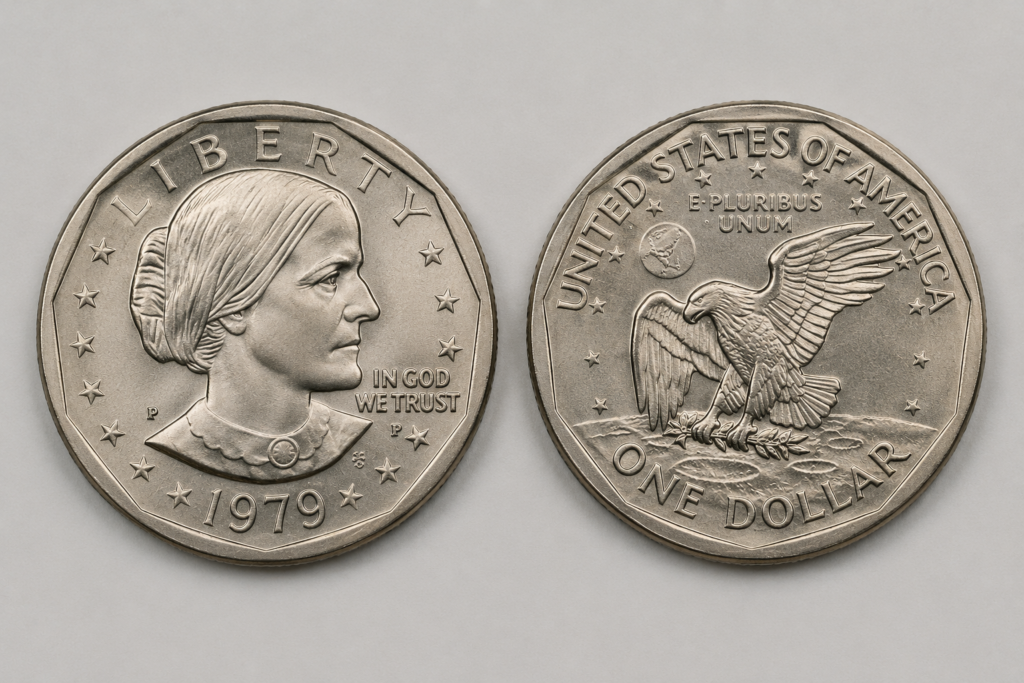
The Susan B. Anthony dollar — the “SBA” — was struck for circulation in 1979, 1980, and 1981, then resurrected for a single year in 1999 to fill a one-year supply gap before the Sacagawea dollar launched in 2000. No SBA contains silver; every coin in the series is copper-nickel clad, the same composition as a Washington quarter. Most circulated SBAs are worth their $1 face value.
Three narrow exceptions drive collector premium above face: the 1979-P Wide Rim variety, the 1979-S and 1981-S Type 2 proofs, and high-grade Mint State business strikes.
What is a Susan B. Anthony dollar worth today?
Most Susan B. Anthony dollars are worth their $1 face value. The series contains no silver — every coin from 1979, 1980, 1981, and 1999 is copper-nickel clad, identical composition to a Washington quarter. The vast majority of SBAs that surface in change jars, estates, and inherited piles are common business-strike coins from the 1979 and 1980 production runs, and they trade at face. The SBA series has no metal-content floor under it.
Three categories carry collector’s premium above face. The 1979-P Wide Rim variety (also called “Near Date”) trades in the mid double digits even in circulated grade and into the four figures at MS-67 and above. The 1979-S and 1981-S Type 2 proofs, distinguished by a clearer, more open S mintmark than the standard Type 1, trade in the mid to high three figures at PR-69 DCAM — the 1981-S Type 2 is the scarcer of the two.
Mint State business strikes graded MS-66 and above carry a premium across most dates because the SBA struck poorly and high-grade survivors are scarce. The year-by-year chart below works through the ranges; the sections that follow cover the identification points and the Wide Rim diagnostic.
Reading a Susan B. Anthony dollar — date, mintmark, and the eleven-sided border
The obverse shows Susan B. Anthony’s right-facing bust, the inscription LIBERTY arcing above, the date below the bust, IN GOD WE TRUST to the left, and the mintmark above and to the right of Anthony’s shoulder. The eleven-sided inner border on both the obverse and reverse is the SBA’s most distinctive design feature.
The outer rim is round, but the inside of the rim is hendecagonal — eleven flat sides — which gives the coin’s silhouette inside the rim a faceted polygon shape rather than a circle. A mintmark is the small letter that identifies the mint that struck the coin; clad describes a coin made from bonded layers of different metals.
No mintmark means Philadelphia. D means Denver. S means San Francisco — both proof and business-strike issues exist at San Francisco in 1979 through 1981, but the 1999 reissue did not include S-mint production. The reverse repeats Frank Gasparro’s Apollo 11 design from the Eisenhower dollar (eagle landing on the moon clutching an olive branch, Earth above), framed by the same eleven-sided inner border. The SBA is the only U.S. dollar coin to share its reverse design with another denomination’s predecessor; the Eisenhower dollar value guide carries the full design history.
Specifications: diameter 26.5 millimeters. Weight 8.1 grams. Edge reeded. Composition is outer layers of 75% copper / 25% nickel bonded to a pure copper core — identical composition to a Washington quarter and to the clad Eisenhower business strikes. The U.S. Mint never struck a silver Susan B. Anthony dollar in any composition — no 90% silver, no 40% silver, no silver-clad version exists. Coins offered as “silver Susan B. Anthony dollars” are either plated novelties or misidentified clad coins.
Why the SBA was confused with a quarter — and why it failed
The Susan B. Anthony dollar was introduced in 1979 to replace the unwieldy Eisenhower dollar with a smaller, more practical coin. The design split the difference between a Washington quarter and an Ike: 26.5-millimeter diameter (the quarter is 24.3 millimeters), 8.1 grams (the quarter is 5.67 grams), reeded edge, copper-nickel clad composition.
The result looked and felt close enough to a Washington quarter in pocket change that cashiers and consumers regularly confused the two, and the coin was rejected by circulation within months of release.
The eleven-sided inner border was added specifically to differentiate the SBA from a quarter at a glance, but the border sits inside the rim, not visible at the coin’s outer edge, so it did not solve the problem. Mint production ran heavily in 1979, scaled back in 1980, and effectively halted for circulation in 1981 with most of that year’s production going to collector sets. Treasury vaults held hundreds of millions of unissued SBAs for nearly two decades.
When the vault stockpiles ran low in 1999 — the SBA was still needed for vending-machine and transit applications that used the dollar-coin slot — the U.S. Mint struck a one-year reissue at Philadelphia and Denver to bridge the gap before the Sacagawea launched in 2000.
The 1999 production is small relative to the 1979 and 1980 runs but large enough that 1999 SBAs are common at face value today. This context is why a holder asking “is my 1979 dollar coin rare?” is almost always disappointed.
The 1979-P Wide Rim variety (Near Date)
Early Philadelphia 1979 SBAs were struck with a Wide Rim — the rim is visibly thicker and the date sits closer to the inner border than on the standard Narrow Rim coins struck later in the year. The Wide Rim variety is sometimes called the “Near Date” 1979 because the position of the date relative to the inner border is the diagnostic detail. The Narrow Rim, sometimes called the “Far Date,” is the common version and represents the vast majority of 1979-P production.
Wide Rim 1979-P SBAs trade in the mid double digits in circulated grades, the low to mid three figures at MS-63 and MS-65, and into the four figures at MS-67 and above. The Narrow Rim trades at face in circulated grade and at a modest premium only in MS-67 and higher.
The diagnostic is straightforward visually but requires a careful look: on a Wide Rim coin, the bottom of the 9 in 1979 sits within a coin-thickness or so of the inner border; on a Narrow Rim coin, the gap is roughly twice as wide, and the date sits well away from the border. Side-by-side photographic reference is the standard authentication tool, and PCGS and NGC both attribute the variety on slabbed examples.
The Wide Rim is the only widely recognized circulation-strike variety in the SBA series. The Type 1 / Type 2 distinction discussed in the next sections applies to S-mint proof coins only, not to Philadelphia or Denver business strikes. No Wide Rim variety exists on the 1979-D, 1979-S, 1980, 1981, or 1999 issues.
Susan B. Anthony dollar value chart by year and mintmark
The chart below covers every SBA date and mintmark: 1979, 1980, 1981, and 1999. Each year breaks into mintmark sub-rows (Philadelphia, Denver, San Francisco, where applicable), with the 1979-P broken into Wide Rim and Narrow Rim sub-rows and the 1979-S and 1981-S proof rows broken into Type 1 and Type 2 sub-rows.
Ranges are illustrative retail values at five tiers — XF-40, MS-63, MS-65, MS-66, MS-67 for business strikes; PR-65, PR-67 DCAM, PR-69 DCAM for proofs — pulled from PCGS Price Guide and NGC Coin Explorer at the time of writing. “Face” in the XF column means the coin trades at $1 face value in that grade.
Last updated: June 2026. Cross-checked against PCGS Price Guide and NGC Coin Explorer at publication.
| Year / Mintmark / Variety | XF-40 (or PR-65) | MS-63 | MS-65 | MS-66 (or PR-67 DCAM) | MS-67 (or PR-69 DCAM) |
| 1979 (P) Wide Rim (Near Date) | $30 | $150 | $250 | $400 | $1,500 |
| 1979 (P) Narrow Rim (Far Date) | Face | $3 | $8 | $25 | $200 |
| 1979-D | Face | $3 | $8 | $20 | $150 |
| 1979-S — clad business strike | Face | $3 | $8 | $25 | $200 |
| 1979-S — Type 1 proof | PR-65: $4 | — | — | PR-67 DCAM: $15 | PR-69 DCAM: $40 |
| 1979-S — Type 2 proof | PR-65: $60 | — | — | PR-67 DCAM: $150 | PR-69 DCAM: $350 |
| 1980 (P) | Face | $3 | $8 | $20 | $150 |
| 1980-D | Face | $3 | $8 | $20 | $125 |
| 1980-S — clad business strike | Face | $3 | $8 | $20 | $125 |
| 1980-S — proof | PR-65: $5 | — | — | PR-67 DCAM: $15 | PR-69 DCAM: $35 |
| 1981 (P) | $2 | $3 | $10 | $30 | $200 |
| 1981-D | $2 | $3 | $10 | $30 | $175 |
| 1981-S — clad business strike | $2 | $3 | $10 | $25 | $150 |
| 1981-S — Type 1 proof | PR-65: $5 | — | — | PR-67 DCAM: $20 | PR-69 DCAM: $60 |
| 1981-S — Type 2 proof | PR-65: $200 | — | — | PR-67 DCAM: $300 | PR-69 DCAM: $700 |
| 1999-P | Face | $4 | $10 | $20 | $80 |
| 1999-D | Face | $4 | $10 | $20 | $80 |
| 1999-P — proof | PR-65: $25 | — | — | PR-67 DCAM: $30 | PR-69 DCAM: $50 |
Key dates, varieties, and the premium layer above face
The SBA variety market is small but well-defined. Wide Rim attribution is straightforward visually but raw eBay listings still misattribute Narrow Rim coins as Wide Rim regularly. Type 1 / Type 2 proof attribution requires close examination of the S mintmark shape.
Any coin you suspect of being a Wide Rim, a Type 2 proof, or an MS-66+ business strike should be professionally authenticated by PCGS or NGC before sale. Raw varieties routinely sell at half the slabbed price because buyers price in attribution risk.
The list below covers the keys, varieties, and high-grade business strikes in the order they matter.
1979-P Wide Rim (Near Date)
The headline variety of the series. Thick rim, date sits close to the inner border. Trades in the mid double digits in circulated grade, low to mid three figures at MS-63 and MS-65, and into the four figures at MS-67 and above. The only widely-recognized business-strike variety in the SBA series.
1979-S Type 2 proof
The 1979-S proof exists in two distinct mintmark styles. Type 1 (filled, blob-like S struck early in the year) is the common version. Type 2 (clearer, more open and rounded S struck later) is the scarce variety. Type 2 trades in the mid three figures at PR-69 DCAM compared to under $50 for Type 1 at the same grade.
1981-S Type 2 proof
Same pattern as the 1979-S. The 1981-S Type 2 has a clearer, more open S mintmark than the Type 1. The 1981-S Type 2 is the scarcer of the two S-mint Type 2 proofs and trades in the high three figures at PR-69 DCAM. The diagnostic is subtle and requires PCGS or NGC attribution on any suspected example.
Mint State business strikes MS-66 and above
The SBA struck poorly across all three mints — bag marks, weak strikes, and luster issues are common on circulation-strike coins. MS-66 examples on common dates trade in the low double digits, MS-67 examples in the high double digits to low three figures, and the rare MS-68 examples reach the mid three figures.
1999-P and 1999-D business strikes
The one-year reissue carries a small “finally made it back to circulation” premium at high Mint State, but circulated 1999 SBAs are common at face value. MS-67 1999-P or 1999-D examples trade in the low to mid double digits. There is no 1999-S — the reissue did not include San Francisco production.
Frequently asked questions
Are Susan B. Anthony dollars silver?
No Susan B. Anthony dollar contains silver. The entire series is copper-nickel clad — outer layers of 75% copper and 25% nickel bonded to a pure copper core, the same composition as a Washington quarter. The U.S. Mint never struck a silver SBA in any composition.
How much is a 1979 Susan B. Anthony dollar worth?
A common-date 1979 Philadelphia, Denver, or San Francisco SBA is worth its $1 face value in circulated grade. The 1979-P Wide Rim (Near Date) variety is the meaningful exception — Wide Rim coins trade in the mid double digits in circulated grade and into the four figures at MS-67 and above. The 1979-S Type 2 proof also carries premium at high proof grades.
What is the 1979-P Wide Rim Susan B. Anthony dollar?
The 1979-P Wide Rim is an early-1979 Philadelphia variety on which the rim is visibly thicker and the date sits close to the inner border. It’s sometimes called the “Near Date” because of the date’s position. The Narrow Rim (“Far Date”) variety, struck later in the year, is the common version. Wide Rim coins trade well above face; Narrow Rim coins trade at face in circulated grade.
Why was the Susan B. Anthony dollar discontinued?
The SBA was discontinued for circulation after 1981 because the public regularly confused it with a Washington quarter. The size, weight, edge, and color were too close to the quarter, and the eleven-sided inner border — added to differentiate the two — sits inside the rim and is not visible at the coin’s outer edge. Treasury vaults held hundreds of millions of unissued SBAs for nearly two decades after production halted.
Why was there a 1999 Susan B. Anthony dollar?
The 1999 SBA was a one-year reissue struck to fill a supply gap before the Sacagawea dollar launched in 2000. The dollar coin was still needed for vending-machine and transit applications, and the Treasury vault stockpiles had run low. The U.S. Mint struck 1999 SBAs only at Philadelphia and Denver — there is no 1999-S — and the series ended after that single year.
What is the difference between a Type 1 and Type 2 proof?
Type 1 and Type 2 refer to two distinct S mintmark styles on the 1979-S and 1981-S proof coins. Type 1 has a filled, blob-like S; Type 2 has a clearer, more open and rounded S. Type 2 was struck later in each year and is the scarcer of the two. The 1981-S Type 2 is the most valuable of the SBA proof varieties, trading in the high three figures at PR-69 DCAM.
Are Susan B. Anthony dollars worth anything?
Most Susan B. Anthony dollars are worth their $1 face value. Three categories carry collector premium above face: the 1979-P Wide Rim variety, the 1979-S and 1981-S Type 2 proofs, and Mint State business strikes graded MS-66 and above. Outside those three categories, an SBA is a one-dollar coin — common, intact, and useful in vending machines but not numismatically scarce.
This article is for informational and educational purposes only and does not constitute investment, sale, or numismatic advice. Value ranges in the chart are illustrative; cross-check against PCGS Price Guide and NGC Coin Explorer before any sale. Any suspected 1979-P Wide Rim, 1979-S or 1981-S Type 2 proof, or MS-66+ business strike should be professionally authenticated by PCGS or NGC.
