
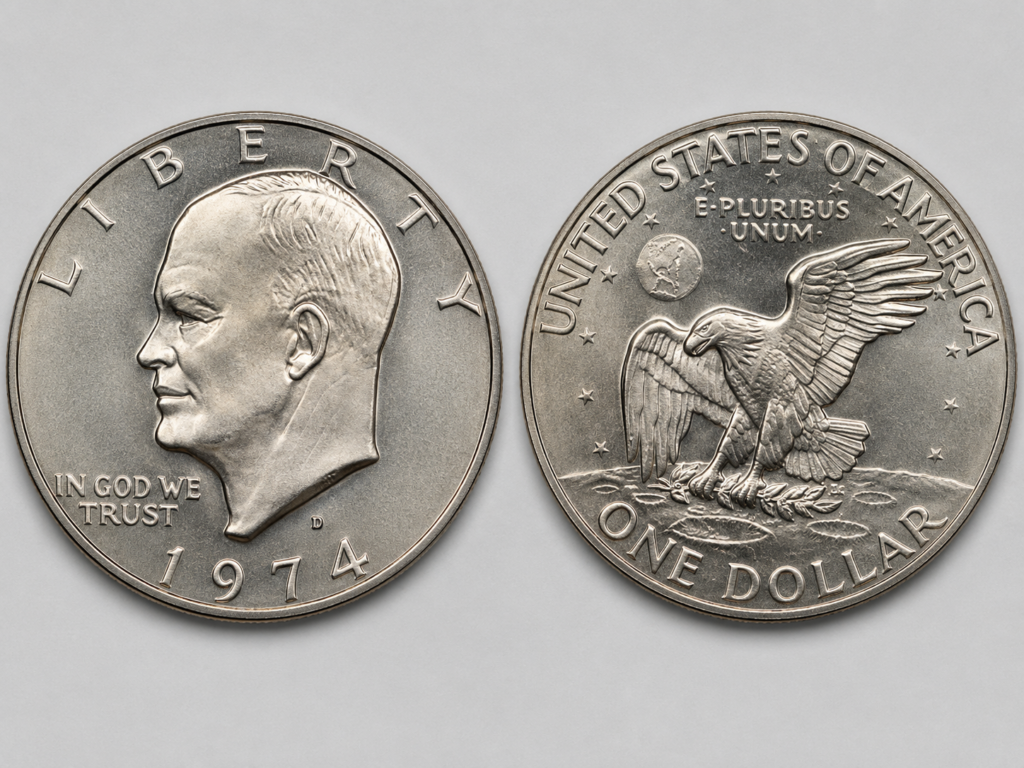
The Eisenhower dollar — the “Ike” — ran for eight calendar years, from 1971 to 1978, but only seven dates appear on the coins. No Ike was dated 1975; the Bicentennial coin dated 1776–1976 was struck across both calendar years. Most Eisenhower dollars are copper-nickel clad and worth their $1 face value.
The San Francisco 40% silver versions struck 1971 through 1974, plus the 1976-S silver Bicentennial proof and uncirculated, each hold 0.3161 troy oz of silver. This guide hands you the year-by-year chart, the silver-versus-clad check, and the variety calls that drive premium above face.
What is an Eisenhower dollar worth today?
Most circulated Philadelphia and Denver Ikes are copper-nickel clad and worth their $1 face value. The San Francisco 40% silver pieces — the Brown Ike proof and Blue Ike uncirculated from 1971 through 1974, plus the 1976-S silver Bicentennial proof and uncirculated — each hold 0.3161 troy oz of silver and trade at the silver floor, which runs in the high single digits to low double digits per coin at typical silver levels. Sealed original packaging adds a modest premium over the silver content.
Above those two floors, four things drive the collector premium. The 1972 Philadelphia Type 2 reverse trades in the low three figures even in circulated grade and climbs sharply at Mint State. The 1976 Bicentennial Type 1 reverse carries a modest premium across grades and a meaningful premium at high Mint State.
Cameo and Deep Cameo silver proofs trade well above the silver floor at the top proof tiers. MS-66 and higher business strikes are scarce on every date and reach the low to mid three figures because the Eisenhower struck poorly across all three mints. The year-by-year chart below works through the ranges; the sections that follow explain what a coin in your hand actually is.
Reading an Eisenhower dollar — date, mintmark, reverse design
The obverse shows Dwight D. Eisenhower’s left-facing bust, the inscription IN GOD WE TRUST to the left of the portrait, LIBERTY arcing across the top, the date below the bust, and the mintmark on the truncation of the neck just above the date. No mintmark means Philadelphia. D means Denver. S means San Francisco — proof issues in every year, plus the 40% silver business-strike-style uncirculateds in 1971 through 1974 and 1976.
The reverse comes in two distinct designs over the run. The Apollo 11 reverse — Frank Gasparro’s adaptation of the Apollo 11 mission insignia, showing an eagle landing on the moon clutching an olive branch with Earth above the eagle’s head — appears on every Ike except the Bicentennial.
The Bicentennial reverse, designed by Dennis R. Williams, shows the Liberty Bell superimposed on the moon, with the dual date 1776–1976 on the obverse instead of a single year. Bicentennial Ikes were struck across the 1975 and 1976 calendar years; no Eisenhower dollar carries a single 1975 date. That gap is the structural confusion behind most of the heirloom-holder questions.
Specifications: diameter 38.1 millimeters. Weight 22.68 grams for the clad business strikes; 24.59 grams for the 40% silver versions. Edge reeded. Composition for clad is outer layers of 75% copper / 25% nickel bonded to a pure copper core. Composition for 40% silver clad is outer layers of 80% silver / 20% copper bonded to a core of roughly 21% silver / 79% copper, yielding a net 40% silver content (0.3161 troy oz ASW). A mintmark is the small letter that identifies the mint that struck the coin; clad describes a coin made from bonded layers of different metals.
Silver Ike or clad Ike? The identification check
Two checks confirm what’s in your hand. First, the mintmark and the year. No mintmark or D means clad, full stop — Philadelphia and Denver produced no silver Ikes in any year. An S-mint Ike can be silver but isn’t always: the San Francisco production included clad proofs in every year, 40% silver Brown Ikes and Blue Ikes in 1971 through 1974, and 40% silver Bicentennial proofs and uncirculateds in 1976. Mintmark alone does not confirm silver on an S-mint coin.
Second, the weight or the edge. A 40% silver Ike weighs 24.59 grams; a clad Ike weighs 22.68 grams. A kitchen scale that reads to 0.1 grams is enough to tell them apart. The edge tells the same story visually. A clad Ike shows a brown copper stripe sandwiched between two nickel-colored layers on the reeded edge.
A 40% silver Ike shows a uniform silver-colored band with no copper stripe visible. Original packaging — the brown plastic box for Brown Ikes, the blue Mylar envelope for Blue Ikes, the matching brown and blue cases for the 1976 silver Bicentennial — confirms a silver Ike when present.
For the 1971 question specifically, our 1971 silver dollar value guide carries the full Brown Ike vs. Blue Ike walkthrough, original-issue pricing, and the 1971-S clad-proof vs. silver-proof distinction. That detail repeats across the 1972, 1973, and 1974 S-mint silver issues with different mintages but the same identification pattern.
The Bicentennial Eisenhower dollar (1776–1976)
The Bicentennial Ike was struck across the 1975 and 1976 calendar years to mark the 200th anniversary of the Declaration of Independence. Production ran in all three mints and in three compositions: clad business strikes from Philadelphia and Denver for circulation, clad and 40% silver proofs from San Francisco for collectors, and 40% silver uncirculateds from San Francisco for collectors.
Every Bicentennial Ike carries the dual date 1776–1976 on the obverse and the Liberty Bell on the moon reverse. No Eisenhower dollar of any kind carries a single 1975 date — the Mint shifted entirely to Bicentennial production for both years.
Circulated clad Bicentennial Ikes from Philadelphia and Denver are worth their $1 face value. The 1976-S 40% silver proof and the 40% silver uncirculated each hold 0.3161 troy oz of silver and trade at the silver floor plus a small premium; sealed-set examples carry slightly more.
Above the two floors, the 1976 Bicentennial Type 1 reverse — a thicker, slightly less sharp lettering style on the lunar-surface inscription and the Liberty Bell detail — is the harder of the two reverses to find and carries premium across grades. Type 2 is the common one. The key-date section below covers the Type 1 / Type 2 diagnostics in detail.
Eisenhower dollar value chart by year, mintmark, and composition
The chart below covers every Eisenhower dollar date and composition: 1971, 1972, 1973, 1974, 1776–1976 Bicentennial, 1977, and 1978. Each year breaks into mintmark sub-rows (Philadelphia, Denver, San Francisco) and the San Francisco rows split further by composition where multiple existed (clad proof, 40% silver proof, 40% silver uncirculated).
The 1972 Philadelphia row breaks into Type 1 / Type 2 / Type 3 reverse sub-rows; the Bicentennial row breaks into Type 1 / Type 2 sub-rows on the Philadelphia, Denver, and S-mint issues.
Ranges are illustrative retail values at five tiers — XF-40, MS-63, MS-65, MS-66, MS-67 for business strikes; PR-65, PR-67 DCAM, PR-69 DCAM for proofs — pulled from PCGS Price Guide and NGC Coin Explorer at the time of writing. “Face” in the XF column means the coin trades at $1 face value in that grade. Re-quote a live source for current pricing before any sale.
Last updated: June 2026. Cross-checked against PCGS Price Guide and NGC Coin Explorer at publication.
| Year / Mintmark / Composition | XF-40 (or PR-65) | MS-63 | MS-65 | MS-66 (or PR-67 DCAM) | MS-67 (or PR-69 DCAM) |
| 1971 (P) — clad | Face | $5 | $25 | $120 | $1,000 |
| 1971-D — clad | Face | $5 | $20 | $60 | $400 |
| 1971-S — clad proof | PR-65: $8 | — | — | PR-67 DCAM: $35 | PR-69 DCAM: $200 |
| 1971-S — 40% silver proof (Brown Ike) | PR-65: $15 | — | — | PR-67 DCAM: $30 | PR-69 DCAM: $120 |
| 1971-S — 40% silver unc. (Blue Ike) | MS-63: $12 | $12 | $20 | $50 | $200 |
| 1972 (P) Type 1 — clad | Face | $5 | $15 | $45 | $300 |
| 1972 (P) Type 2 — clad | $150 | $200 | $300 | $650 | $2,500 |
| 1972 (P) Type 3 — clad | Face | $5 | $20 | $70 | $500 |
| 1972-D — clad | Face | $5 | $15 | $50 | $350 |
| 1972-S — clad proof | PR-65: $8 | — | — | PR-67 DCAM: $30 | PR-69 DCAM: $150 |
| 1972-S — 40% silver proof (Brown Ike) | PR-65: $15 | — | — | PR-67 DCAM: $25 | PR-69 DCAM: $100 |
| 1972-S — 40% silver unc. (Blue Ike) | MS-63: $12 | $12 | $18 | $45 | $175 |
| 1973 (P) — clad (Mint Set only) | $8 | $15 | $25 | $60 | $500 |
| 1973-D — clad (Mint Set only) | $8 | $15 | $25 | $55 | $400 |
| 1973-S — clad proof | PR-65: $12 | — | — | PR-67 DCAM: $40 | PR-69 DCAM: $250 |
| 1973-S — 40% silver proof (Brown Ike) | PR-65: $20 | — | — | PR-67 DCAM: $35 | PR-69 DCAM: $150 |
| 1973-S — 40% silver unc. (Blue Ike) | MS-63: $25 | $25 | $45 | $100 | $400 |
| 1974 (P) — clad | Face | $5 | $15 | $50 | $350 |
| 1974-D — clad | Face | $5 | $15 | $45 | $300 |
| 1974-S — clad proof | PR-65: $8 | — | — | PR-67 DCAM: $25 | PR-69 DCAM: $125 |
| 1974-S — 40% silver proof (Brown Ike) | PR-65: $15 | — | — | PR-67 DCAM: $25 | PR-69 DCAM: $90 |
| 1974-S — 40% silver unc. (Blue Ike) | MS-63: $12 | $12 | $20 | $45 | $150 |
| 1776–1976 (P) Type 1 — clad | $2 | $8 | $30 | $120 | $600 |
| 1776–1976 (P) Type 2 — clad | Face | $3 | $10 | $40 | $300 |
| 1776–1976-D Type 1 — clad | $2 | $8 | $25 | $90 | $500 |
| 1776–1976-D Type 2 — clad | Face | $3 | $10 | $35 | $250 |
| 1776–1976-S Type 1 — clad proof | PR-65: $10 | — | — | PR-67 DCAM: $25 | PR-69 DCAM: $100 |
| 1776–1976-S Type 2 — clad proof | PR-65: $8 | — | — | PR-67 DCAM: $20 | PR-69 DCAM: $80 |
| 1776–1976-S — 40% silver proof | PR-65: $18 | — | — | PR-67 DCAM: $30 | PR-69 DCAM: $90 |
| 1776–1976-S — 40% silver unc. | MS-63: $15 | $15 | $25 | $55 | $200 |
| 1977 (P) — clad | Face | $5 | $15 | $50 | $300 |
| 1977-D — clad | Face | $5 | $15 | $45 | $275 |
| 1977-S — clad proof | PR-65: $8 | — | — | PR-67 DCAM: $20 | PR-69 DCAM: $80 |
| 1978 (P) — clad | Face | $5 | $15 | $50 | $325 |
| 1978-D — clad | Face | $5 | $15 | $45 | $275 |
| 1978-S — clad proof | PR-65: $8 | — | — | PR-67 DCAM: $20 | PR-69 DCAM: $80 |
Denver struck every production year and produced no headline rarities, but Denver business strikes at MS-66 and above carry real premium across the series because the strike was soft. San Francisco struck proofs every year, the 1971-S through 1974-S Brown and Blue Ikes, the 1976-S Bicentennial silver proof and uncirculated, and the 1973-S clad proof that paired with the only 1973 business-strike Ikes.
Key dates, varieties, and the premium layer above the floor
The Eisenhower dollar variety market rewards careful attribution. The 1972 Type 2 reverse requires loupe work on the position of the Caribbean islands on Earth above the eagle’s right wing. The 1976 Bicentennial Type 1 reverse requires close work on the lunar-surface lettering and the Liberty Bell detail. Counterfeit 1972 Type 2 attributions on standard 1972 Type 1 coins show up regularly in raw eBay listings, and 1976 Bicentennial Type 1 / Type 2 misattribution is common at the marketplace level.
Any coin you suspect of being a Type 2 (1972), a Bicentennial Type 1, an MS-66+ business strike, or a Cameo / Deep Cameo proof should be professionally authenticated by PCGS or NGC before sale. Raw varieties routinely sell at half the slabbed price because buyers price in attribution risk.
The list below covers the keys, the varieties, the silver-issue patterns, and the high-grade business strikes in the order they matter.
1972 Philadelphia Type 2 reverse
The headline variety of the series. Three reverse hubs were used on Philadelphia 1972 Ikes — Type 1 (the standard low-relief Earth), Type 2 (a sharper, modified Earth where the Caribbean islands sit in different positions and Earth is in higher relief), and Type 3 (a reverted standard reverse used late in the year). Type 2 is the scarce one and trades in the low three figures even in circulated grade, climbing into the four figures at MS-65 and above.
1976 Bicentennial Type 1 reverse
The harder of the two Bicentennial reverses to find. Type 1 shows thicker, slightly less sharp lettering on the lunar-surface inscription and on the Liberty Bell detail; Type 2 shows sharper, thinner lettering. Type 1 carries a modest premium across circulated grades and meaningful premium at MS-66 and above. Both reverses appear on Philadelphia, Denver, and San Francisco issues — clad and silver.
1973 Philadelphia and 1973 Denver business strikes
Neither was released into general circulation. Both mints struck them, but the entire production was packaged and sold to collectors as part of the 1973 U.S. Mint Set. Surviving examples trade in the low to mid double digits at MS-63 and reach the low three figures at MS-66 and above. A worn 1973-P or 1973-D Ike is almost certainly a coin that traveled from a broken-up Mint Set.
Brown Ike (1971-S through 1974-S, 40% silver proof)
Mirror-finish fields, frosted devices, 40% silver clad composition, sold in a brown plastic display box. Each carries 0.3161 troy oz of silver. Cameo and Deep Cameo strike quality drives the meaningful premium above the silver floor at PR-67 DCAM and PR-69 DCAM tiers. The 1973-S Brown Ike is the scarcest of the four because the 1973 silver-proof production was the smallest.
Blue Ike (1971-S through 1974-S, 40% silver uncirculated)
Satin-finish business-strike style, 40% silver clad composition, sold in a blue Mylar envelope. Same per-year pattern as the Brown Ike. The 1973-S Blue Ike is the scarcest of the four and the standout example of the series — MS-67 examples reach the mid three figures.
1976-S 40% silver Bicentennial (proof and uncirculated)
The 1976-S silver Bicentennial proof shipped in a three-coin silver Bicentennial proof set, alongside the silver Bicentennial Kennedy half and the silver Bicentennial Washington quarter. The silver Bicentennial uncirculated shipped in the matching three-coin set. Both hold 0.3161 troy oz of silver and trade at the silver floor plus a moderate sealed-set premium.
Cameo and Deep Cameo proofs, any S-mint year
Strong contrast between mirror fields and frosted devices commands premium above the standard proof tier. PR-69 DCAM examples of the silver Ikes trade meaningfully above the silver floor; PR-69 DCAM clad proofs trade well above the standard PR-67 tier.
Mint State business strikes MS-66 and above
The Eisenhower struck poorly across all three mints — die wear, soft strikes, and bag marks on the large planchets produced few full-luster MS-66+ examples on any date. Across the series, MS-66 examples trade in the low three figures, MS-67 examples in the mid to high three figures, and the rare MS-68 examples reach the four figures.
Frequently asked questions
How much is an Eisenhower dollar worth today?
Most circulated Philadelphia and Denver Eisenhower dollars are clad and worth their $1 face value; the S-mint 40% silver Ikes trade at the silver floor of 0.3161 troy oz × live silver spot plus a small original-packaging premium. The 1972 Philadelphia Type 2, the 1976 Bicentennial Type 1, Cameo and Deep Cameo proofs, and MS-66 and higher business strikes carry collector premium well above the floor.
Are Eisenhower dollars silver?
Only the San Francisco 40% silver versions are silver — the Brown Ike (proof) and Blue Ike (uncirculated) struck 1971 through 1974, and the 1976-S silver Bicentennial proof and uncirculated. Each holds 0.3161 troy oz in a 40% silver clad composition. Philadelphia and Denver Ikes are copper-nickel clad and contain no silver. S-mint clad proofs also contain no silver; weight and edge confirm silver versus clad on any S-mint coin.
Why is there no 1975 Eisenhower dollar?
The Mint struck no Eisenhower dollars dated 1975 because the entire 1975 calendar-year production was diverted to the Bicentennial coin, which carries the dual date 1776–1976. Bicentennial Ikes were struck across both the 1975 and 1976 calendar years. A coin offered as a “1975 Eisenhower dollar” is either a Bicentennial (dated 1776–1976) or an altered date.
What is the 1972 Type 2 Eisenhower dollar?
The 1972 Type 2 is a Philadelphia reverse variety where Earth above the eagle’s right wing was struck with a sharper, higher-relief hub on which the Caribbean islands sit in different positions than on the standard Type 1. The variety is scarce and trades in the low three figures even in circulated grade, climbing into the four figures at MS-65 and above. Attribution requires PCGS or NGC authentication because raw misattribution is common.
How can I tell a Bicentennial Type 1 from a Type 2?
Type 1 shows thicker, slightly less sharp lettering on the lunar-surface inscription and on the Liberty Bell detail; Type 2 shows sharper, thinner lettering on the same elements. Type 1 is the harder of the two reverses to find and carries premium across grades. Both reverses appear on Philadelphia, Denver, and San Francisco issues in both clad and 40% silver compositions; PCGS and NGC photographic plates are the standard reference for confirming the attribution.
How much silver is in a Brown Ike or Blue Ike?
Each Brown Ike and Blue Ike contains 0.3161 troy oz of silver in a 40% silver clad composition that weighs 24.59 grams. The pattern is identical across the 1971-S, 1972-S, 1973-S, and 1974-S issues, and across the 1976-S silver Bicentennial proof and uncirculated.
What is a 1973 Eisenhower dollar worth?
A circulated 1973 Philadelphia or 1973 Denver Eisenhower dollar trades in the low to mid double digits because neither was released into general circulation — both were sold only as part of the 1973 U.S. Mint Set. Surviving examples climb to the low three figures at MS-66 and above. The 1973-S Brown Ike and Blue Ike are the scarcest of the silver-issue years and the standout silver Ikes of the series.
This article is for informational and educational purposes only and does not constitute investment, sale, or numismatic advice. Value ranges in the chart are illustrative; cross-check against PCGS Price Guide and NGC Coin Explorer before any sale. Any suspected 1972 Type 2, 1976 Bicentennial Type 1, MS-66+ business strike, or Cameo / Deep Cameo proof should be professionally authenticated by PCGS or NGC.
