
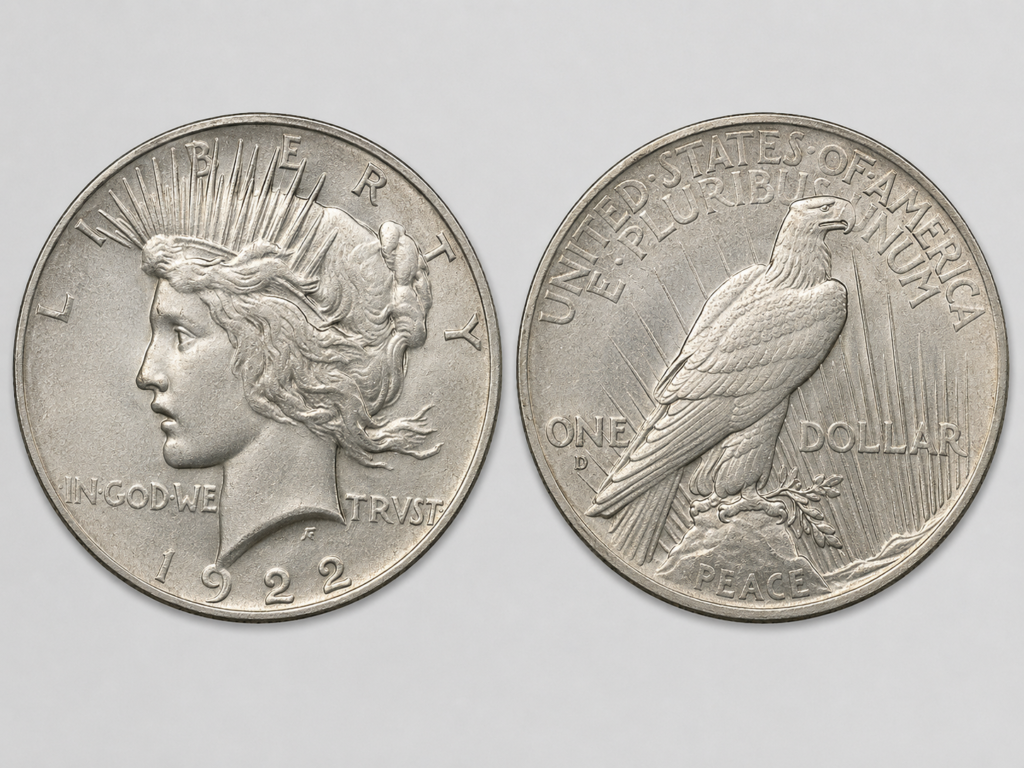
A 1922 silver dollar is a Peace dollar, the first year of the standard low-relief design that ran through 1935. Every Peace dollar is 90% silver and carries 0.7734 troy oz of silver per coin, so each one has a melt-value floor that moves with spot.
Most 1922 examples are common-date pieces worth a small premium over that floor; a handful of dates in the series command serious collector premiums, and one rare experimental 1922 strike trades in six figures.
This guide hands you the chart, reads the mintmark, and shows where the floor stops.
What is a 1922 silver dollar worth today?
A 1922 Peace silver dollar contains 0.7734 troy oz of silver, so its floor value moves continuously with the silver spot price — around $46 per coin at $60 silver. Common-date 1922-P examples (no mintmark — Philadelphia) in circulated condition typically trade at retail in roughly the $55–$70 range, modestly above that floor.
The 1922-D (Denver) and 1922-S (San Francisco) sit slightly higher in the same grades because their mintages were smaller. Uncirculated Mint State pieces trade higher again — MS-65 examples reach into the low three figures, MS-66 and finer reach the low four figures.
The 1922 high-relief experimental strike — covered later — is a six-figure rarity, but the chance any given 1922 is one of them is vanishingly small. For most, holding a 1922 dollar, the honest answer is a modest premium over the silver in the coin.
Is it a Peace dollar or a Morgan? Identifying a 1922 silver dollar
A 1922 silver dollar is always a Peace dollar — Morgan dollars were not struck after 1921, so the date settles the question on sight. The visual difference matters because many start by thinking the two are the same coin.
The Peace obverse shows Liberty wearing a radiant crown (sun-ray spikes); the Morgan obverse shows Liberty in a cotton-and-wheat headdress. The Peace reverse shows an eagle perched on a rock with PEACE below; the Morgan reverse shows a heraldic eagle holding arrows and an olive branch.
Anthony de Francisci designed the Peace dollar in 1921 to commemorate the end of World War I. The series ran 1921, 1922 through 1928, and 1934 through 1935. Specifications match the Morgan: 38.1 mm diameter, 26.73 g total weight, 90% silver, 0.7734 troy oz silver content, reeded edge. If your coin is a Morgan, the Morgan-specific value guide is the right starting point.
Reading the date and mintmark on a Peace dollar
The date sits on the obverse, below Liberty’s neck. The mintmark — the small letter indicating which US Mint facility produced the coin — sits on the reverse, lower left of the eagle, beneath the letters ONE. That is NOT the same spot as a Morgan, where the mintmark sits below the eagle’s tail feathers; looking in the wrong place is the most common identification mistake across these two series.
Three mintmarks appear on the Peace series: no mintmark (Philadelphia), D (Denver), and S (San Francisco). The 1921 issue is the high-relief first-year strike — the relief stands deeper off the surface and detail is crisper than on 1922-and-later coins. The 1922 high-relief experimental strike used those same 1921 dies on a 1922-dated planchet and is the rarity most casual searchers eventually run into.
1922 Peace dollar value chart by mintmark and grade
All three 1922 mintmarks are common-date coins; grade does most of the work in setting their value. The ranges below are illustrative and reflect PCGS Price Guide and NGC Coin Explorer figures at the time of writing — pricing moves, so use the live PCGS / NGC entries linked at the bottom of this section to confirm before any sale.
| Mintmark | G-4 | VF-20 | AU-50 | MS-63 | MS-65 |
| 1922 (no mintmark) | $50–$55 | $52–$58 | $58–$70 | $80–$110 | $200–$300 |
| 1922-D | $50–$55 | $52–$60 | $60–$75 | $90–$140 | $400–$600 |
| 1922-S | $50–$55 | $52–$60 | $60–$75 | $90–$150 | $1,200–$2,000 |
Last updated: June 2026. Cross-checked against PCGS Price Guide and NGC Coin Explorer at publish.
Philadelphia struck about 51.7 million 1922 dollars — the highest mintage of any Peace dollar. San Francisco struck roughly 17.5 million, Denver about 15.1 million. None is a key date, which is why grade carries the value spread more than mintmark.
The full Peace dollar series value chart (1921–1935)
For the broader long-tail Peace-series queries, the year-by-year chart below covers all production years from 1921 through 1935. Cells show representative retail value ranges; refer to PCGS or NGC for the current numbers before acting on any of them.
| Year & mint | VF-20 | MS-63 | MS-65 |
| 1921 (high relief) | $180–$240 | $500–$800 | $3,500–$6,000 |
| 1922 (P, D, S) | $52–$60 | $80–$140 | $200–$2,000 |
| 1923 (P, D, S) | $52–$60 | $80–$180 | $200–$1,600 |
| 1924 (P) | $52–$60 | $80–$110 | $200–$400 |
| 1924-S | $70–$100 | $300–$600 | $8,000–$14,000 |
| 1925 (P) | $52–$60 | $80–$110 | $170–$300 |
| 1925-S | $65–$90 | $200–$500 | $25,000–$45,000 |
| 1926 (P, D, S) | $55–$80 | $110–$200 | $400–$1,800 |
| 1927 (P, D, S) | $70–$100 | $140–$400 | $1,800–$6,000 |
| 1928 (P) | $450–$600 | $700–$1,100 | $5,500–$9,000 |
| 1928-S | $70–$100 | $300–$700 | $25,000–$45,000 |
| 1934 (P, D) | $55–$90 | $140–$400 | $700–$2,500 |
| 1934-S | $80–$140 | $3,500–$6,500 | $25,000–$45,000 |
| 1935 (P, S) | $55–$80 | $80–$300 | $500–$2,500 |
Last updated: June 2026. Cross-checked against PCGS Price Guide and NGC Coin Explorer at publication.
The 1964-D Peace dollar is missing from the chart deliberately. The US Mint struck roughly 316,000 of them in 1965 but ordered the entire run melted before release; possession of any surviving piece is contested under federal law, and no value figure should be quoted for one.
Key dates, semi-keys, and the 1922 high-relief rarity
The dates below are where Peace dollar values diverge sharply from common-date pricing. Any coin you suspect falls into one of these categories should be professionally authenticated by PCGS or NGC before sale — counterfeits and altered coins are common at this end of the market.
1921 high-relief
The first year of the series, struck in high relief only, mintage about 1.0 million. The condition-rarity is in Mint State: heavy-relief design wore quickly in circulation, so well-struck Mint State survivors are scarce. VF examples sit in the low three figures; MS-63 in the high three figures; MS-65 examples reach into solid four figures.
1922 high-relief (experimental)
A handful of 1922-dated coins were struck using the 1921 high-relief dies as part of a brief experiment before the low-relief design was finalized. PCGS and NGC have authenticated only a small population, and verified examples sell in the six figures when they appear. Any coin you believe might be one belongs in front of a professional grader before anything else.
1928 Philadelphia
Mintage 360,649 — the lowest of any regular Peace dollar issue. VF examples sit in the mid three figures, MS-63 in the high three to low four figures, MS-65 in the high four figures. A common Peace dollar holder occasionally has one of these; the Philadelphia 1928 is the most realistic key-date “find” in the series.
1934-S
The series key in Mint State. San Francisco struck about 1.0 million 1934-S Peace dollars, but Mint State survivors are very scarce because most circulated immediately. VF examples sit in the low three figures; MS-63 in the low four figures; MS-65 examples reach into the high four to low five figures.
1964-D (struck but never released)
The 1964-D is included here for the historical record. Approximately 316,000 were struck and all were ordered melted; no example was ever legally released to the public. Possession of any surviving piece is contested under federal law. No value figure applies — this is a status note, not a key date in the collecting sense.
How grade affects a Peace dollar’s value
Grade splits into three tiers. Circulated grades (G-4 through AU-58) show wear on Liberty’s hair and cheek and on the eagle’s feathers; value moves modestly across this tier. Mint State (MS-60 through MS-70) shows no wear, but strike quality, luster, and bag marks drive a steep spread within the tier. Strike is what Peace dollar collectors watch most closely — the series is famous for softly struck reverses on certain mints, so a sharp MS-63 can trade above a soft MS-64.
Grade alone drives a 10x swing on common dates and a 100x swing on key dates. Get professional grading for anything that looks Mint State or might be a key — raw and slabbed pricing diverge sharply once you cross MS-63.
Track your Peace dollars in Gold Silver Ledger
Peace dollar value resolves to date, mintmark, and grade per coin — three numbers a per-piece tracker handles in a way a spreadsheet does not. The catalog has the Peace dollar as a standard product with weight and fineness built in, so adding a coin pulls 0.7734 troy oz of silver against live spot and renders a current melt value on the line.
Record the year, mintmark, and a short condition note. For collector-grade examples — a 1928-P, a 1934-S, a graded 1922-S — log the premium you paid above the silver floor at purchase; the per-piece premium is locked on the row and carries through to cost basis at sale.
Frequently asked questions
How much is a 1922 silver dollar worth today?
A 1922 Peace silver dollar contains 0.7734 troy oz of silver and has a melt-value floor that moves with silver spot — around $46 per coin at $60 silver. Common-date circulated examples typically retail in the $55–$70 range, modestly above that floor. The 1922-D and 1922-S trade slightly higher in the same condition because of smaller mintages.
What is the difference between a 1922 silver dollar with no mintmark, a D, and an S?
The mintmark indicates which US Mint facility struck the coin — no mintmark means Philadelphia, D means Denver, S means San Francisco. All three are common-date Peace dollars; the Denver and San Francisco coins (~15.1 million and ~17.5 million) trade at a modest premium over Philadelphia (~51.7 million) at most grades and a larger premium in high Mint State.
How can I tell if my 1922 silver dollar is high relief?
A 1922 high-relief Peace dollar shows visibly deeper relief than the standard low-relief 1922 — Liberty’s crown rays stand sharply off the surface, detail is crisper, and the coin reads more sculptural than the common version. Authentic 1922 high-relief examples are extremely rare and were struck experimentally before the design was finalized; any coin you believe might be one belongs in front of a PCGS or NGC grader before sale.
How much silver is in a Peace dollar?
Every Peace dollar struck from 1921 through 1935 contains 0.7734 troy oz of pure silver. The coin weighs 26.73 grams total — 90% silver and 10% copper — with a 38.1 mm diameter. The silver content is identical to that of a Morgan silver dollar, since both series used the same Mint Act specifications for the dollar denomination.
What is the rarest Peace silver dollar?
The 1922 high-relief experimental strike is the rarest regularly traded Peace dollar, with only a small authenticated population and six-figure auction prices when one appears. Among regular-issue Peace dollars, the 1928 Philadelphia (lowest mintage at 360,649) and the 1934-S in Mint State (the series key in MS grades) are the most-watched key dates.
Should I clean a 1922 silver dollar before selling it?
No, cleaning a silver coin almost always reduces its value, often substantially. Even gentle wiping leaves microscopic hairlines that PCGS and NGC graders identify immediately, and the coin will either grade lower or be marked “cleaned” on the label. Leave the surface as you found it; an original worn coin is worth more than a polished one.
See your Peace dollars’ melt value live in Gold Silver Ledger
The silver floor under any Peace dollar moves with spot continuously; the collector premium above it is the per-coin number you paid at purchase. The ledger holds both — the Peace dollar sits in the catalog with weight and fineness built in, and current melt value renders against live silver.
This article is for informational and educational purposes only and does not constitute investment, sale, or numismatic advice. Value ranges above are illustrative; cross-check against PCGS Price Guide and NGC Coin Explorer before any sale. Any suspected key date or high-relief example should be professionally authenticated by PCGS or NGC.
