
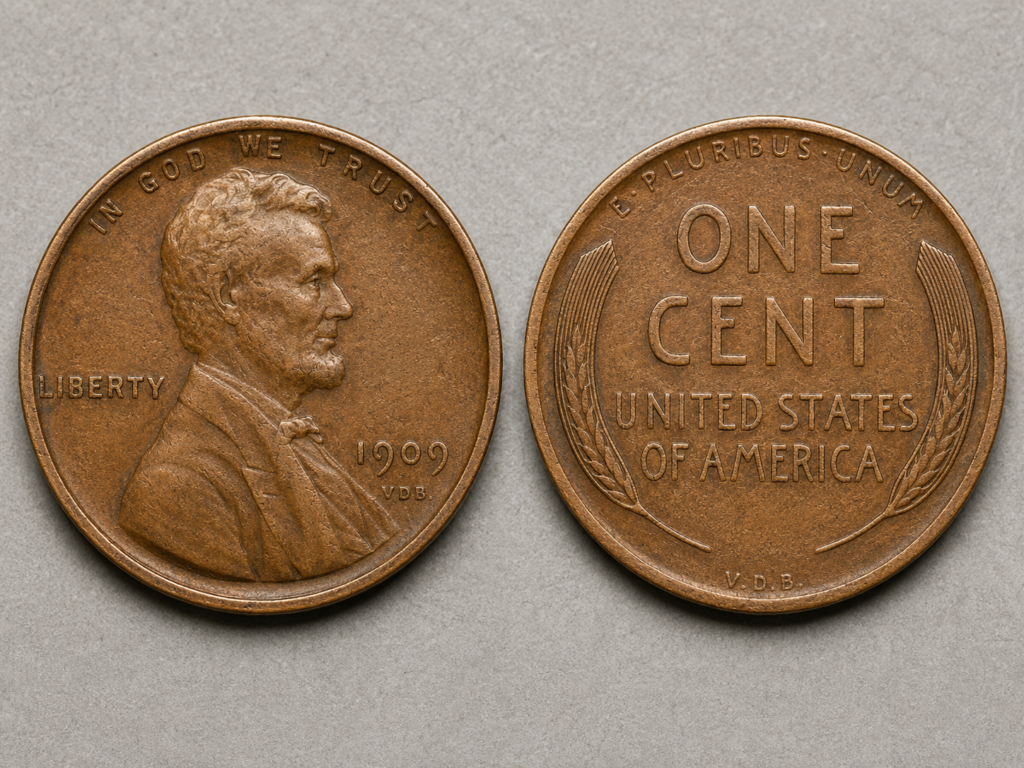
The Lincoln wheat cent ran from 1909 to 1958. Most circulated wheat pennies are worth 3 to 5 cents — collector value, not metal value, because melting U.S. cents is illegal. Key dates like the 1909-S VDB, 1914-D, 1922 No D, and the 1955 Doubled Die reach four and five figures. The chart, the identification steps, and the key-date list are all below.
The Quick Answer: What Is a Wheat Penny Worth?
A typical Lincoln wheat cent (1909–1958) in worn circulated condition trades for 3 to 5 cents — collector premium, not metal value. The bronze content does not set a floor because melting U.S. one-cent coins has been illegal since December 14, 2006, under 31 CFR §82.1.
Common-date wheats in Mint State Red reach $5 to $30. Key dates and major varieties — 1909-S VDB, 1914-D, 1922 No D, 1931-S, the 1943 bronze error, the 1944 steel error, and the 1955 Doubled Die — reach $500, $5,000, or six figures.
The value distribution across the series is bimodal. Roughly 95% of wheat pennies in circulation today are common-date pieces worth a few cents each. The remaining 5% are the small set of key dates and major varieties that command real money. The chart below covers every year and mintmark; the key-date section walks through the names worth recognizing on sight.
Is It a Wheat Penny? Identification Before Valuation
The most common mistake we see is a reader holding a Lincoln Memorial cent — minted 1959 through 2008 — and assuming it’s an old coin. The two reverses look superficially similar at a glance, but they’re distinct designs from different eras.
Wheat cent (1909–1958)
Designed by Victor David Brenner. Obverse: Abraham Lincoln’s right-facing portrait, with LIBERTY at left, IN GOD WE TRUST above, and the date and mintmark to the right of the bust. The Lincoln cent was the first U.S. circulating coin to depict a real person — struck for the centennial of Lincoln’s birth.
Reverse: two stylized wheat ears flanking ONE CENT and UNITED STATES OF AMERICA, with E PLURIBUS UNUM along the top. Diameter 19 mm, weight 3.11 g, bronze (95% copper, 5% tin and zinc) for most years.
Memorial cent (1959–2008)
Same Lincoln obverse, but the reverse shows the Lincoln Memorial building in Washington with Lincoln’s seated statue visible inside the columns. If your coin shows the Memorial building, it isn’t a wheat penny.
Union Shield cent (2010–present)
Same Lincoln obverse with a federal-shield reverse and a banner. Also not a wheat penny.
If you’re checking a wheat reverse for silver content: there is none. Lincoln cents have always been bronze, brass, or steel (in 1943) — never silver. For broader silver-coin identification across denominations, see our reference on what coins are silver.
Wartime exception (1943)
Almost every 1943 Lincoln cent is zinc-coated steel — the wartime composition adopted when copper was needed for ammunition. The steel cents look distinctly silvery and stick to a magnet. 1943 cents in bronze are real but vanishingly rare (a handful exist, struck on leftover 1942 planchets) and reach six and seven figures at auction.
The 1944 inverse — a steel planchet struck with a 1944 bronze die — is similarly rare and valuable. Both errors get a closer look in the key dates section. Historical context on the wartime composition change sits in the history of U.S. coinage.
How to Read the Date and Mintmark
Date and mintmark sit on the obverse, below Lincoln’s bust on the right side of the coin. A mintmark is a small letter indicating which U.S. Mint facility struck the coin.
Three mintmarks appear on wheat cents:
- No mintmark: Philadelphia.
- D: Denver.
- S: San Francisco.
Nothing else is legitimate. If you see no mintmark, the coin is from Philadelphia — almost always. The one major exception is the 1922 No D Strong Reverse, a famous die-error variety covered in the key-dates section: Denver was the only mint producing cents in 1922, and worn obverse dies struck a small number of coins with no visible D. Outside that one date, no mintmark means Philadelphia.
A worn or weak mintmark is not a No-D variety. The 1922 No D requires a strong reverse (the wheat ears and lettering on the reverse must be sharp) and a fully absent D — not a weak D, not a partial D. Misreading a worn 1922-D as a No D is the second-most-common error after the wheat-versus-Memorial mix-up.
The Wheat Penny Value Chart by Year and Mintmark
The chart below shows representative retail value ranges for every wheat-cent year and mintmark, spanning worn circulated condition (G-4 Good Brown) through Mint State Red (MS-65 RD). Values are illustrative and reflect PCGS and NGC Price Guide ranges at the time of writing; verify live pricing for any specific coin before you buy or sell.
A dash (—) means the mint did not strike a wheat cent for that year. Key dates and varieties are flagged in the relevant cell.
Representative wheat cent retail values, G-4 to MS-65 RD. Illustrative; verify live pricing on PCGS or NGC for any specific coin.
| Year | Philadelphia (P) | Denver (D) | San Francisco (S) |
| 1909 | $5–$30 ($10–$50 VDB) | — | $100–$2,000 ($700–$5,000+ VDB key) |
| 1910 | $0.30–$25 | — | $20–$300 |
| 1911 | $0.50–$25 | $5–$200 | $30–$300 |
| 1912 | $1–$50 | $5–$300 | $25–$400 |
| 1913 | $0.50–$40 | $4–$200 | $15–$400 |
| 1914 | $0.50–$30 | $200–$10,000+ (key) | $20–$400 |
| 1915 | $2–$120 | $1–$100 | $30–$600 |
| 1916 | $0.20–$15 | $0.50–$80 | $1–$150 |
| 1917 | $0.10–$15 | $0.50–$80 | $0.50–$100 |
| 1918 | $0.10–$15 | $0.40–$70 | $0.40–$80 |
| 1919 | $0.10–$10 | $0.30–$60 | $0.20–$50 |
| 1920 | $0.10–$10 | $0.40–$80 | $0.30–$70 |
| 1921 | $0.20–$25 | — | $1–$200 |
| 1922 | — | $20–$400 ($700+ No D Strong Reverse key) | — |
| 1923 | $0.20–$15 | — | $5–$300 |
| 1924 | $0.10–$20 | $30–$800 (semi-key) | $1–$150 |
| 1925 | $0.10–$10 | $0.40–$60 | $0.30–$80 |
| 1926 | $0.10–$8 | $0.30–$70 | $5–$300 |
| 1927 | $0.10–$10 | $0.20–$50 | $0.50–$100 |
| 1928 | $0.10–$10 | $0.20–$40 | $0.40–$80 |
| 1929 | $0.10–$8 | $0.20–$30 | $0.20–$50 |
| 1930 | $0.10–$8 | $0.20–$30 | $0.20–$40 |
| 1931 | $0.30–$20 | $4–$100 | $80–$400 (semi-key) |
| 1932 | $1–$30 | $2–$30 | — |
| 1933 | $1–$25 | $2–$30 | — |
| 1934 | $0.10–$8 | $0.30–$60 | — |
| 1935 | $0.05–$3 | $0.10–$15 | $0.10–$15 |
| 1936 | $0.05–$3 | $0.10–$10 | $0.10–$12 |
| 1937 | $0.05–$3 | $0.10–$8 | $0.10–$10 |
| 1938 | $0.05–$3 | $0.10–$8 | $0.10–$10 |
| 1939 | $0.05–$3 | $0.10–$8 | $0.10–$10 |
| 1940 | $0.05–$3 | $0.10–$5 | $0.10–$8 |
| 1941 | $0.05–$3 | $0.10–$5 | $0.10–$5 |
| 1942 | $0.05–$3 | $0.10–$5 | $0.10–$5 |
| 1943 | $0.10–$50 (steel; bronze key: $200K+) | $0.10–$50 (steel) | $0.10–$50 (steel) |
| 1944 | $0.05–$3 (steel error key: $30K+) | $0.05–$3 | $0.05–$3 |
| 1945 | $0.05–$3 | $0.05–$3 | $0.05–$3 |
| 1946 | $0.05–$3 | $0.05–$3 | $0.05–$3 |
| 1947 | $0.05–$3 | $0.05–$3 | $0.05–$3 |
| 1948 | $0.05–$3 | $0.05–$3 | $0.05–$3 |
| 1949 | $0.05–$3 | $0.05–$3 | $0.05–$3 |
| 1950 | $0.05–$3 | $0.05–$3 | $0.05–$3 |
| 1951 | $0.05–$3 | $0.05–$3 | $0.05–$3 |
| 1952 | $0.05–$3 | $0.05–$3 | $0.05–$3 |
| 1953 | $0.05–$3 | $0.05–$3 | $0.05–$3 |
| 1954 | $0.05–$3 | $0.05–$3 | $0.05–$3 |
| 1955 | $0.05–$3 (DDO key: $1,500+) | $0.05–$3 | $0.05–$3 |
| 1956 | $0.05–$3 | $0.05–$3 | — |
| 1957 | $0.05–$3 | $0.05–$3 | — |
| 1958 | $0.05–$3 | $0.05–$3 | — |
Last updated: May 2026.
Each mint has a structural reason for the values you see in the chart.
Philadelphia (P, no mintmark)
Largest mintages most years, lowest premiums most years. The bulk of common-date wheat cents in coffee cans and Whitman folders are Philadelphia issues.
Key Philadelphia dates:
- 1909 VDB (the first-year-of-issue with the designer’s initials on the reverse)
- 1922 No D Strong Reverse die-error variety
- 1943 steel issue (common but historically distinct)
- 1955 Doubled Die Obverse.
Denver (D)
Branch mint operating across most of the wheat-cent era. Two recognized key dates: the 1914-D (mintage 1.193 million, the second-most-recognized wheat-cent key after the 1909-S VDB) and the 1922-D (the only wheat-cent year Denver struck alone, which is what made the 1922 No D variety possible).
The 1924-D is a mid-range semi-key. The U.S. Mint operated Denver continuously through the wheat-cent series; for the institutional backdrop, see our piece on the U.S. Mint.
San Francisco (S)
Branch mint operating across the entire wheat-cent series. The most famous wheat-cent key — the 1909-S VDB — was struck here, with a mintage of 484,000. Other S-mint keys: the 1909-S no VDB, the 1931-S (mintage 866,000), and the 1955-S, which was the last S-mint cent until 1968.
If you’re wondering whether the copper content sets a price floor: it doesn’t. The melt-value framework applies, but with a regulatory ceiling — 31 CFR §82.1 prohibits melting U.S. cents and nickels, so the legal floor of a wheat cent is one cent, not its bronze content.
Key Dates and Varieties: The Wheat Pennies Worth a Closer Look
A small subset of wheat cents diverges sharply from the common-date 3-to-5-cent floor. The list below covers the names every wheat-cent collector knows on sight. For each, you’ll find the mintage where applicable, a representative value at a useful condition tier, and the one-line reason it’s a key.
Any coin you suspect is one of these should be professionally authenticated by PCGS or NGC before sale. Counterfeits, altered-mintmark coins, and added-D coins are common across this list — especially for the 1909-S VDB, the 1914-D, and the 1955 Doubled Die. A professional numismatist can advise on submission for the highest-value pieces.
1909-S VDB. Mintage 484,000
The most-recognized wheat-cent key. Brenner’s initials (VDB) appear on the reverse near the bottom rim, removed mid-1909 after public criticism and restored in small form on the obverse starting in 1918. The 1909-S VDB trades around $700 to $1,500 in Fine (F-12) and $2,500 to $5,000 in Mint State Red.
1909-S no VDB. Mintage 1.825 million
Same San Francisco mint, same year, but without the VDB initials (struck after the initials were removed). Worn examples trade for $100 to $250; Mint State Red examples reach $1,000 to $2,000.
1914-D. Mintage 1.193 million
The second-most-recognized wheat-cent key. Worn examples trade for $200 to $400; Mint State Red examples reach $3,000 to $10,000. Heavily counterfeited; an authentic D mintmark has specific position and shape characteristics, and altered 1944-D coins with a re-engraved date are a known fake.
1922 No D (Strong Reverse)
The famous die-error variety. Denver was the only mint producing cents in 1922, but worn obverse dies struck a small number of coins with no visible D mintmark. The Strong Reverse variety — a sharp reverse paired with the fully absent D — trades for $700 to $1,500 in Fine and reaches five figures in Mint State. Weak-D coins are not Strong Reverse coins; do not confuse the two.
1924-D and 1931-S. Mid-range semi-keys
The 1924-D trades for $30 to $80 in Fine and $300 to $800 in Mint State Red. The 1931-S — mintage 866,000 — trades for $80 to $150 in Fine and $200 to $400 in Mint State Red.
1943 bronze cent
Estimated 20 to 30 authenticated examples. The most famous U.S. coin error. Almost every 1943 Lincoln cent is zinc-coated steel (the wartime composition); a tiny number were struck on leftover 1942 bronze planchets. Authenticated examples sell for $200,000 to $1,000,000 and higher.
The home screen is the magnet test: a steel cent sticks to a magnet, a bronze cent does not. A nonmagnetic 1943 cent should be weighed (a real bronze 1943 weighs 3.11 g; copper-plated steel counterfeits weigh about 2.7 g) and then sent for professional authentication.
1944 steel cent
The inverse error. The normal 1944 Lincoln cent is bronze, struck from recycled brass shell casings — the source of the “shell-case cent” nickname. A handful of 1944 cents were struck on leftover 1943 steel planchets and are worth $30,000 to $100,000 and higher. A magnet test screens for the variety: a 1944 cent that sticks to a magnet warrants authentication.
1955 Doubled Die Obverse (DDO)
The most-asked-about wheat-cent variety. The obverse die received doubled hubbing, producing a dramatically doubled date (1955) and doubled LIBERTY visible to the naked eye. Authenticated examples trade for $1,500 to $3,000 in Fine and $20,000 to $50,000 in Mint State Red.
Don’t confuse the DDO with the much more common 1955 “poor man’s doubled die” (machine doubling, low value) or with the regular 1955-D and 1955-S, which are different coins entirely.
Several other dates carry modest semi-key premiums (1912-S, 1915-S, 1924-S, 1926-S, 1933-D, among them). Most accumulations don’t contain any of these. The names above are the ones that move real money.
How Condition Drives Value: Reading Color and Grade
Two condition multipliers move wheat-cent value: color tier and Sheldon grade.
Color tier. Unique to copper coinage. Lincoln cents are graded in three color tiers, indicated by suffix:
- RD (Red): Full original mint red.
- RB (Red-Brown): Partial red, partial brown patina.
- BN (Brown): Fully patinated to brown.
The color premium is the multiplier most casual readers don’t know about. At MS-65, a common-date wheat in Red can sell for five to ten times the Brown price. As coins age, the original red copper oxidizes — first to red-brown, then to brown — so original-Red examples from the 1910s and 1920s are scarcer than original-Red examples from the 1950s. Mint State Red wheat cents from before 1930 are noticeably scarcer in original color.
Sheldon grade. The standard 1-to-70 numismatic grade scale applied to every U.S. coin. Circulated grades (G-4 Good through AU-58 About Uncirculated) show progressive wear on Lincoln’s hair, cheek, and the wheat ears on the reverse.
Mint State grades (MS-60 through MS-70) show no wear; the spread within Mint State is driven by strike (how sharply detail was transferred from die to coin), luster (the original mint surface), and contact marks from coin-on-coin handling in mint bags.
Proof grades (PR-60 through PR-70) cover the small proof mintages from 1936 to 1942 and 1950 to 1958. For fuller definitions of color tier, strike, luster, doubled die, and planchet, the coin glossary collects them in one place.
A worked example makes the color premium concrete. A common-date 1944-D Lincoln cent — easy to source in every grade-and-color combination — runs roughly:
- G-4 BN: 5 cents.
- VF-20 BN: 15 cents.
- MS-63 RB: $3.
- MS-65 RD: $20.
That’s a roughly 400x spread between worn Brown and high-grade Red on the same date, with no rare variety in play. On key dates, the multipliers are larger: a 1909-S VDB in MS-65 RD trades for several times the MS-65 BN price.
If a coin looks Red and might grade Mint State, professional grading is worth the submission fee. Slabbed PCGS or NGC wheat cents sell at multiples of raw-coin prices.
When (and How) to Sell a Wheat Penny
Four sale paths work for wheat cents, with different speed-versus-price tradeoffs. Pick the path that matches the coin and your timeline.
Sell common-date bulk to a dealer or by the pound on eBay
Fastest, lowest unit price. Typical realization is $0.02 to $0.04 per common-date wheat in bulk, sold by the pound or by the count. Appropriate for the 95% of an accumulation that’s common-date filler. Dealer offers vary by region and current copper demand; some pay slightly above face for bulk lots, others price strictly by the pound.
Sell individual key dates to a coin dealer.
Faster than auction, lower gross than online marketplaces. Dealers typically pay 60% to 80% of PCGS Price Guide retail for raw coins and 70% to 90% for slabbed coins. A slabbed 1909-S VDB in MS-63 RD will fetch a noticeably higher offer than the same raw coin.
Sell on eBay or another auction marketplace
Higher gross than dealer sales for individual key dates, with seller fees (typically 13% to 15% all-in) and authentication friction that reduces net. Buyers expect PCGS or NGC slabs for any coin priced above roughly $200; raw key dates draw counterfeit-suspicion discounts.
Consign to a major auction house
Heritage Auctions, Stack’s Bowers, and GreatCollections handle the highest-value wheat cents — top-grade 1909-S VDB, the 1943 bronze, the 1944 steel, MS-65+ RD 1955 DDO. Best price discovery, slowest process, seller’s fees of 5% to 15%. Appropriate for any wheat cent worth $1,000 or more in current PCGS Price Guide retail.
For any coin you believe might be a key date or major variety, professional grading (PCGS or NGC) before sale is the answer. Slabbed key-date wheat cents sell at multiples of raw-coin prices, and the 1943 bronze, 1944 steel, and 1955 DDO markets are dense with counterfeits.
For the broader sale framework — timing, tax consequences, what dealer markups look like — see our guide on how to sell gold or silver. Wheat cents aren’t gold or silver, but the sale-path structure is the same.
Frequently Asked Questions
What is a wheat penny worth today?
A typical wheat penny (1909–1958) in worn circulated condition trades for 3 to 5 cents at retail — a small collector premium above face value, with no metal-value floor because melting U.S. cents has been illegal since December 14, 2006.
Mint State examples reach $5 to $30, and key dates (1909-S VDB, 1914-D, 1922 No D, 1955 Doubled Die) reach four and five figures.
How much is a 1943 steel penny worth?
A 1943 steel penny in worn condition trades for 10 cents to $1, and in Mint State for $20 to $50, because the wartime steel composition was used on roughly 1.1 billion 1943 cents — making the steel issue common, not rare.
The valuable 1943 cents are the bronze ones, struck by error on leftover 1942 bronze planchets; those reach $200,000 and higher at auction. A magnet test separates the two: steel cents stick to a magnet, bronze cents do not.
What is the rarest wheat penny?
The rarest wheat penny is the 1943 bronze cent, with fewer than 30 authenticated examples, struck by error on leftover 1942 bronze planchets after the U.S. Mint changed to zinc-coated steel for the wartime issue.
Authenticated examples have sold for $200,000 to over $1,000,000 at auction. The 1944 steel cent is the inverse error and is similarly rare; the 1909-S VDB is the most famous regular-issue key.
How can I tell what mintmark my wheat penny has?
The mintmark on a wheat penny sits on the obverse, just below the date on the right side of the coin, and reads as no letter (Philadelphia), a small D (Denver), or a small S (San Francisco). A magnifying glass or loupe helps on worn coins.
A weak or partial mintmark is not a No-D variety — the famous 1922 No D requires a strong reverse and a fully absent D, not a weak one.
Are wheat pennies made of copper or silver?
Wheat pennies are bronze (95% copper, 5% tin and zinc) for most years, with two wartime exceptions: 1943 cents are zinc-coated steel, and 1944 through 1946 cents were struck from recycled brass shell casings (95% copper, 5% zinc, no tin).
No wheat penny has ever been struck in silver — the silvery-looking 1943 issue is steel, and it sticks to a magnet.
Should I clean a wheat penny before selling it?
Cleaning a wheat penny reduces its value and can disqualify it from numismatic grading. Professional graders at PCGS and NGC penalize coins that show evidence of cleaning — hairline scratches, unnatural color, harsh surfaces — and may decline to slab them. Even on a common-date wheat worth a few cents, cleaning makes the coin harder to sell to a collector; the market accepts wheat cents as found.
Are wheat pennies a good investment?
Wheat pennies are a hobby with a long-tail collector market rather than a precious-metals investment, because the bronze content cannot legally be extracted (31 CFR §82.1 prohibits melting U.S. cents) and common-date pieces trade for a few cents each. The exception is the key-date subset — 1909-S VDB, 1914-D, 1922 No D, 1931-S, 1955 DDO, the 1943 bronze, the 1944 steel — which has historically held collector value.
This isn’t financial advice; values fluctuate with collector demand, and a qualified advisor is the right resource for any sizable decision.
What is the 1955 Doubled Die penny?
The 1955 Doubled Die Obverse (DDO) is a Lincoln wheat cent struck from a die that received doubled hubbing, producing a dramatically doubled date (1955) and doubled LIBERTY visible to the naked eye. Authenticated examples trade for $1,500 to $3,000 in Fine condition and $20,000 to $50,000 in Mint State Red.
Don’t confuse the DDO with the much more common 1955 “poor man’s doubled die” (machine doubling, low value) or with the regular 1955-D and 1955-S coins, which are separate issues.
