
Selling gold sounds straightforward — until the dealer’s offer is 5–15% below the spot price you saw online, and you have no idea whether that’s normal or a ripoff. This guide shows how to value what you have, which buyer channel pays the most for which kind of gold, and what the IRS expects to see when the check clears.
This article is for informational and educational purposes only. It is not financial, investment, or tax advice. Consult a CPA or fee-only fiduciary advisor before any sale of consequence.
How Much Is Your Gold Actually Worth?
The selling price of gold is the spot price minus the buyer’s spread. For liquid bullion coins like the American Gold Eagle, expect to receive 95–99% of spot. For scrap and jewelry, expect 70–85% of the melt value after refining costs. Numismatic coins trade on collector demand, not weight, and can sell well above or below melt.
That gap comes from real costs in the chain — and from the gold’s specific category. Three value tiers are worth understanding before any quote conversation.
Bullion is priced off the spot price of the underlying metal. Government-mint coins (American Gold Eagle, Canadian Gold Maple Leaf, American Gold Buffalo) and bars from recognized refiners (PAMP Suisse, Credit Suisse, Valcambi) trade closest to spot.
Numismatic coins are priced on collector demand. Year, mint mark, condition (grade), and rarity matter more than gold content. The same physical gold can be worth twice as much in this category as it would be sold as bullion — or much more.
Scrap is jewelry, dental gold, and unmarked bars priced off melt value: the dollar value of the pure gold content, minus a refining margin. The buyer weighs the item, tests purity, and pays weight × purity × spot, less their cut.
Your first job is figuring out which tier each item belongs to. Every other decision in this guide follows from that sorting. We cover the mechanics of premium over spot and the math behind melt value in their own articles.
Spot price itself is a wholesale reference — the live price at which 400-ounce Good Delivery bars trade between professional dealers on the London Bullion Market. Everything below that size carries a spread. The spread isn’t a dealer trick; it’s a structural feature of the market.
First, Sort What You’re Selling — Bullion, Numismatic, or Scrap
The sorting decision drives which buyer pays the most. Send a numismatic coin to a scrap buyer and you can lose 30–80% of the value. Send scrap jewelry to a coin dealer, and they’ll wave you off. Get the sort right first.
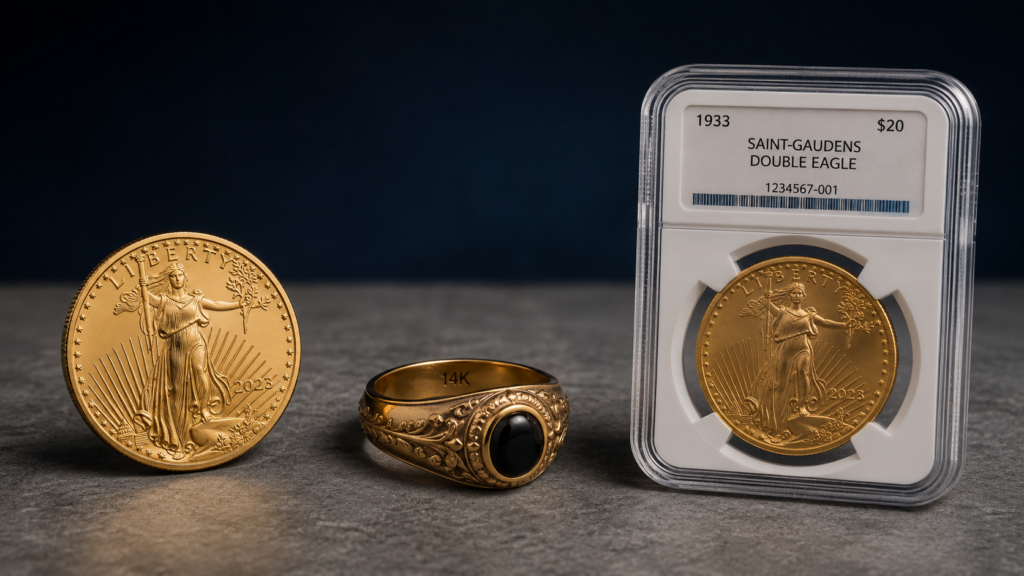
Bullion. Government-mint coins and recognized-refiner bars: American Gold Eagle, American Gold Buffalo, Canadian Gold Maple Leaf, Krugerrand, Austrian Philharmonic, and bars from PAMP Suisse, Credit Suisse, Valcambi, or Perth Mint. Recognized weight and purity, accepted by every major bullion dealer, trades close to spot. The most liquid pieces are 1 oz and 1 kg sizes from the largest mints. See our gold bullion guide and the best gold coins to buy.
Numismatic. Pre-1933 U.S. gold (Saint-Gaudens Double Eagle, Liberty Head $20, Indian Head $10 / $5 / $2.50), coins in PCGS or NGC grading slabs, foreign rarities, key dates, and proof issues. A worn common-date $20 Saint-Gaudens trades near melt; a high-grade rare-date can trade at 5× to 20× melt. The wrong buyer means a very wrong price.
Scrap. Jewelry, dental gold, industrial gold, and unmarked small bars. Buyers calculate value as weight × karat fineness × spot, minus a refining margin. Karat-to-fineness: 10k = .417, 14k = .585, 18k = .750, 22k = .917, 24k = .999. Jewelry is weighed in grams; bullion is weighed in troy ounces (one troy ounce = 31.1035 grams). Do the conversion before any quote.
Before contacting a buyer, record per item: hallmark or mint mark, stated purity, weight (gram scale for jewelry; troy oz for coins and bars), year, and condition for coins, and whether the piece is in original packaging or a grading slab.
Watch for gold-filled and gold-plated jewelry — the “GF,” “HGE,” or “1/20 12K GF” stamps are the tell, and these items pay almost nothing. Costume jewelry with no purity stamp is not gold. Unmarked estate finds that look like gold should be tested before any quote conversation.
Where to Sell Gold — Five Buyer Channels
Five buyer channels handle most gold sales. Each is best for a specific kind of gold, and each pays differently. The table summarizes the trade-offs; the paragraphs below explain each in turn.
Buyer channels at a glance.
| Channel | Best for | Typical payout | Speed | Privacy |
|---|---|---|---|---|
| Local coin dealer | Bullion; common numismatic | 95–98% of spot on liquid bullion | Same day | Cash anonymous below $10,000 and ICTA thresholds |
| National online dealer | Bullion; recognized numismatic | 95–99% of spot | 1–2 weeks | Identity recorded |
| Pawn shop / cash-for-gold | Scrap jewelry; dental gold | 50–80% of melt value | Same day | Identity often required by state law |
| Auction house | High-grade numismatic; rarities | Hammer price less 10–20% commission | 1–3 months | Identity recorded |
| Refiner (direct) | Bulk scrap; dental gold; industrial | 90–96% of melt value | 1–4 weeks | Identity recorded |
Local coin dealer
Best for bullion and common numismatic. Payouts run 95–98% of spot for liquid bullion. Same-day cash or check; cash transactions are anonymous below $10,000 and below ICTA product quantities. Your payout varies with the individual dealer’s inventory needs — always get a second quote.
National online dealer
APMEX, JM Bullion, Money Metals Exchange, Kitco, SD Bullion, and others run buy programs for bullion and recognized numismatic products. Payouts run 95–99% of spot on the most liquid coins. The dealer mails an insured shipping kit, holds your shipment while quoting, and wires or mails payment after you accept. You accept their price lock based on intraday spot movement; the process takes 1–2 weeks.
Pawn shop or cash-for-gold buyer
A convenience trade. Scrap jewelry pays 50–80% of melt; bullion brought in unidentified can pay much less. Do not bring bullion coins here — a pawn shop will rarely pay above melt for a Gold Eagle that a coin dealer buys at 97% of spot.
Auction house
Heritage Auctions, Stack’s Bowers, GreatCollections, and regional auction houses are the right channel for high-grade numismatic coins, key dates, and rarities. Payouts equal hammer price minus a seller’s commission (10–20%) and any catalog fees. 1–3 months from consignment to payout. Not appropriate for common bullion or scrap.
Refiner
Direct sale to a refining facility for bulk scrap (over roughly $5,000 of gold content), dental gold lots, or industrial gold. Refiners pay 90–96% of melt because the refining is in-house. Requires a minimum lot size, full identification, and payment after assay (1–4 weeks).
The pattern: bullion goes to an online dealer or local coin shop; numismatic of clear value goes to an auction house or numismatic specialist; scrap in volume goes to a refiner; scrap in small quantity goes to a local coin shop. Pawn shops are convenience trades, not value trades.
How Dealers Calculate Their Offer — The Bid/Ask Spread
The bid/ask spread is the gap between what a dealer charges to sell you a coin (the ask) and what they’ll pay to buy the same coin back from you (the bid). The gap covers their handling, inventory carry, hedging, and margin. Understanding the spread is the difference between recognizing a fair offer and walking away from a bad one. See our bid/ask spread on bullion guide for the deep dive.
Typical bid-side discounts on common bullion at a fair dealer:
- American Gold Eagle, 1 oz: 1–3% below spot
- American Gold Buffalo, 1 oz: 1–3% below spot
- Canadian Gold Maple Leaf, 1 oz: 1–3% below spot
- Generic 1 oz round or bar: 2–4% below spot
- Krugerrand, 1 oz: 2–4% below spot
- 1 kilo bar: 1–2% below spot (best per-ounce pricing for size)
- Fractional coins (1/2, 1/4, 1/10 oz): 3–6% below spot — smaller units carry wider spreads
- Bars from unrecognized refiners: 5–10%+ below spot, or refused outright
Worked example, scrap: 14k jewelry weighing 20 grams. Pure gold weight = 20 × 0.585 = 11.7 grams = 0.376 troy ounces. At a $2,400 spot price, the gold content is $903. A refiner pays roughly 90% of melt, about $812. A cash-for-gold buyer pays 70–85% of melt ($632–$767). A pawn shop pays 50–70% of melt ($452–$632). Same ring, $812 versus $452, and the only variable is the channel.
Worked example, bullion: one 1 oz American Gold Eagle at $2,400 spot. An online dealer pays $2,360–$2,400, a local coin shop pays $2,330–$2,380, a pawn shop pays $2,000–$2,200, and a mall cash-for-gold kiosk pays $1,800–$2,100. Same coin, $2,400 versus $1,800.
The takeaway: when the offer falls within the typical-spread range for the channel, it’s fair. When it’s below that range, walk and get another quote. You’re not negotiating against a fair offer; you’re recognizing a bad one.
Step-by-Step: How to Sell Gold for the Best Price
Here are eight steps from “I have gold to sell” to a documented, completed sale.
- Identify what you have: Photograph each item, weigh it (gram scale for jewelry; troy oz reference for coins and bars), record the hallmark or mint mark, note any year and condition for coins, and decide whether it’s bullion, numismatic, or scrap.
- Look up the current spot price: Use a public reference (Kitco, Money Metals price feed, or our pricing page when live). Lock the time of your quote — spot moves throughout the trading day, and dealer bid prices update in near real-time.
- Compute your floor value: For bullion: weight in troy oz × purity × spot. For scrap: gram weight × karat fineness × spot ÷ 31.1035. For numismatic, floor is melt value; ceiling is whatever the collector market will pay (research recent auction results on Heritage Auctions or PCGS CoinFacts).
- Get two or three written quotes: For bullion, quote one online dealer and one local coin shop. For scrap, quote one local coin shop and one refiner if quantity warrants it. For numismatic, quote one specialized dealer and one auction house. Written quotes keep buyers honest.
- Compare quotes against your floor: Bullion offers below 90% of spot for liquid coins are poor. Scrap offers below 70% of melt are poor. Numismatic offers below recent auction comps for the same coin in similar grade are poor. Anything in the “poor” range earns a “thank you, I’ll think about it” and another quote.
- Confirm payment, timing, and reporting before agreeing: Cash, check, or wire. Same day, or shipped and waited. Whether the dealer will issue a Form 1099-B at this transaction size and product type (see the next section). Get the answer in writing before the sale, not after.
- Complete the sale and document it: Keep the dealer’s printed receipt (item by item where possible), date of sale, buyer’s name and address, sale price per item and total, weight and purity as confirmed by the buyer, and any 1099-B copy issued.
- Save records for tax filing: Match sale records against purchase records — the cost basis side. The difference, item by item, is your taxable gain or loss. If purchase records are missing, the IRS default is zero basis, which means tax on the full sale price rather than on the actual gain. See our cost basis guide and inventory guide.
A few things not to do. Don’t ship gold to a buyer who hasn’t published a bid price and a free-return policy in writing. Don’t split one large sale across multiple smaller transactions to dodge 1099-B reporting — that’s structuring and is independently illegal. And don’t let an in-person buyer take your gold to “test” it without you watching.
Taxes, 1099-B Reporting, and the Cash Transaction Threshold
This article does not provide tax advice. The rules below summarize federal treatment as of May 2026; talk to a CPA before any sale of consequence.
When you sell physical gold for more than you paid, the difference is a capital gain. The IRS treats physical precious metals as “collectibles” under Internal Revenue Code §408(m), so long-term gains (held more than one year) are taxed at a maximum federal rate of 28% — the collectibles rate — rather than the standard 0% / 15% / 20% long-term rates that apply to stocks. Short-term gains (held one year or less) are taxed at your ordinary income rate. State capital gains tax may also apply. See our capital gains tax on gold guide.
The 28% figure is a maximum, not a flat rate. Taxpayers in lower brackets pay their ordinary rate up to the 28% cap.
Cost basis is what you originally paid, including the premium over spot. If you can’t document the basis, the IRS assumes zero, and you owe tax on the full sale price, not the actual gain. The single highest-impact thing a seller can do is produce original purchase records; the next-highest is to start tracking purchases now.
When dealers must report your sale.
| Product | Reportable quantity | Form |
|---|---|---|
| Gold bars and rounds | 1 kg (32.15 troy oz) or more | 1099-B |
| Krugerrand, Mexican Onza, Canadian Gold Maple Leaf | 25 troy oz or more (aggregate) | 1099-B |
| American Gold Eagle | Not reportable in any quantity | — |
| American Gold Buffalo | Not reportable in any quantity | — |
| Silver bars and rounds | 1,000 troy oz or more | 1099-B |
| 90% silver U.S. coins (junk silver) | $1,000 face value or more | 1099-B |
| Any cash payment to/from a dealer | $10,000 or more | Form 8300 |
Source: ICTA (Industry Council for Tangible Assets) reportable items list, as adopted by major U.S. dealers. Numismatic coins are not on the list. Fractional coins generally are not. The exemption for American Gold Eagles, American Silver Eagles, and American Buffaloes is structural — these coins can be sold in any quantity without triggering a 1099-B. See our 1099-B reporting guide for the full ICTA list and edge cases.
| American Gold Eagles, American Silver Eagles, and American Buffaloes are not 1099-B reportable in any quantity. This is a structural advantage of U.S. Mint bullion when planning a sale. |
Form 8300 is separate from 1099-B. When a dealer receives more than $10,000 in cash in a single transaction or in related transactions within 24 hours, the dealer files Form 8300 with the IRS and FinCEN. The rule applies in both directions (buying and selling). Wire transfers, personal checks, and electronic transfers are not “cash” for Form 8300 purposes. See our IRS reporting on metal sales guide.
Selling at a loss still requires reporting the sale; the loss may offset other capital gains. Inherited gold receives a “stepped-up” cost basis equal to fair market value on the date the previous owner died — meaning the gain is calculated from that stepped-up value, not the original purchase price. Gifted metals carry over the giver’s original basis. See our cost basis guide.
This is not tax advice. Talk to a CPA about your specific situation.
Red Flags and Common Mistakes
The selling side of the gold market has fewer regulations than the buying side, and a thicker layer of predatory marketing. Patterns to watch:
Cash-for-gold mailers with no published rate
You mail your gold, they make an offer, and the “free return” takes 30+ days while your gold sits in their custody. Get the bid rate in writing before any gold leaves your hands.
Pawn shops paying scrap rates on bullion
A 1 oz American Gold Eagle is worth around $2,360 to a coin dealer and around $2,000 at a pawn shop — same coin, different buyer model. Bring bullion to a bullion buyer.
Selling numismatic to scrap buyers
A pre-1933 $20 Saint-Gaudens in MS-63 grade can sell for $2,500–$3,000 in the numismatic market; the same coin sold to a refiner pays melt. Get the coin evaluated by a numismatic specialist before any scrap-channel sale.
Pressure tactics
“I can only honor this price for 10 minutes.” “Gold is dropping today — sell now.” Gold doesn’t expire. The right answer to every pressure tactic is “thank you, I’ll think about it.”
“Test” that requires you to give up custody
Acid tests, XRF gun tests, and electronic gold testers all run in front of you in seconds. There is no legitimate need to leave the gold with a buyer before a quote.
Structuring
Splitting one large sale across smaller transactions to avoid Form 1099-B or Form 8300 thresholds is a federal crime under 31 U.S.C. §5324. It is independently chargeable, even when the underlying sale is fully legal and all taxes are paid. See our anonymity and reportable thresholds guide.
Hidden fees in mail-in sales
Watch for shipping insurance not included, assay fees deducted from payout, refining fees not disclosed before the quote, and restocking fees on returned shipments. Reputable mail-in buyers publish their fee schedule. The ones that don’t, aren’t.
When (or Whether) to Sell
“Is it a good time to sell gold?” is the wrong question for an individual seller. The right questions are personal. Do you need the cash? Are you rebalancing a portfolio that’s now overweight metals? Are you simplifying an estate? Is the tax-year timing right? Is the specific item appreciating faster as a collectible than as bullion (in which case selling it as bullion destroys value)?
As of May 2026, gold trades near $4,500 per troy ounce — context, not a buy or sell signal. We don’t make price predictions in this guide. Check a current chart.
Tax-year timing is one piece of selling math you control. A sale on December 31 falls in the current tax year; a sale on January 1 falls in the next. Sellers with significant gains near year-end may benefit from waiting; sellers with offsetting losses may benefit from selling sooner. Talk to a CPA.
If you’re selling a large position, consider splitting across multiple sessions or buyers — not for tax purposes (that would be structuring) but to smooth one-day price volatility across multiple sales.
The right time to sell is when selling solves a problem you actually have, at a price that’s fair for the channel you’re using.
Tracking What You Sold and What You Still Own
The hardest part of selling gold isn’t finding a buyer. It’s reconstructing what you paid for it. Receipts get lost. Dealers go out of business. Inherited and gifted items have no paper trail. And without documented basis, the IRS default assumption is zero, meaning capital gains tax on the full sale price, not on the actual gain.
Good records capture, per item: date acquired, dealer or source, price paid (including premium), weight, purity, and any documentation. For inherited items, that’s the date the previous owner died and the fair market value on that date. On the sale side: date sold, buyer, sale price, weight at sale, fees deducted, and a copy of any 1099-B issued.
Gold Silver Ledger captures purchase records at the moment of purchase — when it’s easy — and on the sale side records the disposition with sale date, gross proceeds, and buyer reference. The display unit toggles between troy ounces, grams, and kilograms, which helps when a dealer quotes per-troy-oz against jewelry weighed in grams. By the time you sell, the Form 8949 inputs are already built.
The seller struggling to reconstruct basis on a sale today is the buyer who will document the next purchase. The argument for tracking lands hardest right after a difficult sale. See our inventory guide and cost basis guide.
Frequently Asked Questions
How much will I get for my gold?
For liquid bullion coins, expect 95–99% of spot. For bars from recognized refiners, 92–98% of spot. For scrap jewelry, 70–85% of melt value depending on buyer channel. For numismatic coins, anywhere from melt up to many multiples of melt depending on rarity and grade.
Do I need ID to sell gold?
Yes for any cash sale of $10,000 or more (Form 8300), yes for any 1099-B-reportable bullion sale, and yes at most coin shops and pawn shops, regardless of size — state recordkeeping laws often require it. Mail-in dealers always require ID. There is no anonymous gold sale at a meaningful size. See our anonymity and reportable thresholds guide.
Will the dealer report my sale to the IRS?
Only for specific products and quantities on the ICTA reportable items list (1 kilo or more of gold bars, 25 troy oz or more of Krugerrands, Maples, or Mexican Onzas, etc.), and always for cash payments of $10,000 or more (Form 8300). American Gold Eagles, American Silver Eagles, and American Buffaloes are not 1099-B reportable in any quantity. See our 1099-B reporting guide.
Can I sell gold without paying taxes?
If you sell at a profit, capital gains tax applies. There’s no special exemption for physical metal. If you sell at a loss, no tax is owed and the loss may offset other capital gains. The 28% collectibles rate is a maximum federal rate, not a flat rate — taxpayers in lower brackets pay their ordinary rate up to the 28% cap.
What’s the best place to sell gold?
There isn’t one. The best place for bullion isn’t the best place for numismatic, and neither is the best place for scrap. The right answer depends on what you have — see the sorting section and the channels table above.
Should I melt my gold jewelry first?
No. Refiners melt scrap in bulk for efficiency; an individual melting one ring loses purity to oxidation and pays an assay fee that exceeds whatever margin they think they’re capturing. Sell to a refiner or a coin shop that pays refiner-adjacent rates and let them handle the melting.
Can I sell gold online safely?
Yes, with a reputable national dealer that provides an insured shipping kit, holds your shipment, sends a written quote, and ships back free if you reject. Avoid services that don’t publish a bid rate before they receive your gold. Confirm BBB rating, years in business, and reviews on independent platforms before shipping anything.
What if I inherited the gold and have no records?
Inherited metals receive a “stepped-up” cost basis equal to fair market value on the date the previous owner died. You’ll need that date and a fair-market-value estimate — reconstructable from the spot price on that date for bullion, or from a qualified appraisal for numismatic. See our cost basis guide.
This article is for informational and educational purposes only. It is not financial, investment, or tax advice. Consult a CPA or fee-only fiduciary advisor about your specific situation.
