
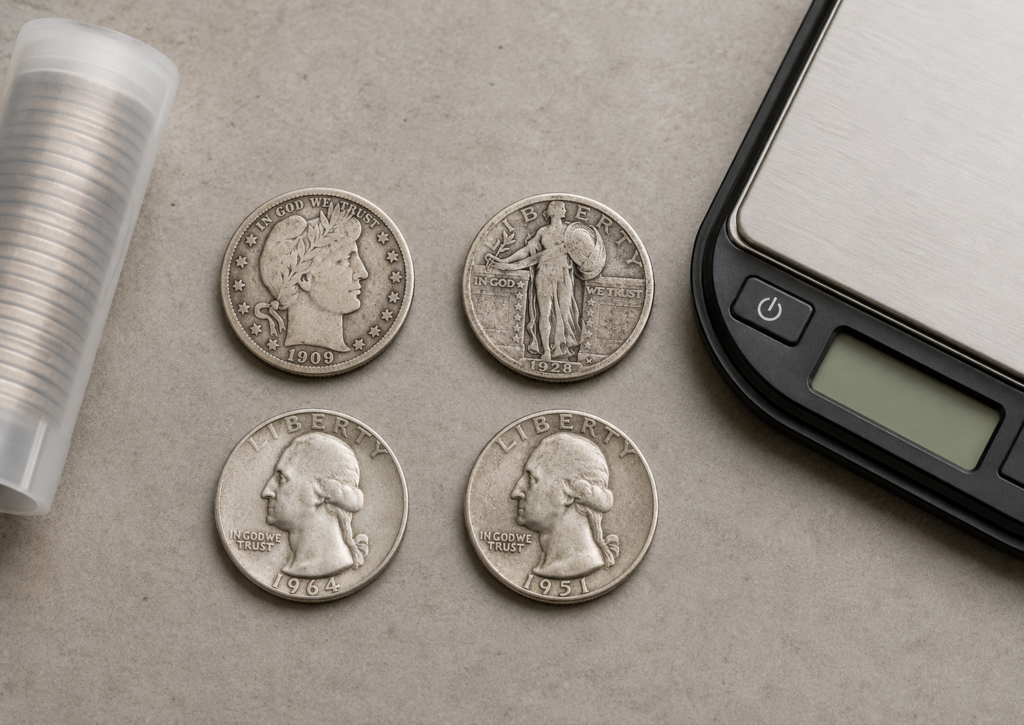
Most U.S. quarters minted in or before 1964 are 90% silver. From 1965 onward they switched to copper-nickel clad and contain no silver. A worn pre-1965 Washington quarter holds 0.1808 troy ounces of silver — its melt floor at any given spot price. Older series and key Washington dates trade well above that floor. This guide covers every U.S. silver quarter, what is inside it, and what it is worth today.
The Short Answer: What a Silver Quarter Is Worth
U.S. quarters minted from 1892 to 1964 are 90% silver and contain 0.1808 troy ounces of silver each. As of May 2026, silver trades near $80 per ounce, so a worn common-date silver quarter has a melt value of about $14.46. Older series (Standing Liberty, Barber) and a few key Washington dates trade well above melt because of rarity and condition, not metal content.
The phrase silver quarter is shorthand for any U.S. 25-cent coin minted with a 90% silver composition. The standard cutoff is 1964, the last year of 90% silver quarters for circulation. From 1965 forward, every quarter struck for general use is copper-nickel clad: copper inner layer, copper-nickel outer cladding, no silver content. The change came from the Coinage Act of 1965, which removed silver from circulating dimes and quarters and reduced half dollars from 90% to 40%.
One number runs through every section of this guide: ASW (actual silver weight) — the troy-ounce amount of pure silver in a coin, as opposed to its gross weight. A pre-1965 quarter weighs 6.25 grams gross but contains only 5.625 grams of pure silver, or 0.1808 troy ounces. ASW is the only number that matters for melt value.
This article covers every U.S. silver quarter and how to value it. If you want the sortable identification reference — every year, every mintmark, sorted by series — see our companion guide on which quarters are silver.
| The single most useful fact in this guide: 1964 = silver. 1965 = clad. The diameter did not change at the transition (24.3 mm both before and after); only the composition and weight did. If you have a quarter dated 1965 or later, it is almost certainly clad and contains no silver. |
Silver Quarter Specs and Melt Value
Four U.S. quarter types account for nearly every silver quarter in private hands today: the Barber (1892–1916), the Standing Liberty (1916–1930), the Washington silver era (1932–1964), and the 40% silver collector versions of the 1976 Bicentennial. The table below covers each year range, silver percentage, gross weight, and ASW. This is the most-referenced asset on the page; bookmark it if you sort coins.
Every U.S. silver quarter, with silver percentage and actual silver weight (ASW).
| Quarter | Year range | Silver % | Gross weight | ASW (troy oz) |
| Barber Quarter | 1892–1916 | 90% | 6.25 g | 0.1808 |
| Standing Liberty Quarter | 1916–1930 | 90% | 6.25 g | 0.1808 |
| Washington Quarter (silver era) | 1932–1964 | 90% | 6.25 g | 0.1808 |
| 1976 Bicentennial (40% silver, S-mint collector) | 1976 | 40% | 5.75 g | 0.0739 |
| 1976 Bicentennial (circulation strike) | 1976 | 0% | 5.67 g | 0 |
| Washington Quarter (clad era) | 1965–present | 0% | 5.67 g | 0 |
| Silver proof quarters (collector-only) | 1992–present | 90% / .999 | 6.25 g | 0.1808 / 0.2009 |
Two things are worth flagging in plain prose, because the table can mislead at a glance.
First: all 90% silver quarters share the same melt math. A Barber, a Standing Liberty, and a 1932 Washington all carry the same 6.25 grams gross and the same 0.1808 troy oz of silver. Series and date drive collectible value; they do not change melt value.
Second: the 1976 Bicentennial issue exists in two completely different forms. Circulation 1776-1976 quarters from Philadelphia and Denver are clad — 5.67 grams, zero silver. The collector-only S-mint version (40% silver, 5.75 grams) was sold separately by the U.S. Mint and never released into general circulation. The Bicentennial design is the same on both, so the date and the dual-date inscription alone tell you nothing about silver content. Look at the mintmark and the weight.
For melt math: at $X per ounce silver, a 90% silver quarter is worth 0.1808 x $X. For face-value bag math (the way junk silver is priced at retail), $1 of face value = four silver quarters = 0.7234 troy oz of silver before circulation wear. Dealers price $1,000 face bags against ~715 troy oz to account for wear, which is the figure you will see in most market quotes.
Washington Silver Quarters (1932–1964): The Default Case
If you have a silver quarter in your hand right now, it is almost certainly a Washington silver quarter from 1932 to 1964. The series was introduced in 1932 to commemorate the bicentennial of George Washington’s birth, designed by sculptor John Flanagan, and ran for 33 years before the Coinage Act of 1965 ended its 90% silver composition. Specifications: 6.25 grams gross, 90% silver, 0.1808 troy oz ASW, 24.3 mm diameter, reeded edge.
| Washington silver quarter quick spec: 6.25 g gross, 90% silver, 0.1808 troy oz ASW, 24.3 mm diameter. Every date from 1932 to 1964 shares this spec. |
Most Washington silver quarters from 1934 through 1964 are common-date coins. They trade at melt plus a small dealer premium — typically a few dollars per coin at retail above the melt floor, with bag-pricing closer to spot. The 1964 quarter draws especially heavy search volume because it is the last silver year, but the 1964 issue itself is one of the highest-mintage Washingtons in the series. Common date, common premium.
The exceptions are the two inaugural-year mintmarked issues. The 1932-D (Denver, mintage roughly 436,800) and the 1932-S (San Francisco, mintage roughly 408,000) are the two key Washington dates. Both command meaningful premiums above melt even in worn grades, with the 1932-D more famous in the market and the 1932-S marginally lower in mintage. The 1932 Philadelphia issue, by contrast, is a high-mintage common date. No quarters were struck in 1933. Minor semi-keys include the 1937-S, 1937-D, and 1940-D.
A note on war-era dates, because the question comes up often: there is no “war quarter” composition. Wartime-dated Washington quarters (1941 through 1945) are 90% silver — the same as every other Washington silver quarter from 1932 to 1964. The wartime metal change applied to nickels only: from mid-1942 through 1945, Jefferson “war nickels” were struck in a 35% silver alloy because nickel metal was needed for the war effort.
Quarters were left alone. A 1942, 1943, 1944, or 1945 quarter is a standard 90% silver Washington, valued the same way as any common-date silver Washington: melt floor plus a small premium for circulated, more for high grade.
A word on mintmarks. The Philadelphia issue has no mintmark; D is Denver; S is San Francisco. From 1932 to 1964, the mintmark sits on the reverse below the eagle. (It moved to the obverse in 1968, after silver had already left the series.) San Francisco struck quarters intermittently and ended general production in 1955, then returned for proofs and modern silver issues. Mintmark drives most of the year-by-year value variation outside the 1932 keys.
Standing Liberty Quarters (1916–1930): Numismatic Territory
A Standing Liberty quarter shares the same metal specifications as a Washington — 6.25 grams, 90% silver, 0.1808 troy oz ASW — but the resemblance ends at the melt math. Standing Liberty quarters are numismatic before they are silver. Most worn examples are worth multiples of melt, and any reader holding one should consult a price guide or a grader before selling at melt.
The series was designed by Hermon A. MacNeil and ran for 14 years. It exists in two distinct types. Type 1 (1916–1917) shows Liberty’s right breast exposed, and the 1916 issue specifically has a mintage of roughly 52,000 — one of the lowest-mintage U.S. coins of the 20th century. The 1916 commands four- to five-figure prices in any grade. The 1917 Type 1 issues from all three mints are scarce but more accessible than the 1916.
Type 2 (1917–1930) shows Liberty wearing chain mail over her tunic — a design change often attributed to wartime modesty norms, though the actual historical motivation is disputed. Type 2 issues from most years trade in two- or low-three-figure ranges for circulated grades. No quarters were struck in 1922.
One quirk worth knowing: the date on a Standing Liberty quarter was struck in a high-wear position on the pedestal beneath Liberty, and it frequently wears off entirely on circulated examples. A dateless Standing Liberty is still 0.1808 troy oz of silver — melt-floor value applies — but the numismatic premium is lost without the date. Acid date restoration exists as a niche service but is rarely worth pursuing unless the coin shows clear high-grade detail elsewhere.
Barber Quarters (1892–1916): Specialist Territory
A Barber quarter is older still — designed by U.S. Mint Chief Engraver Charles E. Barber, struck from 1892 to 1916, with the same 6.25 g / 90% silver / 0.1808 troy oz ASW spec as everything that followed it. Most circulated Barber quarters trade well above melt. Age, lower survivor counts, and consistent collector demand keep even common dates several multiples above their silver content at retail.
The series was struck at four mints: Philadelphia (no mintmark), Denver (D, from 1906), San Francisco (S), and New Orleans (O, 1892–1909). Notable key dates include the 1896-S (low mintage), the 1901-S (one of the more famous Barber rarities, regularly commanding high four- to five-figure prices), the 1913-S, and the 1914-S. Even outside these key dates, condition drives substantial price variation across the series.
The operating rule for any Barber quarter: do not sell for melt without a price-guide check. A worn common-date Barber is almost always worth more sold to a collector than melted, and a high-grade example or a key date can be worth many multiples of its silver content. PCGS CoinFacts and NGC Coin Explorer both publish per-date prices for the series.
1976 Bicentennial and Modern Silver Proof Quarters
After the 1964/1965 transition, two narrower windows of silver-quarter production followed. The first is the 1976 Bicentennial. The second is the ongoing silver proof set program.
Bicentennial quarters carry the dual date 1776-1976 and a colonial drummer-boy reverse designed by Jack L. Ahr. Circulation strikes from Philadelphia and Denver are clad — 5.67 grams, zero silver. The U.S. Mint additionally produced a collector-only 40% silver version at San Francisco, identified by an “S” mintmark on the obverse, weighing 5.75 grams with an ASW of 0.0739 troy oz. The silver collector Bicentennial was sold in special blue-pack (uncirculated) or brown-box (proof) U.S. Mint packaging, never released into general circulation.
Two checks separate a 40% silver Bicentennial from a clad one. First, the S mintmark on the obverse, to the right of Washington’s ponytail. Second, the weight: 5.75 grams for silver versus 5.67 grams for clad. The 0.08-gram gap is borderline for kitchen scales but cleanly readable on a jeweler’s scale. Original Mint packaging is the third tell, though most coins have long since been removed from their original packaging.
From 1992 onward, the U.S. Mint has produced annual silver proof sets containing silver-composition versions of the year’s circulating coins, including the quarter. The composition was 90% silver (matching the pre-1965 standard, 6.25 g, 0.1808 troy oz ASW) from 1992 through 2018, then shifted to .999 fine silver in 2019 (same 6.25 g gross weight, slightly higher ASW at roughly 0.2009 troy oz). All carry the S mintmark and ship in U.S. Mint hard-shell proof packaging. These are collector pieces; they were never struck for circulation.
The State Quarters program (1999–2008), the America the Beautiful series (2010–2021), and the American Women series (2022–present) are all clad for circulation. Silver versions of each design exist only inside the annual silver proof sets — they are not the quarters you find in change.
How to Value a Silver Quarter: Melt, Premium, and Numismatic Upside
Melt value is the silver content of a coin multiplied by the current spot price — the live wholesale price of one troy ounce of silver. For any 90% silver quarter, melt = 0.1808 x spot. As of May 2026, silver trades near $80 per ounce, so a worn common-date silver quarter has a melt value of about $14.46. A 40% silver Bicentennial at the same spot rate is worth about $5.91 in metal.
Numismatic premium is the dollar amount above melt that a coin earns from rarity, condition, mintmark, or historical significance. Common-date Washington silver quarters carry modest premiums above melt at retail — a few dollars per coin in circulated grades. Key-date Washingtons (1932-D, 1932-S), most Standing Liberty quarters, and most Barber quarters carry premiums that often dwarf the melt value of the coin.
The valuation process is as follows:
1. Identify the series and date using the table above. If the date is 1965 or later and the coin came from circulation, it is clad — face value, no silver.
2. If the coin is a common-date Washington from 1934 to 1964, use melt as the floor and add a modest dealer premium. Bag-pricing runs closer to melt; per-coin retail runs a few dollars above.
3. If the coin is a 1932-D, a 1932-S, any Standing Liberty, any Barber, or a high-grade common date, get a numismatic price-guide check. Do not sell at melt.
4. If the coin is a 1976 Bicentennial, weigh it and check the mintmark. Clad weighs 5.67 g; 40% silver weighs 5.75 g and carries an S mintmark.
For face-value bag math at common dealer pricing: a $100 face bag holds 400 silver quarters and contains about 71.5 troy oz of silver after circulation wear (the industry-standard figure). At $80 per ounce, that bag holds roughly $5,720 in silver. The raw mathematical figure before wear is 72.34 troy oz; dealers use 71.5 to standardize for worn coins.
Condition matters more for some series than others. For common-date Washingtons, condition affects price mainly above MS-65. For Standing Liberty and Barber quarters, condition affects price across the entire grade range. Before selling anything that looks above-average for its series, consult a published price guide.
How to Track Silver Quarters in a Mixed Portfolio
Silver quarters accumulate in three different forms. Junk-silver bags ($1, $5, $10, $100 face value) are priced and traded by face value. Common-date Washington rolls and tubes are tracked by count. Individual key-date Washingtons, Standing Liberty quarters, and Barber quarters earn their own line per coin because each one carries date, mintmark, grade, and a numismatic premium that varies coin to coin.
A single “silver quarters” row in a spreadsheet collapses the moment you hold more than one of these forms. The face-value bag is not really a quarter — it is a unit of melt weight priced against a dealer benchmark. The 1932-D in a flip is not really comparable to a face bag — it is a numismatic asset with a market price independent of melt. Tracking both as “quarters x n” obscures everything that matters about either one.
A purpose-built tracker handles this without spreadsheet gymnastics. Gold Silver Ledger logs silver quarters in whichever form fits the holding — a $100 face bag stays a $100 face bag, a roll of common-date Washingtons stays a roll, and a 1932-D Washington gets its own line.
For the full inventory workflow, including face-value, roll, and per-coin tracking, see how to inventory a coin or bullion collection.
Storage scales with value. Junk-silver bags do not need individual protection — they are valued for metal, not condition. Common-date Washingtons in rolls or tubes are fine. Anything with possible numismatic upside (a 1932-D or S, a Standing Liberty in identifiable grade, any Barber) belongs in a 2×2, a flip, or a graded holder that prevents handling. Cleaning a silver coin is the fastest way to destroy its numismatic value irreversibly.
Frequently Asked Questions
Is a 1964 quarter silver?
Yes. 1964 was the last year of 90% silver Washington quarters for circulation. A 1964 quarter is 6.25 grams gross with 0.1808 troy oz of silver — about $14.46 in melt at May 2026 spot near $80 per ounce. It is a common-date coin, so retail typically runs a small premium above melt, with more for uncirculated and MS-65+ grades.
Is a 1965 quarter silver?
No. 1965 was the first year of copper-nickel clad quarters under the Coinage Act of 1965. A 1965 quarter is 5.67 grams gross and contains zero silver. It is worth face value in circulation. The diameter (24.3 mm) did not change at the 1964-to-1965 transition; only the composition and the weight did.
What years are silver quarters?
1892 through 1964 for circulation. Specifically: Barber 1892–1916, Standing Liberty 1916–1930, Washington 1932–1964. No quarters were struck in 1922, 1931, or 1933. The 1976 Bicentennial has a collector-only 40% silver version with an S mintmark, but the circulation 1776-1976 quarter is clad. Silver proof sets from 1992 forward contain silver quarters, but those were never released into circulation.
Are war-era quarters silver?
Yes, but no differently than any other Washington quarter from the era. Wartime-dated Washington quarters (1941 through 1945) are 90% silver, the same as every other Washington silver quarter from 1932 to 1964. The wartime composition change applied to nickels only: 1942–1945 Jefferson “war nickels” went to a 35% silver alloy because nickel metal was needed for the war. There is no “war quarter” variant.
How much silver is in a quarter?
A pre-1965 U.S. quarter — Barber, Standing Liberty, or Washington — contains 0.1808 troy oz of silver. Gross coin weight is 6.25 grams; pure silver weight is 5.625 grams. The 40% silver 1976 Bicentennial collector version contains 0.0739 troy oz. Modern silver proof quarters from 1992 to 2018 contain 0.1808 troy oz (90% silver); from 2019 onward they contain roughly 0.2009 troy oz at .999 fine.
How much does a silver quarter weigh?
A pre-1965 silver quarter weighs 6.25 grams. A clad (1965 or later) quarter weighs 5.67 grams — a 0.58-gram difference that any reliable kitchen scale catches. The 40% silver 1976 Bicentennial collector quarter weighs 5.75 grams. Diameter is 24.3 millimeters across all of these.
How much is a 1942 quarter worth?
Treat a 1942 (or 1943, 1944, 1945) Washington quarter as a common-date silver Washington. Melt floor is 0.1808 x spot — about $14.46 at May 2026 silver prices near $80 per ounce. Mintmark and grade drive any premium above melt. The 1942 issue searches heavily because of the war-era association, but the coin itself is a standard 90% silver Washington with no special wartime composition.
How much is a $100 face bag of silver quarters worth?
Standard industry math: $100 face value = 400 silver quarters = roughly 71.5 troy oz of silver after circulation wear. At $80 per ounce silver, that is about $5,720 in melt content. Dealer ask prices typically run a small premium over melt for bags; bid prices run a small discount. The 71.5 ozt figure accounts for the average wear on circulated coins — the raw pre-wear math is 72.34 ozt per $100 face.
Should I clean a silver quarter before selling?
No. Cleaning destroys numismatic value on coins where it might exist — any Barber, any Standing Liberty, any key-date Washington, any high-grade common date — and adds nothing for melt-only sales. Sell as-is. The premium a buyer or refiner pays is based on metal content, not appearance.
Is buying silver quarters a good investment?
Silver quarters give exposure to the silver spot price plus, in some cases, a numismatic premium tied to date, mintmark, and condition. Junk-silver quarter bags provide cost-effective spot exposure with low premium over melt; key-date Washingtons, Standing Liberty quarters, and Barber quarters carry separate collector-market dynamics. Whether either fits your portfolio depends on your goals, time horizon, and how the rest of your holdings are allocated.
This article is educational, not financial advice — consult a qualified professional for advice specific to your situation.
