
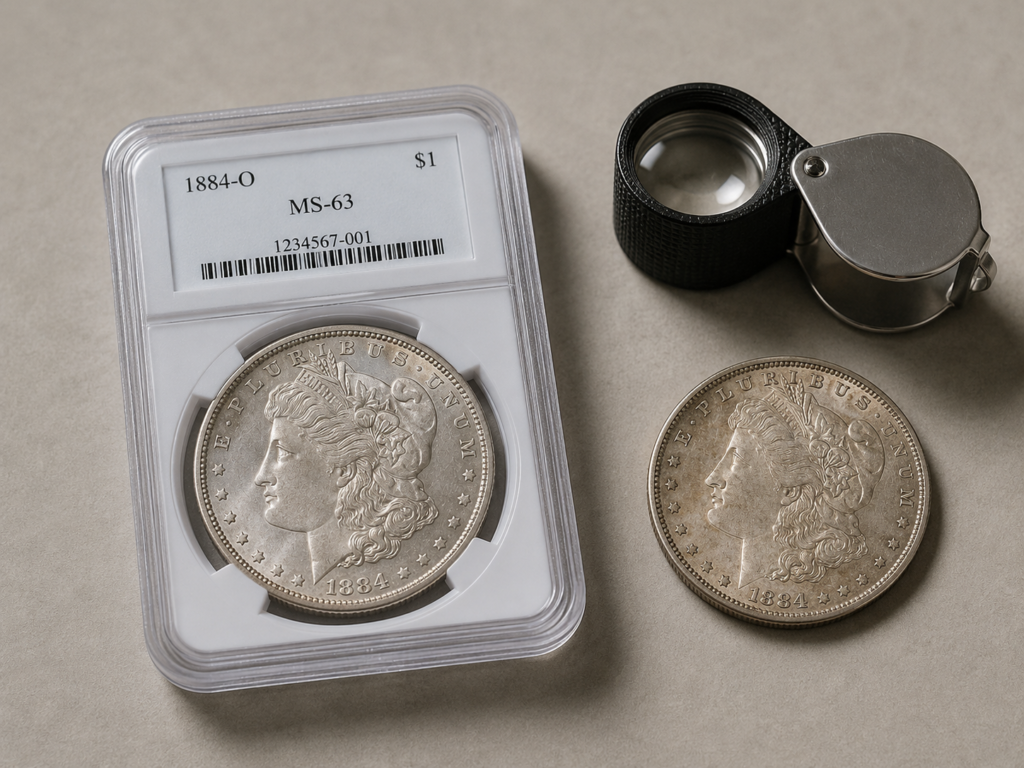
If you’re holding a coin you think might be valuable, grading turns a guess into a certified, sealed grade that buyers trust. But sending a coin off costs money and time, and it only pays on the right kind of coin.
This guide explains what coin grading is and how the 70-point scale works, when a coin is actually worth grading, and how the three main services — PCGS, NGC, and ANACS — compare on reputation, cost, turnaround, and resale value, so you can pick the one that fits what you own.
This article is general information on coin grading services, not financial, investment, or professional numismatic advice. A coin’s grade and value depend on the individual coin, the service, and the market, and grading fees and turnaround change often, so confirm current specifics with the grading service and a qualified professional before you submit.
What coin grading actually is
Coin grading is a third-party service that authenticates a coin and rates its physical condition on the 70-point Sheldon scale, from Poor (1) to a flawless Mint State or Proof (70). The graded coin is sealed in a tamper-evident holder, or slab, with its grade and a unique certificate number, which buyers trust as an independent verdict on condition.
Grading rates condition and confirms the coin is genuine; it doesn’t tell you what the coin is worth. That dollar figure is an appraisal, a separate step our coin appraisals guide covers in full. The two work together on valuable coins — a certified grade makes an appraisal more precise and the coin easier to sell — but they answer different questions.
Authentication is part of why grading matters: a slab is also independent protection against a counterfeit, which is its own subject in our guide to spotting a fake.
Does your coin need grading?
Grading isn’t free, and it doesn’t add value to every coin. A common bullion coin — an American Silver Eagle, a Gold Maple Leaf, a bag of junk silver — trades close to its melt value plus a standard premium over spot, and a slab rarely lifts that price by more than the grading cost. Grading earns its fee on a narrower set of coins. It’s usually worth grading when your coin is:
- Rare or a key date: Scarce coins where authenticity and condition drive a value far above metal content.
- In high grade: A coin whose condition is exceptional, where one point on the scale can change the price sharply.
- Of uncertain authenticity: A piece you need verified as genuine before you buy, sell, or insure it.
- A modern issue graded for the label: First-strike or top-population moderns that collectors pay a premium to own certified.
PCGS, NGC, and ANACS at a glance
Three services dominate US coin grading, and each has a clear identity. PCGS and NGC are the two most widely accepted; ANACS is the oldest and the most affordable. Here’s how they line up:
Table: PCGS, NGC, and ANACS at a glance.
| Service | Founded | Known for | Cost tier | Resale standing |
| PCGS | 1986 | Premium benchmark for US coins; strong registry-set community | Higher | Typically the highest; often brings a premium |
| NGC | 1987 | Co-leader; the go-to for world, ancient, and modern coins | Moderate, often just below PCGS | Very strong; broadly accepted and liquid |
| ANACS | 1972 (oldest US service) | Affordability, variety attribution, and grading problem coins | Lowest | Solid but generally below PCGS and NGC for the same grade |
How do PCGS, NGC, and ANACS compare?
All three grade to the same scale, so the differences come down to reputation, price, turnaround, and what each does best. Here’s how each one stacks up.
PCGS: the premium benchmark
PCGS helped invent third-party grading in 1986 and remains the name most collectors treat as the standard for US coins. Its grades tend to command the strongest resale premium, and its registry-set program gives serious collectors a reason to prefer PCGS holders. If you own a high-value US coin and want the widest, deepest buyer pool, PCGS is the default many collectors reach for.
The trade-offs are cost and focus. PCGS generally sits at the higher end on fees, and while it grades world coins, its center of gravity is US material. For a common coin, that premium standing rarely justifies the cost, which loops back to whether the coin needs grading at all.
NGC: the global co-leader
NGC launched in 1987 and stands alongside PCGS as one of the two most widely accepted services. It’s especially strong on world coins, ancients, and modern issues, and it’s the official grader for several mints’ releases.
Its fees often run slightly below PCGS at comparable tiers, and turnaround is competitive, which makes it a common choice for collectors who want top-tier acceptance without the highest price.
For most owners, NGC offers the best balance of acceptance, cost, and speed. On a strictly US high-end coin some buyers still favor a PCGS holder, but the gap is narrow, and NGC coins stay highly liquid across the market.
ANACS: the affordable specialist
ANACS is the oldest US grading service, dating to 1972, and it competes on price and specialty rather than prestige. It’s the most affordable of the three, and it’s a go-to for variety attribution — doubled dies, repunched and over-mintmarks — and for grading problem coins that have been cleaned or damaged, which it assigns a Details grade rather than rejecting outright.
The trade-off is resale. ANACS-graded coins generally sell at a discount to PCGS and NGC for the same grade, so ANACS suits lower-value coins, variety attribution, or an honest read on a problem coin better than maximizing the price of a high-end piece.
What does coin grading cost and how long does it take?
All three services price grading in tiers, and the pattern is the same: the cheaper the tier, the longer the wait, plus surcharges for very valuable coins that need higher declared-value handling. Fees and turnaround change often, so confirm the current numbers on each service’s site before you submit. In broad strokes, the tiers run:
- Economy: The lowest per-coin fee, for lower-value coins, with the longest turnaround.
- Standard: A mid tier for more valuable coins, priced by the coin’s declared value.
- Express: A higher fee for faster handling when you don’t want to wait weeks.
- Same-week or walkthrough: The priciest tier, for the fastest turnaround or the highest-value coins.
Which grading service should you choose?
The right service depends on the coin. For a high-value US coin you want to sell for the most, PCGS’s resale premium is hard to beat. For world coins, ancients, moderns, or the best all-around balance of cost and acceptance, NGC is a strong default.
For varieties, problem coins, or lower-value pieces where you want certification without paying top dollar, ANACS is the practical choice.
One more name is worth knowing. Certified Acceptance Corporation (CAC) built its reputation verifying coins already graded by PCGS and NGC, adding a sticker to those it judged solid for the grade. In 2023 it launched its own full grading service, CACG, which has gained fast traction at major auctions and in price guides.
It isn’t one of the three legacy services this guide compares, but if you’re buying or selling high-end coins, CAC-verified and CACG-graded coins now carry real weight in the top tier.
If you’re unsure what you have or which service fits, a neutral professional can tell you before you spend on grading. A qualified expert can flag whether a coin is even worth submitting, which our guide to working with a numismatist covers. That step often saves more than it costs, especially on an inherited coin you can’t yet identify.
This article is for informational and educational purposes only. It isn’t financial, investment, tax, or professional numismatic advice. Confirm a coin’s grade and value with the grading service and a qualified professional before acting.
Frequently asked questions
Is PCGS or NGC better?
Neither PCGS nor NGC is definitively better; both are top-tier services trusted across the market, with PCGS often commanding a slight resale edge on US coins and NGC favored for world, ancient, and modern issues. For most owners the choice comes down to cost, turnaround, and the kind of coin you’re grading rather than any real gap in quality.
What is the cheapest coin grading service?
ANACS is generally the cheapest of the three major grading services, with per-coin fees below PCGS and NGC at comparable tiers. It’s a practical choice for lower-value coins and variety attribution, though ANACS-graded coins tend to resell at a small discount to the other two.
Is ANACS a good grading service?
ANACS is a legitimate, respected grading service and the oldest in the US, especially strong on variety attribution and grading problem coins. Its main trade-off is resale, since ANACS coins usually sell for somewhat less than PCGS or NGC coins at the same grade, so it fits lower-value and specialty coins better than high-end pieces.
How much does it cost to grade a coin?
Grading a single coin typically ranges from a modest economy fee to a much higher charge for fast turnaround or very valuable coins, and the exact fee depends on the service, the tier, and the coin’s declared value. Because fees change often, check the current rates on PCGS, NGC, or ANACS before you submit.
Should I get my bullion coins graded?
Most common bullion coins aren’t worth grading, because a slab rarely adds more value than the grading fee costs, and they trade close to their metal value plus a standard premium. Grading pays off on key-date, rare, high-grade, or first-strike coins where certification meaningfully raises the price.
Do PCGS, NGC, and ANACS use the same grading scale?
Yes, all three use the 70-point Sheldon scale, which runs from Poor (1) to a flawless Mint State or Proof (70), so a grade like MS-65 means the same condition tier across services. Small differences in how strictly each applies the standard can affect resale value, but the scale itself is shared.
What is CAC or CACG grading?
CAC (Certified Acceptance Corporation) started by verifying coins already graded by PCGS and NGC, adding a sticker to those solid for their grade, and in 2023 it launched its own full grading service, CACG. Both carry growing weight in the high-end market, though CAC and CACG aren’t among the three legacy services most collectors compare first.
How long does it take to get a coin graded?
Coin grading turnaround ranges from a few business days at the fastest, priciest tiers to several weeks or more at the cheapest economy tiers. The wait depends on the service, the tier you pay for, and how busy the grader is, so check current estimates before you submit a time-sensitive coin.
