
Ask when to buy gold and you are really asking two different questions at once. One is about the market’s price: where gold trades today versus next month, which no one predicts reliably, dealers and analysts included. The other is about your own schedule: how much, how often, and for how long you plan to hold. You cannot control the first. You control the second completely.
This guide is about spending your energy on the clock you can actually run, and treating the one you cannot with healthy skepticism.
This article is general education, not investment advice. It makes no prediction about where the gold price is headed. How and when you buy should fit your own goals and cash flow, so consider talking with a qualified, fee-based financial professional before committing a large sum.
What does “when to buy gold” really mean?
There is no time that is reliably the best to buy gold, because no one predicts short-term prices consistently. For most investors, a steady buying schedule beats trying to catch a top or bottom, and the right timing is set by your holding period and budget rather than by the day’s price.
The question hides two clocks. The market’s clock is the spot price, which moves on forces such as real interest rates, the strength of the dollar, and sudden demand shocks that even professionals do not time consistently.
Your clock is your cadence, your budget, and how long you plan to hold, all of which you control. If you have already decided what and where to buy, our complete guide to buying gold covers those basics; this guide is only about the timing.
Why does timing the gold market rarely work?
Timing the market means buying before a rise and avoiding a fall, which requires predicting the spot price. The spot price is the live wholesale value of an ounce of gold, set continuously on global markets; our spot price guide explains how it works. Its short-term moves react to interest-rate expectations, currency swings, and events no one schedules, which is why forecasts from banks and analysts disagree with each other and with what actually happens.
Even investors who intend to time end up buying on emotion. Gold tends to draw the most attention after it has already risen and the headlines are loudest, and to feel least appealing after a long, quiet stretch, which is the opposite of buying low. Waiting for a lower price also carries a cost that is easy to ignore: the purchases you never make while you sit waiting for a dip that may not come.
None of this means timing never works for anyone. Some buyers do catch a low, and a patient buyer holding cash through an obvious run-up is not being foolish. It means timing is not a reliable, repeatable strategy for most people, because it depends on being right about something inherently unpredictable, and being right twice: when to buy, and whether you were wrong to keep waiting.
What does dollar-cost averaging do for a gold buyer?
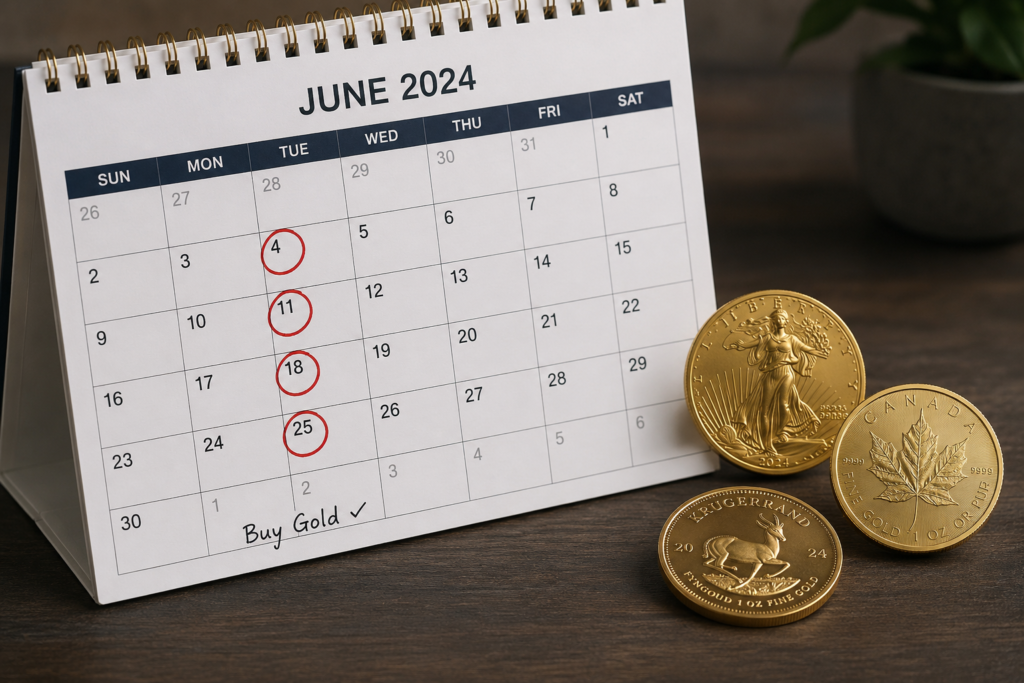
Dollar-cost averaging means buying a fixed dollar amount of gold on a regular schedule, such as a set amount every month or quarter, regardless of the price that day. When gold is cheaper, your fixed amount buys a little more; when it is pricier, it buys a little less. Over many purchases, your entry price settles near the average, which removes the pressure to pick a single right moment.
The real product of dollar-cost averaging is not a better price; it is a removed decision. You stop trying to read the market and start following a rule, which is what most people can actually sustain. It also fits how many people have money to invest in the first place, a bit each month rather than a lump sum all at once.
The cadence details, including how often to buy, what purchase size makes sense given premiums, and how to run the same rule across gold and silver, are their own topic. Our dollar-cost averaging strategy guide covers the mechanics in depth. This section is only about what the approach does and why it suits the timing problem.
Lump sum or dollar-cost averaging: the honest tradeoff
If you already have the full amount to invest, the real question is not timing but sequencing: put it all in now, or feed it in over months. The evidence and the psychology pull in different directions, and both deserve an honest hearing.
The case for lump sum
Research on diversified stock and bond portfolios has found that investing a lump sum immediately beat averaging it in about two-thirds of the time, because markets rise more often than they fall, so money invested sooner has more time to grow. Gold is a different asset, with no yield and long flat stretches, so treat this as directional rather than a guarantee. The underlying logic, that time in the market usually beats timing the market, still applies.
The case for dollar-cost averaging
Averaging in reduces both the risk and the regret of putting everything in right before a drop, and it keeps you from freezing at the decision. For many investors, the behavioral benefit, actually following through instead of waiting, outweighs the average-return edge of going all in at once.
How to choose between them
If the sum is small relative to your finances and your horizon is long, a lump sum is defensible. If deploying it all at once would keep you up at night, or you would likely stall, averaging in over a few months is a reasonable price for peace of mind. How much to commit in the first place is a separate question our guide to how much gold to own walks through.
The market signals people watch, and what they’re worth
Plenty of indicators get cited as reasons to buy or wait. They are worth understanding, mostly so you can hold them loosely. None of them tells you what the price will do next, and treating any one as a green light is just market timing with extra steps.
Real interest rates
Gold competes with interest-bearing savings, so falling real, after-inflation rates often coincide with more interest in gold. It is a driver, not a timer, and the relationship is loose because it moves with expectations that are already priced in.
The US dollar
Gold is priced in dollars, so a weaker dollar can accompany a higher gold price and the reverse. This describes a tendency, not a schedule you can trade on.
Seasonality
Gold has shown historically firmer stretches around certain months, tied to jewelry and gift-buying demand in some markets. The pattern is real in the record but unreliable year to year, and major events routinely override it, so do not build a buying plan on the calendar of past averages.
The gold-to-silver ratio
Some buyers use the ratio between the two metals to decide which to favor. It is an allocation lens, not a timing signal, and it says nothing about the direction of either price.
The timing you can actually control: premium and cost
Spot is not the only price that moves. The premium over spot, the markup above the metal value that you pay for a specific coin or bar, rises when demand spikes and dealer inventory tightens, often in the same anxious moments when people rush to buy. Our premium over spot guide covers why it varies. Buying in calmer periods, and comparing the premium percentage across products, is a real cost lever you control no matter where spot goes.
The number that matters for a long-term holder is total cost per ounce, meaning spot plus premium plus any sales tax, not whether spot ticked up or down the day you bought. A smaller premium on a widely traded coin can matter more to your eventual result than a modest wiggle in spot, and it is knowable in advance rather than guessed at.
Whatever schedule you settle on, run each purchase the same careful way: a vetted dealer, transparent pricing, a traceable payment, and insured delivery.
Our guide to buying gold safely covers that process. A good cadence executed carelessly still exposes you to the risks that have nothing to do with the market.
Building a gold buying rule you’ll stick to
The point of everything above is to replace a hard prediction with a simple rule you can actually keep. A workable rule answers four questions and then mostly runs itself.
- Amount: A fixed dollar figure per purchase that fits your budget without strain.
- Frequency: Monthly, quarterly, or per-paycheck, often enough to stay consistent but spaced enough that premiums and fees do not eat into small buys.
- Product and account: Which coin or bar you default to, and whether it sits in a taxable holding or a gold IRA.
- A pause valve: The one condition, decided in advance, that would make you skip or resize a buy, so the choice is made calmly rather than in the moment.
Keep your blended cost per ounce in view
A buying rule creates a series of purchases at different spot prices and different premiums, and after a year the single most useful number is your blended cost per ounce: what you have paid on average versus what the position is worth now.
That figure is easy to lose in a spreadsheet and nearly impossible to reconstruct from memory. Capturing each purchase as you make it is the only reliable way to keep it, and our cost basis guide explains why that number drives everything from performance to taxes.
Gold Silver Ledger records each purchase with its price and premium and shows your blended cost basis against live gold spot, so a dollar-cost-averaging routine stays legible instead of turning into a shoebox of receipts. If you are setting up a buying schedule, it is worth having the record in place from the first purchase.
Frequently asked questions
When is the best time to buy gold?
The best time to buy gold is whenever fits your budget and long holding period, because no one reliably predicts short-term prices, and for most investors a consistent schedule beats trying to catch a top or bottom. Framing the decision around your own horizon rather than the day’s price is what makes it repeatable.
Is it better to buy gold all at once or over time?
Investing a lump sum all at once has historically beaten averaging in about two-thirds of the time for diversified portfolios, simply because money invested sooner has more time to grow, though that research is not gold-specific. Averaging in over time reduces the regret of buying right before a drop, so the better choice depends on your risk tolerance and whether a lump sum would make you hesitate.
Does dollar-cost averaging work for gold?
Dollar-cost averaging works for gold as a way to remove the pressure of timing, spreading purchases across many price points so your entry settles near the average. It does not guarantee a better price than buying all at once, but it makes a buying routine easy to sustain and keeps emotion out of each purchase.
Should I wait for the gold price to drop before buying?
Waiting for the gold price to drop is a bet that you can predict short-term moves, which even professionals do not do consistently, and the dip you are waiting for may never arrive. If your horizon is years, the purchases you skip while waiting usually cost more than the small price difference you are trying to capture.
What is the worst time to buy gold?
The worst time to buy gold is in a panic, when a price spike and a surge in demand also push dealer premiums to their highest, so you overpay on both the metal and the markup at once. Buying on emotion after a sharp run-up is the pattern most likely to leave you paying more than you needed to.
How often should I buy gold?
How often you buy gold should balance consistency against cost, with monthly, quarterly, or per-paycheck schedules all common; buy often enough to stay disciplined but spaced enough that premiums and fees do not eat into small purchases. The right frequency is the one you will actually keep over years.
Is there a best month or season to buy gold?
Gold has shown historically firmer stretches around late-year and early-year demand in some markets, but the seasonal pattern is unreliable from year to year and is routinely overridden by larger events. It is not dependable enough to build a buying plan around, so treat it as context rather than a signal.
Does timing matter if I plan to hold gold for years?
Timing matters far less over a multi-year holding period, because a long horizon smooths out the short-term price swings that make any single entry point feel high-stakes. For a long-term holder, staying consistent and keeping your total cost per ounce low usually matters more than the exact day you buy.
This article is general education, not investment advice, and makes no prediction about the gold price. If you are deciding how to deploy a significant sum, consider consulting a qualified, fee-based financial professional about what fits your situation.
