
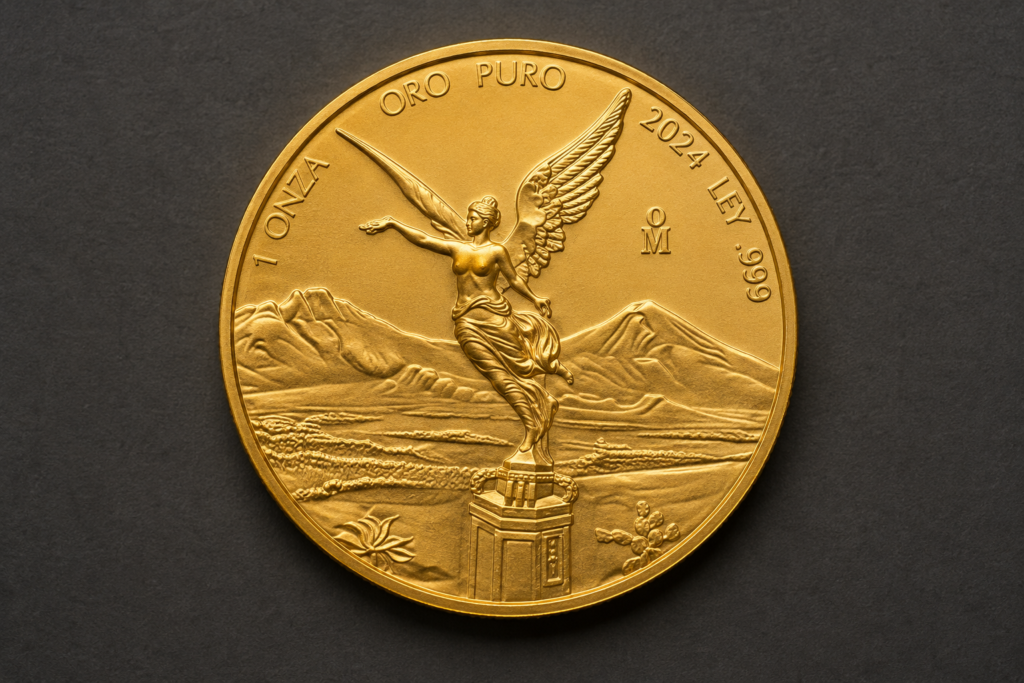
Mexico struck more than half a million 1 troy ounce Gold Libertads in 1981, and then halted the program for a decade. When Casa de Moneda de México resumed production in 1991, it switched the alloy from .900 to .999 fineness, added two new fractional sizes, and settled into per-year mintages that have stayed an order of magnitude below the American Gold Eagle and the Canadian Gold Maple Leaf ever since.
This guide covers the 1981 single-year run, the 1991 reboot, the five-size modern ladder, premium pricing, IRA eligibility, and how to source back-year Libertads with confidence.
Premium figures and dealer prices move daily; the numbers in this guide are durable framing rather than current quotes. Mintage figures are confirmed against Banco de México and numismatic references at the time of publish, but specific year-by-year counts on low-mintage issues should be verified before pricing a back-year coin. Tax treatment is informational and not professional advice.
Mexico’s gold bullion coin in one paragraph
The Mexican Gold Libertad is the official gold bullion coin of the United Mexican States, issued under the authority of Banco de México and struck at Casa de Moneda de México. The program launched in 1981 in three sizes (1 troy ounce, 1/2 troy ounce, 1/4 troy ounce) at .900 fineness — the alloy tradition of the older Mexican Centenario 50 peso coin.
Banco de México paused the program after that single year and brought it back in 1991 at .999 fineness, adding the 1/10 troy ounce and 1/20 troy ounce fractionals to create the five-size ladder that runs today.
Like its silver counterpart, the Gold Libertad carries no peso face value — the denomination is the weight expression itself (“1 ONZA ORO PURO” on the 1 troy ounce coin). Our Mexican Silver Libertad guide covers the no-face-value design choice and the Casa de Moneda de México heritage in depth.
This article focuses on what is distinctly true of the gold series: the 1981/1991 production gap, the post-1991 scarcity profile, the five-size modern ladder, and the back-year sourcing problem that defines a real Gold Libertad position.
Gold Libertads from 1991 forward are IRA-eligible under IRC §408(m)(3) at .999 fine, comfortably above the default .995 gold threshold; the 1981 issues are not. Our guide to gold bullion covers the broader category context.
Two production runs, separated by a decade
The 1981 inaugural run is the foundational year of the program. Casa de Moneda de México struck the Gold Libertad in three sizes that year: about 596,000 pieces at 1 troy ounce, 193,000 at 1/2 troy ounce, and 313,000 at 1/4 troy ounce, all in .900 fine gold. At those mintage levels, the 1981 issues are the most widely distributed Gold Libertads in the U.S. market and the cleanest entry point if you are focused on metal content rather than collector premium.
Banco de México suspended the Gold Libertad after 1981. From 1982 through 1990, nine full years, no Gold Libertads were struck at all. The reasons tie to the broader Mexican monetary instability of the period (the same context that shaped the Silver Libertad’s 1982 no-face-value launch). For the Gold Libertad specifically, the result is a clean ten-year gap in the production record between the 1981 issues and any post-1991 coin.
No peer major sovereign gold bullion program has a comparable halt; the Krugerrand, Maple Leaf, Eagle, Britannia, Philharmonic, and Chinese Gold Panda have all been continuous since their launches.
The 1991 reboot is the start of the modern bullion program. Casa de Moneda de México resumed production at .999 fineness rather than the original .900, brought the 1/10 troy ounce and 1/20 troy ounce sizes into the ladder for the first time, and committed to annual production from 1991 forward.
The 1991 issues retained the Winged Victory reverse and the Mexican coat of arms obverse from 1981; the 1996 reverse refresh (adding the volcanoes Popocatépetl and Iztaccíhuatl) and the 2000 obverse refresh (adding the ten-coat-of-arms ring) arrived on the same timeline as the Silver Libertad.
Why post-1991 mintages stayed small
Banco de México has produced the post-1991 Gold Libertad in dramatically smaller annual quantities than the 1981 run. The structural reason is straightforward. Casa de Moneda de México distributes the Libertad through authorized purchasers, and international demand for the Gold Libertad has never approached the demand for the American Gold Eagle, the Canadian Gold Maple Leaf, or the South African Krugerrand.
Mexico doesn’t have a domestic gold-buying market on the scale of the United States or Canada, and the Libertad does not carry the marketing budget that drives Eagle and Maple sales abroad. The mint produces to demand, and demand has stayed modest.
The result is per-year mintages that sit an order of magnitude below the major peer gold sovereigns. Where the U.S. Mint strikes American Gold Eagles in the hundreds of thousands or low millions per year across the ladder, Casa de Moneda de México mints the Gold Libertad in the low thousands per size in most years, and in the hundreds in some years.
Several individual size-and-year combinations carry mintages under 1,000 pieces, which puts them in a different category from any bullion-tier peer.
Some commonly cited low-mintage Gold Libertad issues include the 2003 1 troy ounce at roughly 500 coins and the 2008 1 troy ounce at roughly 800 coins. Several 1/20 troy ounce and 1/10 troy ounce years across the post-1991 era carry similarly low numbers.
The dealer market treats these issues as bullion-plus-collector hybrids: a back-year low-mintage Gold Libertad trades at the gold floor plus a meaningful collector premium that can multiply the bullion floor in extreme cases. Confirm current mintage figures against the Banco de México archive or a numismatic reference (PCGS, NGC) before pricing a specific back-year issue.
The five-size ladder
Every modern Gold Libertad (1991 forward) shares the same .999 fineness, the same Winged Victory reverse, the same Mexican coat of arms obverse (with the post-2000 ten-coat-of-arms ring), and the same no-peso-face-value design choice. The five sizes differ in metal content, diameter, gross weight, per-year mintage, and the premium they command above spot.
1/20 troy ounce (1.555 g of .999 gold, 13 mm diameter)
The smallest fractional. Per-year mintages routinely run in the hundreds to low thousands. Highest premium per troy ounce in the ladder. Sold in mint-sealed plastic capsules.
1/10 troy ounce (3.110 g, 16 mm)
The next fractional up. Premium profile similar to the 1/20 oz on a per-ounce basis. Sold in mint-sealed plastic capsules.
1/4 troy ounce (7.776 g, 22 mm)
Middle of the modern ladder. The 1981 issue (.900 fine) is the most widely distributed 1/4 oz year by a wide margin and is the cheapest 1/4 oz entry point on the secondary market.
1/2 troy ounce (15.552 g, 28 mm)
The largest fractional. Premium per troy ounce closest to the 1 oz workhorse among the fractionals.
1 troy ounce (31.103 g, 34 mm)
The workhorse. The most widely distributed Libertad size in the U.S. market and the size accepted by every IRA custodian. Post-1991 issues are .999 fine and IRA-eligible; the 1981 issue is .900 fine and is not. The metal-content floor under any Libertad size is the published weight multiplied by the live gold spot price.
Design notes for gold buyers
The Gold Libertad shares the design system with the Silver Libertad. The Winged Victory statue (Victoria Alada) crowns the Angel of Independence monument in Mexico City and sits on the reverse; the Mexican coat of arms (the eagle on the cactus with the snake) sits on the obverse; the 1996 reverse refresh added Popocatépetl and Iztaccíhuatl behind Victoria Alada; the 2000 obverse refresh added a ring of ten historical national seals around the current coat of arms.
Our Mexican Silver Libertad guide covers the design narrative in depth — the Angel of Independence monument, the Italian sculptor Enrico Alciati, the volcanoes, and the historical seals on the obverse ring.
Two gold-specific notes. First, the 1981 issues are .900 fine alloy, which gives the coin a noticeably yellower-toned strike than the .999 fine post-1991 issues. A 1981 1 oz placed next to a 2010 1 oz reads as a different metal in good light. Second, the post-1991 .999 fine alloy is softer and more prone to surface marks than the .900 alloy, which is why post-1991 issues typically ship in mint-sealed plastic capsules where the 1981 issues often arrive loose.
The capsules matter for resale: a sealed capsule on a low-mintage back-year issue is part of the collector dimension that supports premium pricing.
What you pay above spot
The Gold Libertad’s premium structure is unlike any peer gold sovereign. Current-year issues at the 1 troy ounce size carry a moderate per-coin premium over spot, comparable to or modestly above a current-year American Gold Eagle or Canadian Gold Maple Leaf. That is the floor, and it applies to a small fraction of available inventory. Most Gold Libertads on the dealer market are back-year issues, and back-year pricing depends heavily on the specific year and size.
Three structural reasons place the back-year Gold Libertad market in its own category. Casa de Moneda de México runs much smaller annual mintages than any peer mint, with several individual size-and-year combinations carrying mintages under 1,000 pieces.
Single-mint production limits supply. And the limited international distribution of the Libertad means many back-year coins never made it into the U.S. market in the first place, which compresses available supply further. Our Chinese Gold Panda guide covers the closest peer-mint scarcity story for comparison.
For a bullion-allocation position, a current-year 1 oz Gold Libertad delivers gold exposure at a moderate premium over spot. For a collector-leaning position, individual back-year issues at low-mintage dates can multiply the bullion floor. Live premium figures move daily, so check current dealer pricing at purchase. See our premium over spot guide for the framework and our gold spot price guide for the live-data layer.
Gold Libertads in an IRA
Every modern bullion Gold Libertad from the 1991 reboot forward meets the IRS fineness rule under IRC §408(m)(3). The .999 fineness clears the default .995 gold threshold, and every size in the five-size modern ladder qualifies.
The 1981 inaugural issues are .900 fine and fail the default gold fineness rule, so they are structurally taxable-only and are not IRA-eligible at any size. That gives the Gold Libertad a clean two-era IRA split: 1981 NOT eligible, 1991 forward eligible.
The Gold Libertad qualifies under the default fineness rule only. There is no statutory exception. That places the Libertad on the same eligibility path as the Canadian Gold Maple Leaf, the Gold Vienna Philharmonic, the post-2013 Gold Britannia, and the Chinese Gold Panda: eligible by fineness, not by named exception.
IRA-held Libertads must be stored at an IRS-approved depository; home storage of IRA gold is not permitted. Comparable IRA-eligible sovereign gold options:
- Canadian Gold Maple Leaf: .9999, default rule.
- Austrian Gold Philharmonic: .9999, default rule.
- Gold Britannia: .9999 since 2013, default rule. Pre-2013 issues at .9167 fail the default rule.
- American Gold Eagle: .9167 (22-karat). IRA-eligible via a named statutory exception.
- South African Krugerrand: .9167. Not IRA-eligible. It fails the fineness rule and has no statutory exception.
Sourcing back-year Libertads
Current-year Gold Libertads at the 1 troy ounce size are sold at every major U.S. gold bullion dealer (APMEX, JM Bullion, Money Metals Exchange, SD Bullion, Provident Metals, Hero Bullion). Back-year issues live in a different inventory pool: the major dealers carry some back-year stock at the 1 oz size, but the fractional ladder and the lower-mintage years are more reliably found at specialty Mexican coin dealers and through certified populations at PCGS and NGC.
Coin shows are a productive sourcing venue for low-mintage back-year Libertads. Our how to buy gold guide covers the broader buying framework.
Authentication on a low-distribution coin
Authentication on a Gold Libertad relies on the published specifications per size (1 troy oz at 31.103 g and 34 mm; the analogous gross weight and diameter for each smaller size), the reeded edge profile, and the strike characteristics consistent across Casa de Moneda de México production. A handheld Sigma Verifier reads the .999 gold conductivity signature on post-1991 issues; the 1981 .900 fine issues read differently and need a Sigma sample tuned for the lower-fineness alloy.
The ping test confirms a struck precious-metal profile against base metal. Side-by-side comparison with a known-genuine reference coin is the practical buyer-side check, particularly on low-mintage back-year issues where dealer reference inventory may be thin.
Storage choices
Storage choices for taxable positions are open: a home safe rated for fire and theft, a bank safe deposit box, or a private depository (Brink’s, Loomis, Delaware Depository). IRA-held Libertads must be stored at an IRS-approved depository; home storage of IRA gold is not permitted. Mint-sealed plastic capsules on post-1991 issues should be preserved for resale — the collector market values original mint packaging on low-mintage back-year coins.
Selling a Gold Libertad
Current-generation 1 oz Gold Libertads resell at any major U.S. dealer at the prevailing bid-ask convention for .999 fine gold sovereigns. Back-year Libertads at low-mintage dates often sell better at coin shows or to specialty Mexican coin dealers than at the major bullion houses, which price back-year stock conservatively because they trade on volume. U.S. capital gains on physical gold are taxed as collectibles, up to 28% on long-term gains rather than the standard 15% to 20% long-term capital gains rate.
The collectibles rate applies to the full gain regardless of how much of that gain came from collector premium rather than bullion appreciation. Consult a qualified tax professional before filing.
Frequently asked questions
Is the 1981 Mexican Gold Libertad real gold?
Yes, the 1981 Mexican Gold Libertad is real gold, struck in .900 fine alloy (about 30.262 grams of pure gold in the 1 troy ounce coin, with an additional copper alloy bringing the gross weight to 33.625 grams). The 1981 alloy follows the older Mexican Centenario gold-coin tradition; the modern bullion program switched to .999 fineness when production resumed in 1991. The 1981 issue is the most widely distributed Gold Libertad year by a wide margin.
Why did Mexico stop minting the Gold Libertad after 1981?
Banco de México suspended Gold Libertad production after 1981 and did not strike another Gold Libertad until 1991, a full ten years later. The pause reflected broader Mexican monetary instability through the 1980s. When the program returned in 1991, the alloy moved from .900 to .999 fineness and the ladder expanded to add the 1/10 troy ounce and 1/20 troy ounce fractionals.
How rare is the Mexican Gold Libertad?
Post-1991 Gold Libertads have per-year mintages an order of magnitude below the major peer gold sovereigns, with several individual size-and-year combinations carrying mintages under 1,000 pieces. The 2003 1 troy ounce at roughly 500 coins and the 2008 1 troy ounce at roughly 800 coins are among the lowest-mintage major sovereign gold bullion issues from any mint. The 1981 inaugural year is the exception: the 596,000 1 troy ounce, 193,000 1/2 troy ounce, and 313,000 1/4 troy ounce produced that year are widely available on the secondary market.
What sizes does the Gold Libertad come in?
The modern Gold Libertad ladder runs in five sizes: 1/20, 1/10, 1/4, 1/2, and 1 troy ounce, all at .999 fineness. The 1/20 and 1/10 sizes joined the program in 1991; the 1/4, 1/2, and 1 oz sizes have been struck since 1981 (in .900 fineness in 1981 and in .999 fineness from 1991 forward). The Gold Libertad does not have the 2 oz, 5 oz, or 1 kilo sizes that the Silver Libertad runs.
Is the 1981 Gold Libertad IRA-eligible?
No, the 1981 Gold Libertad is not IRA-eligible. The 1981 issues are .900 fine alloy and fail the IRS default gold fineness rule under IRC §408(m)(3), which requires gold held in an IRA to be at least .995 fine. There is no statutory exception that covers the Libertad at lower fineness. Every Gold Libertad from 1991 forward at .999 fineness clears the default rule and is IRA-eligible.
How much does a Mexican Gold Libertad weigh?
A 1 troy ounce post-1991 Gold Libertad weighs 31.103 grams of pure .999 fine gold, with no hardening alloy added (the gross weight equals the pure metal content). The 1981 1 troy ounce issue is .900 fine, with 31.103 grams of pure gold inside a 33.625 gram gross weight (about 3.36 grams of copper alloy). The five-size ladder runs 1.555 g (1/20), 3.110 g (1/10), 7.776 g (1/4), 15.552 g (1/2), and 31.103 g (1 oz) of pure metal content.
What is the difference between the Gold Libertad and the Mexican Centenario?
The Mexican Centenario is a 50 peso commemorative gold coin (37.5 grams gross, .900 fineness, about 1.2057 troy ounces of pure gold) originally struck 1921 to 1947 to commemorate the centenary of Mexican independence; the Mexican Gold Libertad is the modern bullion program launched in 1981 and continued from 1991 forward. The Centenario has been restruck multiple times over the decades and carries a 1947 dual date on most modern restrikes; the Libertad is dated by year of issue and runs in a five-size ladder. The 1981 Gold Libertad’s .900 fineness directly references the Centenario alloy tradition.
This guide is informational only and is not investment, tax, or legal advice. Confirm current specifications against Banco de México and Casa de Moneda de México and verify back-year mintage figures against PCGS, NGC, or the Banco de México archive before pricing a specific issue. Confirm current premium and tax treatment with a qualified professional before acting.
