
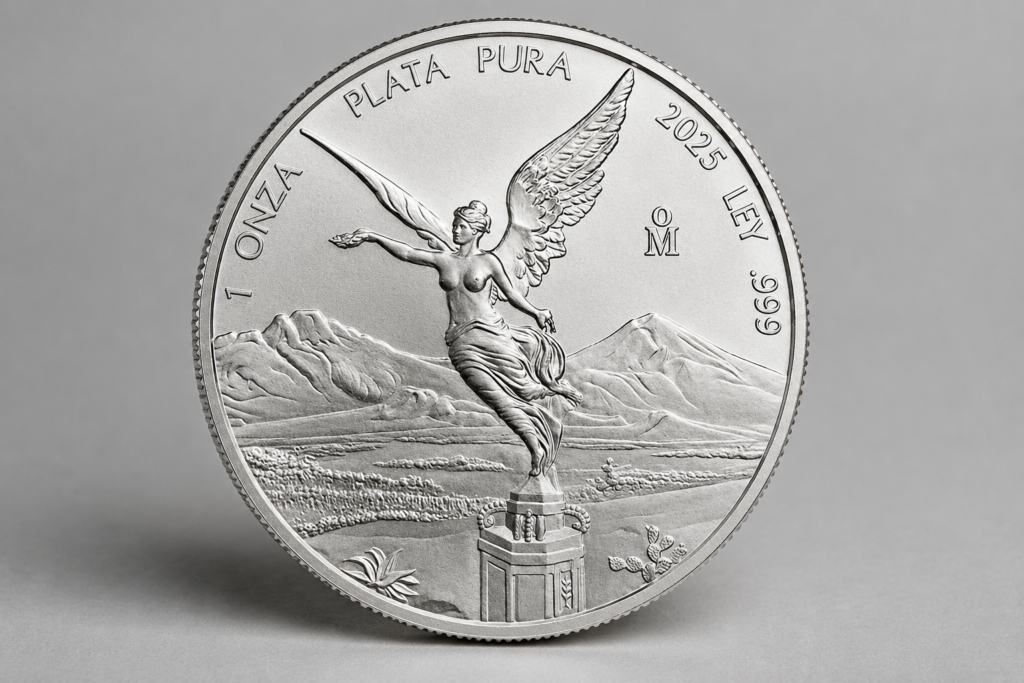
Casa de Moneda de México was already 257 years old when the United States opened its first mint in Philadelphia. The same mint has been striking the Mexican Silver Libertad continuously since 1982, which makes the Libertad the longest-running modern 1 troy ounce silver bullion coin from any sovereign mint, and the only one of its peers that carries no face value.
Today the program runs in eight sizes, all at .999 fineness, with per-year mintages that sit well below the American Silver Eagle and the Canadian Silver Maple Leaf. This guide covers what makes the coin different and how a Libertad position actually works.
Premium figures and dealer prices move daily; the numbers in this guide are durable framing rather than current quotes. Tax treatment is informational and not professional advice.
Mexico’s silver bullion coin, and the one that came first
The Mexican Silver Libertad is the official silver bullion coin of the United Mexican States, issued by Banco de México and struck at Casa de Moneda de México in Mexico City. The series launched in 1982 at one troy ounce and .999 fineness, which made it the first modern 1 troy ounce silver bullion coin issued by any sovereign mint.
The American Silver Eagle followed in 1986, the Canadian Silver Maple Leaf in 1988, the modern Chinese Silver Panda bullion strike in 1989, the Australian Silver Kangaroo in 1993, and the Silver Vienna Philharmonic in 2008. The modern .999 Silver Britannia did not arrive until 2013.
Today the program runs in eight sizes, from 1/20 troy oz to 1 kilo, all at .999 fineness, all struck at the same single mint, and all carrying the same defining quirk: no peso face value. The denomination is the weight expression itself (“1 ONZA PLATA PURA” on the 1 troy oz coin). Silver Libertads are IRA-eligible by default IRS rule under IRC §408(m)(3) because .999 fine silver clears the default threshold.
A 491-year-old mint
Casa de Moneda de México was founded in 1535 in Mexico City by royal decree of Carlos I of Spain (Charles V, Holy Roman Emperor). It is the oldest mint in the Americas, predating the U.S. Mint (founded 1792) by more than two and a half centuries, and the Royal Canadian Mint (1908) by nearly four. For most of its history, the mint produced Spanish colonial coinage struck from the silver of New Spain. After Mexican independence in 1821, it continued as the central mint of the new republic.
Banco de México, the central bank of the United Mexican States and founded in 1925, holds the sovereign authority to issue the Libertad. Every Silver Libertad is struck at Casa de Moneda de México. Single-mint production means no mint-of-origin variation across the program’s history and no mintmark on the coin, because there is only one issuing mint.
For a bullion buyer, that consistency matters: every Silver Libertad from every year is struck to the same .999 fineness at the published weight.
Why there’s no peso on the coin
Every other major sovereign silver bullion coin carries a token face value. The American Silver Eagle is denominated at $1, the Canadian Silver Maple Leaf at 5 Canadian dollars, the Silver Britannia at £2, the Silver Philharmonic at €1.50, the Silver Panda at 10 yuan, and the Silver Kangaroo at $1 Australian. The Mexican Silver Libertad carries none. The reverse field shows the weight expression itself (“1 ONZA PLATA PURA” for the 1 troy oz size, with the analogous wording for each other size) where a token peso amount would otherwise sit.
Banco de México adopted the no-face-value approach in 1982 against the backdrop of the Mexican debt crisis and the multi-year devaluation of the peso. A peso-denominated face value on a one-ounce silver coin would have priced almost immediately below the metal content at prevailing silver prices, and the devaluations of the 1980s and early 1990s would have widened that gap further.
The Libertad is legal tender within Mexico at a variable redemption value, set by Banco de México and tied to the prevailing silver price. That mechanism is unique to this coin among major sovereign silver bullion. For U.S. buyers, the legal-tender mechanism is informational; the coin is valued on its silver content and the secondary-market premium it commands.
Reading the Silver Libertad: Winged Victory, the volcanoes, and the ring of seals
The reverse depicts the Winged Victory statue (Victoria Alada) that crowns the Angel of Independence monument (Ángel de la Independencia) on Paseo de la Reforma in Mexico City. The monument was commissioned by Mexican president Porfirio Díaz to commemorate the centenary of Mexico’s 1810 War of Independence and completed in 1910. Italian artist Enrico Alciati sculpted the figure: a winged woman holding a laurel crown in her right hand and broken chains in her left.
From 1996 forward, the Libertad reverse adds the volcanoes Popocatépetl and Iztaccíhuatl behind the figure, the two snow-capped peaks that frame the eastern horizon from central Mexico City.
The obverse depicts the current Mexican coat of arms: the golden eagle perched on a prickly-pear cactus consuming a snake, taken from the Aztec founding legend of Tenochtitlán. From 2000 forward, the obverse adds a ring of ten historical Mexican national seals around the current coat of arms, drawn from the various official seals used by independent Mexico across the nineteenth and twentieth centuries.
The ring is unique to the post-2000 issues and gives the modern Libertad an obverse density unlike any other sovereign silver bullion coin.
Where most major silver sovereign designs read flat (a portrait, an animal, a national symbol), the Libertad packs three layers of Mexican iconography onto each face. Victoria Alada and her broken chains carry the Independence narrative.
The volcanoes carry the geographic identity. The ring of historical seals carries the modern republic’s self-portrait across two centuries. That visual density is part of why the Libertad attracts buyers who value the program for reasons beyond the silver content alone.
Three design generations: 1982, 1996, and 2000
The first generation (1982 through 1995) is the original program. One troy ounce only at launch; the five-size fractional ladder (1/20, 1/10, 1/4, 1/2, 1 oz) arrived in 1991; the 2 troy oz, 5 troy oz, and 1 kilo sizes were added through the early-to-mid 1990s. The 1982 first-year-of-issue is a recognized premium issue across the program, with a modest mintage, foundational status, and the cleanest first-generation reverse (Victoria Alada without the volcanoes, on a simpler obverse without the coat-of-arms ring).
The second generation (1996 through 1999) added the volcanoes Popocatépetl and Iztaccíhuatl behind the Victoria Alada figure on the reverse. The obverse continued in the pre-2000 single-seal format. The 1996 redesign year is often called out specifically in dealer listings, and the four years of second-generation production before the obverse change in 2000 sometimes trade as a transitional sub-series.
The third generation (2000 to present) is the current Libertad. The obverse picked up the ring of ten historical Mexican national seals around the current coat of arms, the most visually distinctive obverse refresh in the program’s history. The reverse retained the post-1996 Victoria Alada with the volcanoes.
Specifications (the eight-size ladder, .999 fineness, no peso face value) have not changed since 2000. A current-year Silver Libertad and a 2001 Silver Libertad are visually nearly identical; both differ visibly from a 1985 or a 1997 issue.
The eight-size ladder, from 1/20 oz to 1 kilo
Every size in the Libertad ladder shares the same .999 fineness, the same Victoria Alada reverse, the same coat-of-arms obverse (post-2000), and the same no-peso-face-value design choice. The eight sizes differ in metal content, diameter, gross weight, per-year mintage, and the premium they command above spot.
1/20 troy oz (1.555 g of .999 silver, 16 mm diameter)
The smallest fractional. Lower per-year mintages than the 1 oz; highest premium per troy ounce in the ladder. Sold in mint-sealed plastic capsules.
1/10 troy oz (3.110 g, 20 mm)
The next fractional up. Similar premium profile to the 1/20 oz.
1/4 troy oz (7.776 g, 27 mm)
Middle of the fractional band.
1/2 troy oz (15.552 g, 33 mm)
The largest fractional. Premium per troy ounce closest to the 1 oz workhorse among the fractionals.
1 troy oz (31.103 g, 40 mm)
The workhorse. The most widely distributed Libertad size in the U.S. market and the size accepted by every IRA custodian. The cost-efficient choice for a silver-allocation position. Sold loose, in capsules, or in 25-coin mint tubes.
2 troy oz (62.207 g, 48 mm)
A collector-leaning larger size with low per-year mintages and a meaningful per-ounce premium above the workhorse.
5 troy oz (155.517 g, 65 mm)
A large-format issue with low per-year mintages and a substantial collector dimension.
1 kilo (1000 g, 110 mm)
The largest size in the ladder. Very low per-year mintages and the highest collector-dimension premium of the size ladder. The metal-content floor under any Libertad size is the published weight multiplied by silver spot.
What you pay above spot, and what you’re paying for
The Silver Libertad usually trades at a higher premium over spot than the Silver Maple Leaf, the post-2013 Silver Britannia, the Silver Vienna Philharmonic, and the Australian Silver Kangaroo on a like-for-like .999 basis. The American Silver Eagle sits at or above the Libertad on premium because of the U.S. domestic premium. The Silver Panda is often at or above the Libertad because of its annual-design rotation; our Chinese Silver Panda complete buyer’s guide covers that program in depth.
Three structural reasons place the Libertad above most of the .999 silver peer group. Casa de Moneda de México runs much smaller annual mintages on the Silver Libertad than the U.S. Mint, the Royal Canadian Mint, the Royal Mint, or the Austrian Mint run on their flagship silvers, by an order of magnitude in many years on the 1 oz size, and by a wider margin on the fractionals and larger sizes. Single-mint production limits supply. And four decades of lower-mintage history have built a collector-dimension demand layer on top of the bullion floor.
For a bullion-allocation position, the per-coin premium gap between a current-year Libertad and a current-year Silver Maple Leaf can be material across a multi-coin purchase. For a position that values the lower-mintage profile and the Casa de Moneda heritage, the premium is part of what you are paying for.
Holding Silver Libertads in an IRA
Every Silver Libertad from the 1982 launch forward meets the IRS fineness rule under IRC §408(m)(3). The .999 fineness clears the default threshold, and every size in the eight-size ladder qualifies; the IRA-eligibility rule does not distinguish by weight. The 1982 launch year and every subsequent year are eligible. There is no vintage exclusion comparable to the pre-1989 Chinese Silver Panda issues or the pre-2013 Silver Britannia.
Our silver Britannia complete buyer’s guide covers that vintage-driven contrast in detail.
The Libertad qualifies under the default fineness rule only. There is no statutory exception. That puts the Libertad on the same eligibility path as the Silver Maple, Silver Philharmonic, post-2013 Britannia, 1989-forward Silver Panda, and Silver Kangaroo: eligible by fineness, not by named exception. IRA-held Libertads must be stored at an IRS-approved depository; home storage of IRA silver is not permitted.
Some custodians prefer the 1 troy oz size for accounting simplicity, but the fineness rule itself accepts every size in the ladder. Comparable IRA-eligible sovereign silver options:
- Canadian Silver Maple Leaf: .9999, default rule
- Austrian Silver Philharmonic: .999 since 2008, default rule
- Chinese Silver Panda: .999 from 1989 forward, default rule
- Australian Silver Kangaroo: .9999, default rule
- American Silver Eagle: .999 default rule plus the statutory exception that covers any American Eagles
Buying, verifying, storing, and selling
Here is where to go to buy and sell Silver Libertad.
Where to buy
The Silver Libertad is sold at every major U.S. silver bullion dealer (APMEX, JM Bullion, Money Metals Exchange, SD Bullion, Provident Metals, Hero Bullion), at major Mexican dealers, and at coin dealers across both markets.
Current-year issues are widely stocked at the 1 troy oz size and in 25-coin mint tubes; back-year issues are available in varying depth depending on the year and the dealer. Lower-mintage years carry collector-dimension premiums above the generic Libertad price.
The fractional sizes and the 2 oz, 5 oz, and 1 kilo sizes have narrower distribution than the 1 troy oz workhorse and may require specialty dealers. Our how to buy silver guide covers the broader buying framework.
How to verify what you got
Authentication relies on the published specifications, the reeded edge, and the strike characteristics consistent across Casa de Moneda de México production. Unlike the Silver Eagle, Maple Leaf, or Silver Britannia, the 1 troy oz Libertad usually ships loose without a factory assay sleeve; single-coin mint capsules exist but are not the universal default. A handheld Sigma Verifier reads the .999 silver conductivity signature in a way that distinguishes a real Libertad from base-metal counterfeits.
The ping test confirms a struck precious-metal profile against base metal. Counterfeits exist, particularly for high-premium back-year issues and the larger sizes, so side-by-side comparison with a known-genuine reference coin is the practical buyer-side check.
Storage choices
Storage choices for taxable positions are open: a home safe rated for fire and theft, a bank safe deposit box, or a private depository (Brink’s, Loomis, Delaware Depository). IRA-held Libertads must be stored at an IRS-approved depository; home storage of IRA silver is not permitted. The 1 oz Libertad typically lives in mint tubes or protective capsules; the fractionals and the larger sizes usually arrive in mint-sealed plastic capsules that should be preserved for resale.
Reselling a Libertad
Resale at any major dealer is straightforward for current-generation issues. Bullion-grade Libertads trade at the same bid-ask convention as other major .999 silver sovereigns. The Libertad differs from the Maple or Philharmonic in that the year-and-size combination materially affects resale: a generic back-year 1 oz trades at bullion-plus-premium, while lower-mintage years and most issues at the 1/20, 1/10, 2, 5, and 1 kilo sizes can carry meaningful collector premium.
U.S. capital gains on physical silver are taxed as collectibles, up to 28% on long-term gains rather than the standard 15% to 20% long-term capital gains rate. Consult a qualified tax professional before filing.
Frequently asked questions
Is the Mexican Silver Libertad real silver?
Yes, every Mexican Silver Libertad struck since the 1982 launch contains .999 fine silver at the published weight (one troy ounce in the 1 oz coin, with the same fineness across the seven other sizes in the ladder). The coin has no peso face value because Banco de México chose to denominate the Libertad by its weight rather than a fixed peso amount, but the silver content itself is independently verifiable and meets the same .999 fineness standard as the Silver Eagle, Maple Leaf, Britannia, Philharmonic, and Panda.
Why doesn’t the Silver Libertad have a face value?
The Silver Libertad has no fixed peso face value because Banco de México launched the program in 1982 during the Mexican debt crisis, and a peso-denominated face value on a one-ounce silver coin would have priced almost immediately below the metal content. The Libertad is legal tender within Mexico at a variable redemption value tied to the prevailing silver price, which is unique to this coin among major sovereign silver bullion programs.
Who makes the Mexican Silver Libertad?
The Mexican Silver Libertad is issued under the authority of Banco de México (the central bank of the United Mexican States) and struck at Casa de Moneda de México, the official Mexican mint. Casa de Moneda was founded in 1535 by royal decree of Carlos I of Spain and is the oldest mint in the Americas. Single-mint production means every Libertad from every year of the program comes from the same facility.
What sizes does the Silver Libertad come in?
The Silver Libertad is produced in eight sizes: 1/20, 1/10, 1/4, 1/2, 1, 2, and 5 troy ounces, plus a 1 kilo size that contains about 32.151 troy ounces of pure silver. Every size is .999 fine and carries the same Victoria Alada reverse and coat-of-arms obverse design. The 1 troy oz is the workhorse for most U.S. buyers; the fractionals, the larger sizes, and the 1 kilo carry higher per-ounce premiums.
Are Mexican Silver Libertads harder to find than American Silver Eagles?
Yes, Mexican Silver Libertads have substantially lower per-year mintages than American Silver Eagles, by an order of magnitude in many years on the 1 troy oz size, and by a wider margin on the fractionals and larger sizes. They are still widely sold by every major U.S. silver dealer, but back-year Libertads at the fractional and larger sizes can take more searching to source, and lower-mintage years often carry a collector-dimension premium above the generic Libertad price.
Can I hold Silver Libertads in a retirement account?
Yes, Mexican Silver Libertads from every year of the program are IRA-eligible under IRC §408(m)(3) because their .999 fineness clears the default IRS silver standard. Every size in the eight-size ladder qualifies under the same default rule. IRA-held Libertads must be stored at an IRS-approved depository, and home storage of IRA silver is not permitted.
What was the first year of the Silver Libertad?
The Silver Libertad launched in 1982 at one troy ounce and .999 fineness, which made it the first modern 1 troy ounce silver bullion coin issued by any sovereign mint. The 1982 issue had a modest mintage and is recognized as a foundational year across the program; 1982 first-year-of-issue Libertads often carry a collector premium above the generic Libertad price at any size.
This guide is informational only and is not investment, tax, or legal advice. Confirm current specifications against Banco de México and Casa de Moneda de México, and confirm current premium and tax treatment with a qualified professional before acting.
