
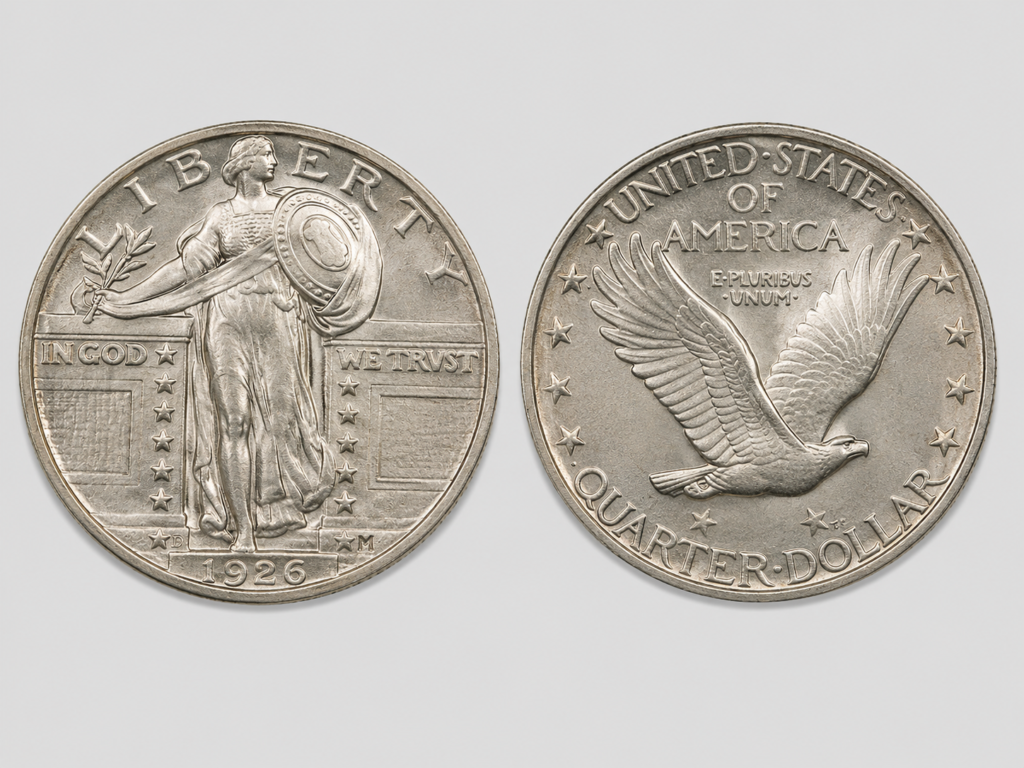
The Standing Liberty quarter ran for fifteen years, from 1916 to 1930, with no coins struck in 1922. Every piece is 90% silver — 0.1808 troy oz of silver inside, which puts a real floor under every common-date coin at the live silver spot.
A handful of dates carry premium far above the floor: the 1916 with its 52,000-piece mintage, the 1918/7-S overdate, the 1921, 1923-S, and 1927-S, and any Mint State coin with a Full Head designation.
This Standing Liberty quarter guide hands you the year-by-year chart, the type breakdown, and the key-date list in one place. The companion liberty quarter searches lead to the same coin.
What is a Standing Liberty quarter worth today?
Most circulated Standing Liberty quarters from the common-date 1920s years trade at the silver floor — 0.1808 troy oz × the live silver spot — which works out to a few dollars per coin at typical silver levels. That floor is real because the coin is 90% silver and is recognized junk-silver content; any dealer who buys junk silver buys these coins by the bag.
Above the floor, the 1916 sits in the four to five figures at every grade because of the 52,000-piece mintage. The 1918/7-S overdate, the 1921, 1923-S, and 1927-S sit in the low to high hundreds in Good through Fine and climb fast at Mint State.
Full Head Mint State examples of any date carry a significant premium over the same coin without the Full Head designation, because the strike was soft across most of the series, and full-strike survivors are uncommon. The chart below works through the year-by-year ranges; the identification, mintmark, and type sections that follow walk through what a coin in your hand actually is.
Is it really a Standing Liberty quarter? Identification before valuation
The obverse shows Liberty standing on a pedestal, facing right, holding a shield in her left hand and an olive branch extended in her right. The date sits on the base of the pedestal. The reverse shows an eagle in flight with thirteen stars above. Diameter is 24.3 millimeters. Weight is 6.25 grams. Composition is 90% silver and 10% copper — the same alloy as every U.S. silver quarter from 1796 through 1964.
Two tells distinguish a Standing Liberty quarter from anything else. The standing-figure obverse is unique — no other circulating U.S. quarter shows a full standing Liberty. The eagle-in-flight reverse is also unique — every Washington quarter has an eagle perched on arrows, not in flight.
A Barber quarter from 1892 through 1916 shows a profile Liberty bust similar to the Barber dime and half, a completely different design. A coin with no visible date is often a worn pre-1925 Standing Liberty quarter — the date wore off in circulation on many examples, and the next section covers that.
How to read the date and mintmark
The date sits on the base of the pedestal on the obverse — exposed and unprotected. From 1916 through 1924, the date wore off faster than any other U.S. coin series because the design left no recessed area to protect it. The U.S. Mint solved the problem in 1925 by recessing the date into the pedestal; coins from 1925 onward (the Type 2b design) hold their dates well.
A dateless pre-1925 Standing Liberty quarter is still a 90% silver coin and still sells at silver content, but no collector premium applies because the buyer cannot confirm the date.
The mintmark sits on the obverse just above and to the left of the date area, on the pedestal base. No mintmark means Philadelphia. D means Denver. S means San Francisco. San Francisco is the source of most of the famous keys — the 1918/7-S overdate, the 1923-S, and the 1927-S all came out of the San Francisco mint.
Two specific traps: a worn date is the most common reason a key-date suspicion turns out wrong (a partial “1927-S” often reads as 1927 only and is actually a 1927 Philadelphia coin worth a fraction of the S-mint), and any suspected overdate or major key belongs in front of PCGS or NGC before sale.
The three Standing Liberty types and what they tell you about the coin
The series ran fifteen years and changed design twice along the way. Knowing which of the three types your coin belongs to tells you the year range, the rough rarity tier, and what to do when the date itself has worn off.
Type 1 (1916 and early 1917): Bare-breast obverse
The original 1916 design shows Liberty with her right breast exposed, no chain mail, and three reverse stars below the eagle. Mintage of the 1916 was just 52,000 — the lowest-mintage U.S. quarter of the twentieth century and the headline rarity of the series. Type 1 also covers early 1917 in all three mints (Philadelphia, Denver, San Francisco). Type 1 1917s tend to survive in higher average condition than the Type 2 1917s because they were saved as novelties before the mid-year redesign.
Type 2 (mid-1917 through 1924): Chain-mail obverse, exposed date
Partway through 1917, the design was modified. Chain mail was added across Liberty’s chest and three additional stars were placed below the eagle on the reverse. The chain-mail change is the popular myth — the modesty modification — and the reverse-star change is the technical one most often missed in casual descriptions. Type 2 dates run from mid-1917 through 1924 and cover most of the famous variety dates: the 1918/7-S overdate, the 1921 low-mintage Philadelphia issue, and the 1923-S. The 1917 year is the only year that exists in both Type 1 and Type 2 across all three mints.
Type 2b (1925 through 1930): Chain-mail obverse, recessed date
In 1925 the Mint moved the date into a recessed well on the pedestal so it would wear less. The obverse design is otherwise unchanged from Type 2. Type 2b dates run from 1925 through 1930 and hold their dates well even in heavily circulated condition. The major key of the Type 2b run is the 1927-S at a mintage of 396,000 — small, scarce, and condition-sensitive at Mint State.
Type identification matters most when the date is worn off entirely. A bare-breast Liberty narrows the coin to 1916 or early 1917. A chain-mail Liberty with an exposed date narrows it to mid-1917 through 1924. A chain-mail Liberty with a recessed date narrows it to 1925 through 1930. The chart below sits in those three groups for that reason.
Standing Liberty quarter value chart by year and mintmark
The chart below covers every year of the series — no 1922, no coins struck — grouped by type. Ranges are illustrative retail values at five condition tiers — Good (G-4), Fine (F-12), Extremely Fine (EF-40), Mint State (MS-63), and Mint State Full Head (MS-63 FH) — pulled from PCGS Price Guide and NGC Coin Explorer at the time of writing.
The Full Head column roughly doubles or more from the standard MS-63 line on common dates and adds a significant premium on the keys. Re-quote a live source for current pricing before any sale.
| Year / Variety | G-4 Good | F-12 Fine | EF-40 | MS-63 | MS-63 FH |
|---|---|---|---|---|---|
| Type 1 — Bare-breast obverse (1916 and early 1917) | |||||
| 1916 | $3,500–5,500 | $8,000–12,000 | $15,000–25,000 | $30,000–50,000 | — |
| 1917 Type 1 (P) | $30–45 | $45–65 | $90–135 | $225–325 | $425–600 |
| 1917 Type 1 D | $50–75 | $80–115 | $135–195 | $300–425 | $700–1,000 |
| 1917 Type 1 S | $50–75 | $80–115 | $135–195 | $325–450 | $1,200–1,800 |
| Type 2 — Chain-mail obverse, exposed date (mid-1917 through 1924) | |||||
| 1917 Type 2 (P) | $25–40 | $40–60 | $70–105 | $200–290 | $525–750 |
| 1917 Type 2 D | $45–65 | $75–105 | $140–200 | $320–450 | $1,400–2,000 |
| 1917 Type 2 S | $40–60 | $70–100 | $135–195 | $310–435 | $1,800–2,500 |
| 1918 (P) | $22–32 | $30–45 | $60–90 | $220–310 | $1,000–1,500 |
| 1918-D | $45–65 | $80–115 | $160–225 | $425–600 | $3,000–4,500 |
| 1918-S | $25–35 | $40–60 | $75–110 | $275–390 | $8,000–14,000 |
| 1918/7-S (overdate) | $2,500–3,500 | $8,000–12,000 | $22,000–30,000 | $60,000–90,000 | — |
| 1919 (P) | $50–75 | $75–110 | $130–185 | $310–435 | $700–1,000 |
| 1919-D | $130–185 | $240–340 | $525–725 | $1,200–1,700 | $15,000–22,000 |
| 1919-S | $110–155 | $210–290 | $475–650 | $1,100–1,600 | $18,000–28,000 |
| 1920 (P) | $22–32 | $30–45 | $60–90 | $220–310 | $675–950 |
| 1920-D | $70–100 | $130–185 | $260–365 | $575–800 | $5,500–8,500 |
| 1920-S | $25–35 | $40–60 | $80–115 | $285–400 | $15,000–22,000 |
| 1921 | $225–315 | $390–550 | $800–1,150 | $2,100–2,950 | $5,500–8,000 |
| 1923 (P) | $22–32 | $32–48 | $65–95 | $225–315 | $1,800–2,600 |
| 1923-S | $425–600 | $850–1,200 | $1,900–2,700 | $4,500–6,500 | $8,500–13,000 |
| 1924 (P) | $22–32 | $30–45 | $60–90 | $210–295 | $725–1,050 |
| 1924-D | $80–115 | $120–170 | $200–285 | $425–600 | $1,200–1,750 |
| 1924-S | $30–45 | $55–80 | $110–155 | $290–410 | $5,500–8,500 |
| Type 2b — Chain-mail obverse, recessed date (1925 through 1930) | |||||
| 1925 | $8–12 | $15–22 | $30–45 | $200–280 | $500–725 |
| 1926 (P) | $8–12 | $15–22 | $30–45 | $200–280 | $525–750 |
| 1926-D | $15–22 | $25–38 | $55–80 | $240–340 | $5,500–8,500 |
| 1926-S | $10–15 | $22–32 | $110–155 | $525–740 | $11,000–16,000 |
| 1927 (P) | $8–12 | $15–22 | $30–45 | $200–280 | $475–675 |
| 1927-D | $22–32 | $45–65 | $110–155 | $370–520 | $2,800–4,000 |
| 1927-S | $55–80 | $240–340 | $1,800–2,500 | $10,000–15,000 | $55,000+ |
| 1928 (P) | $8–12 | $15–22 | $30–45 | $200–280 | $525–750 |
| 1928-D | $10–15 | $22–32 | $45–65 | $235–330 | $1,250–1,800 |
| 1928-S | $10–15 | $22–32 | $45–65 | $235–330 | $750–1,100 |
| 1929 (P) | $8–12 | $15–22 | $30–45 | $200–280 | $475–675 |
| 1929-D | $10–15 | $22–32 | $45–65 | $225–315 | $1,150–1,650 |
| 1929-S | $10–15 | $22–32 | $45–65 | $225–315 | $700–1,000 |
| 1930 (P) | $8–12 | $15–22 | $30–45 | $200–280 | $475–675 |
| 1930-S | $10–15 | $22–32 | $45–65 | $225–315 | $725–1,050 |
Last updated: June 2026. Cross-checked against PCGS Price Guide and NGC Coin Explorer at publication.
Philadelphia struck the series every year except 1922. The Denver Mint struck Standing Liberty quarters in 1917, 1918, 1919, 1920, 1924, 1925, 1926, 1927, 1928, and 1929 — no D-mint in 1921, 1923, or 1930. San Francisco struck the series in 1917, 1918, 1919, 1920, 1923, 1924, 1925, 1926, 1927, 1928, 1929, and 1930, and is the source of every famous key.
The series ended in 1930 and was replaced by the Washington quarter in 1932 at the bicentennial of George Washington’s birth.
Full Head designation and key dates worth a closer look
The Standing Liberty quarter market is dense with counterfeits and altered coins — especially around the 1916, the 1918/7-S overdate, and the 1927-S in high grade. Any coin you suspect of being a key date, the overdate, or a Full Head Mint State example should be professionally authenticated by PCGS or NGC before sale. Raw key dates routinely sell at half the slabbed price because buyers price in authentication risk.
The list below covers the Full Head designation first (it applies to every date) and then the date-specific keys.
Full Head (FH) designation
A Mint State Standing Liberty quarter is designated Full Head when Liberty’s head shows three distinct olive leaves and her ear is fully defined. The strike was soft on the head detail across most of the series, so Full Head Mint State examples are scarce. Full Head doubles the standard Mint State price on common dates and adds significant premium to keys. PCGS uses FH; NGC uses FH; the two are interchangeable for buyers.
1916
The series key, mintage 52,000 — the lowest-mintage U.S. quarter of the twentieth century. Worth low five figures in Good and well into the five figures at Mint State. Counterfeits and altered 1917 Type 1 coins (with the date reworked to read 1916) are the standard market problem; authentication is non-negotiable.
1918/7-S overdate
An 8 punched over a 7 on a 1918-S coin. Rare and routinely counterfeited; the overdate is visible under magnification on the date. Authenticated examples trade in the low five figures in Good and into the six figures at Full Head Mint State.
1921
Philadelphia-only, mintage 1.916 million. Carries significant premium across all grades; altered dates from 1923 or 1924 coins occasionally surface but are uncommon.
1923-S
Mintage 1.36 million. Trades in the high hundreds in Good and into the four figures at Mint State; one of the harder dates to find with a Full Head.
1927-S
Mintage 396,000 — the major key of the Type 2b series. Trades in the low hundreds in Good and climbs into the five figures at Mint State. The Full Head 1927-S is a condition rarity that sells in the high five figures and above when offered.
1917 Type 1 vs Type 2
All three 1917 mints exist in both types. Type 1 examples generally carry modest premiums over Type 2 at the same grade because Type 1 1917s were produced for a shorter window and tend to survive in higher average grades.
Frequently asked questions
What is a Standing Liberty quarter worth today?
Most circulated Standing Liberty quarters trade at the silver floor — 0.1808 troy oz × the live silver spot, which works out to a few dollars per coin at typical silver levels. The 1916, the 1918/7-S overdate, the 1921, 1923-S, and 1927-S key dates carry premium far above the floor, and Full Head Mint State examples of any date trade at significant premium over their standard Mint State equivalents.
How much silver is in a Standing Liberty quarter?
Every Standing Liberty quarter contains 0.1808 troy oz of pure silver in a coin weighing 6.25 grams total. The composition is 90% silver and 10% copper, the same alloy used in every U.S. silver quarter from 1796 through 1964. Diameter is 24.3 millimeters and the edge is reeded.
What is a 1916 Standing Liberty quarter worth?
An authenticated 1916 Standing Liberty quarter is worth low five figures in Good condition and well into the five figures at Mint State. The 1916 had a mintage of just 52,000 — the lowest of any U.S. quarter struck in the twentieth century — and is the most-counterfeited date in the series, so any 1916 offered for sale should be slabbed by PCGS or NGC. Altered 1917 Type 1 coins with reworked dates are the most common fake.
What is the difference between Type 1 and Type 2 Standing Liberty quarters?
Type 1 Standing Liberty quarters (1916 and early 1917) show Liberty with her right breast exposed and three stars below the eagle on the reverse; Type 2 quarters (mid-1917 through 1924) show Liberty with chain mail across her chest and three additional stars below the eagle. The chain mail is the popular myth — often described as a modesty modification — and the reverse-star change is the technical one. Both Type 1 and Type 2 exist for 1917 across all three mints.
What does Full Head mean on a Standing Liberty quarter?
Full Head (FH) is a Mint State designation indicating that Liberty’s head on the obverse shows three distinct olive leaves and a fully defined ear. The strike was soft across most of the series, so Full Head Mint State examples are scarce; the designation roughly doubles the MS-63 price on common dates and adds significant premium to keys. PCGS and NGC both use FH and the two designations are interchangeable for buyers.
Why are so many Standing Liberty quarters dateless?
Standing Liberty quarters minted from 1916 through 1924 had the date sitting on an exposed surface of the pedestal that wore off in circulation faster than any other U.S. coin series. The U.S. Mint solved the problem in 1925 by recessing the date into the pedestal — 1925 through 1930 coins hold their dates well. A dateless pre-1925 Standing Liberty quarter still sells at its silver content because the metal is recognizable, but no collector premium applies because the date cannot be confirmed.
Were any Standing Liberty quarters minted in 1922?
No, the U.S. Mint struck no Standing Liberty quarters in 1922 because the silver supply that year was prioritized for the 1922 Peace dollar production run, which left no capacity for quarters. A coin offered as a “1922 Standing Liberty quarter” is either a different date with a worn or altered last digit, or a counterfeit; the genuine 1922 quarter does not exist.
This article is for informational and educational purposes only and does not constitute investment, sale, or numismatic advice. Value ranges in the chart are illustrative; cross-check against PCGS Price Guide and NGC Coin Explorer before any sale. Any suspected key date, overdate, or Full Head Mint State example should be professionally authenticated by PCGS or NGC.
