
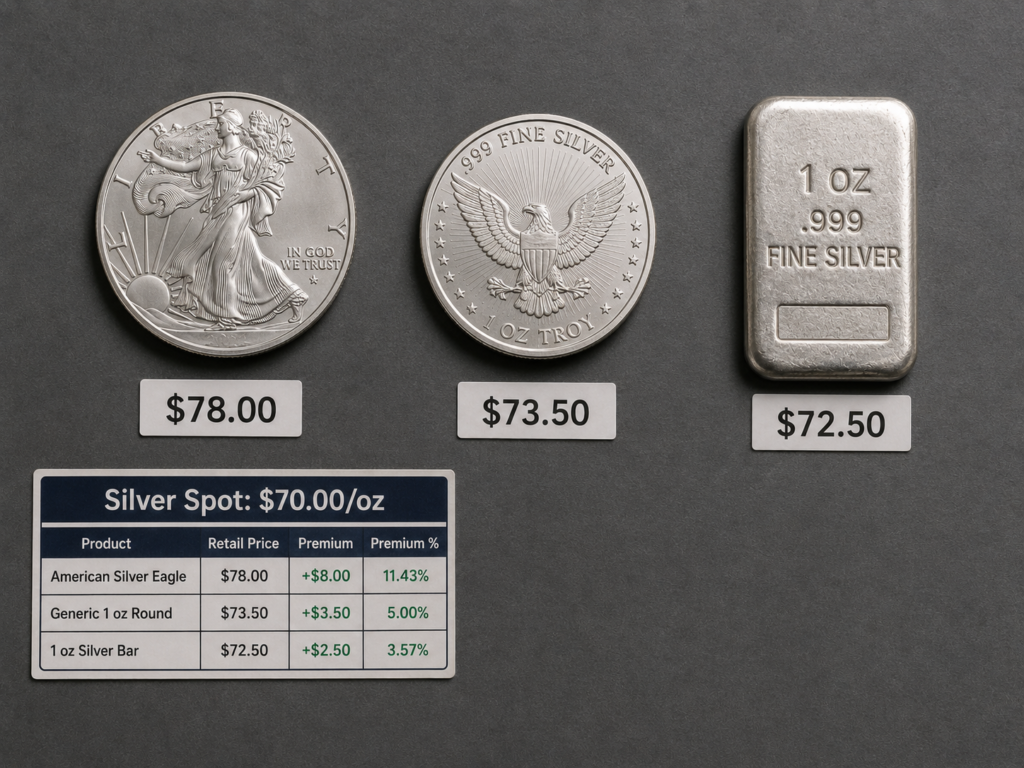
Two ostensibly identical 1 oz silver products at very different prices is the question that sends most investors searching for premium over spot in the first place. Spot price is the wholesale futures number for one troy ounce of refined metal; the premium is everything else between spot and the retail price tag on a finished bullion product.
The premium covers fabrication, distribution, dealer margin, and a variable layer that moves with retail demand. The right amount depends on the product, where it sits in the supply chain, and what the market is doing the day you buy.
This guide walks through what is inside the premium, how it varies by product class, when it compresses and expands, and how to track what you actually paid.
This article is for informational and educational purposes only. Premium ranges cited here are illustrative — actual numbers depend on the dealer, the product, and market conditions on the day of purchase. Re-quote your own pricing at the moment of buy.
What “premium over spot” actually means
Spot price is the current wholesale price for one troy ounce of precious metal, established through continuous global trading, particularly London’s OTC market and New York’s COMEX futures market. It is the number that scrolls across financial dashboards. Premium is the markup between spot and the retail price of a finished bullion product: a coin, a bar, a round, a bag of junk silver.
Retail price equals spot times weight, plus premium. Dealers usually quote premium as a percentage over spot (“the Eagle is at 10% premium”) or as a dollar amount per coin (“the Eagle is $5.00 over spot”). The percentage version is more useful for comparing across products and across time.
Dollar and percent premiums move in opposite directions as spot moves. When spot rallies, the same dollar premium becomes a smaller percentage; when spot falls, the same dollar premium becomes a bigger percentage.
The buyer usually sees the percentage; the dealer often sets the dollar amount on a given product, then lets the percentage drift with the market. Either way, the premium is one of the few numbers in bullion that does not have a single correct answer — it is set by a stack of upstream costs and the supply-demand state of the day.
What goes into the premium
Four cost components sit inside every bullion premium. The first three are roughly fixed per piece — a $1.50 fabrication cost on a 1 oz silver coin does not move when spot does. The fourth is the variable layer that moves with the supply-demand state.
Refining and minting (fabrication)
The largest fixed component on most products. Raw metal arrives at a mint as doré bars, refined cathode, or recycled stock; the mint refines to investment-grade purity and strikes the product. Industry-cited ranges: refining 0.5–1% of spot, minting 1–3% of spot for most retail products.
Sovereign mints (the U.S. Mint, Royal Canadian Mint, Perth, Austrian) carry higher fabrication overhead than private mints because production runs, quality control, and security requirements differ. Fabrication is per piece, not per ounce — which is why a 1 oz coin carries more premium than a 100 oz bar even when total metal cost is similar.
Distribution and wholesale
Mints sell to authorized purchasers (a small number of large wholesalers); wholesalers sell to retail dealers; retail dealers sell to the buyer. Each step covers handling, insured transit, and inventory financing. Industry-cited ranges: distribution 0.5–1% of spot for most products.
Sovereign coins sold through monetary authority channels carry additional channel fees that private rounds avoid — the U.S. Mint’s Authorized Purchaser program is the most visible example. You don’t need a wholesale chart; the point is that the retail price tag includes margin at each step, a more direct channel would not.
Dealer retail margin
The final layer added at the storefront or website, typically 2–4% on standard products at established retailers. Larger margins are common on small-volume, specialty, or limited edition products where dealer holding cost and risk are higher.
Smaller margins appear on high-volume staples (1 oz Eagles, kilo bars) where competitive pressure compresses the spread. The dealer margin is the layer that varies most across retailers — comparing two dealers for the same product is comparing margins, with everything upstream roughly equal.
After the three fixed layers, the fourth is supply-and-demand variability. When retail demand spikes — a bank-stress headline, a hot inflation print, a viral social-media moment — distributors run thin, and dealers raise their over-spot to ration limited stock.
When demand cools, premiums compress back toward the fixed-cost floor. The variable layer can move premiums by 5–10 percentage points on retail silver in a matter of weeks; gold tends to be steadier.
How premium varies by product
Same metal, different products, different premiums — driven by product class, mint reputation, unit size, and channel. The summary table below shows typical ranges in calm markets; it explains why each class sits where it does. All numbers are framed as ranges because the variable layer above moves them around.
Typical premium ranges by product type, calm markets. Retail demand spikes can push numbers higher.
| Product class | Typical premium range | Why |
| Gold kilo bar | 1–3% over spot | Lowest fabrication-per-ounce; large unit size spreads fixed cost across more metal |
| Gold 1 oz bar (recognized refiner) | 2–4% | Higher per-piece fabrication; recognized refiners carry small reputation premium |
| Gold 1 oz sovereign coin (Eagle, Maple, Krug, Buffalo, Philharmonic) | 3–6% | Sovereign fabrication and distribution channels; resale liquidity |
| Fractional gold (1/2, 1/4, 1/10 oz) | 5–15% | Fixed fabrication cost spreads across smaller metal weight |
| Silver 1 oz round (private mint) | 5–10% | Same metal as an Eagle, no sovereign branding or distribution channel |
| Silver 10 oz / 100 oz bar | 3–8% | Larger unit size; lower per-ounce fabrication |
| American Silver Eagle (1 oz) | 20–25% (higher in spikes) | Sovereign coin, U.S. Mint Authorized Purchaser channel, strong domestic demand |
| Junk silver (90% pre-1965) | 3–10% over melt (15–25% in spikes) | Sorted dimes often higher than bulk mixed bags due to buyer preference |
| Platinum / palladium coins | 5–10% | Thinner retail liquidity, smaller supply chain, wider bid-ask |
Gold — coins, bars, and the unit-size effect
Sovereign 1 oz gold coins typically run 3–6% over spot in calm markets, with the American Gold Eagle and Gold Buffalo at the higher end because of U.S. domestic demand and the Canadian Maple Leaf and Krugerrand at the lower end.
Gold bars carry lower premiums than coins of equivalent weight — 1 oz bars 2–4%, kilo bars 1–3%. Fractional gold runs the highest percentage premium because the fixed fabrication cost spreads across less metal. Recognized refiners (PAMP, Credit Suisse, the Royal Canadian Mint, the U.S. Mint) carry a small reputation premium above generic bars because resale liquidity is higher.
Silver — sovereign coins, generic rounds, and bars
The widest premium spread in retail bullion. American Silver Eagle premiums commonly run 20–25% over spot in calm markets and can sit much higher during retail-demand spikes. Canadian Silver Maple, Austrian Silver Philharmonic, and other sovereign silver coins land slightly lower. Private-mint silver rounds typically run 5–10% — same metal weight, same purity, no sovereign branding or U.S. Mint distribution channel.
Silver bars sit in roughly the same range as rounds at 10 oz and above; 1 oz bars run a bit higher because fabrication per piece is roughly constant. The same ounce of silver sits in an Eagle at 22% premium and in a generic round at 7% — both decisions are defensible, but the buyer should know which one they are making.
Junk silver and the platinum-group metals
Junk silver — pre-1965 U.S. 90% silver coinage — is priced as face value times multiplier times spot, with the dealer markup expressed as a premium over melt. Calm-market range is 3–10% over melt; during physical-demand spikes, 15–25% is not unusual on $1 face value bags.
Sorted dimes usually run higher than bulk mixed lots because buyers prefer the smaller, known-wear pieces. Platinum and palladium retail products see thinner liquidity than gold or silver and wider bid-ask spreads. Platinum American Eagles and Canadian Maples typically run 5–10% over spot in normal markets; bars sit closer to 3–6%. Platinum-group premiums move sharply with retail demand because the supply chain is smaller to start.
How premium changes over time
Premiums compress in slow markets and expand in retail-demand spikes — the variable layer covered above. American Silver Eagle premiums sat in the mid-teens in late 2019; the same Eagles ran 35–45% over spot during the 2021–2023 retail silver demand cycle.
The driver was distribution-chain strain, not a change in fabrication cost — mints ran lean, distributors ran thin, and dealers raised their over-spot to ration limited stock. When the cycle cooled, premiums compressed back toward the fixed-cost floor over a matter of months, not years.
A buyer’s premium decisions look very different in compression versus expansion regimes. In a compression regime, Eagle premiums approach private-round premiums, narrowing the case for paying extra for sovereign branding. In an expansion regime, the Eagle premium can blow past 30%, and generic rounds become the disproportionately better per-ounce buy.
How Gold Silver Ledger surfaces the premium you actually paid
Published premium ranges describe the market. The number that actually shows up in your cost basis at sale is the per-piece premium you paid on the specific buy, on the specific day. Gold Silver Ledger captures that number on every line item and surfaces the average two ways: by metal, and by form.
The two views answer different questions; together, they show whether you tend to pay above the market average, with it, or below.
Per-piece premium, locked at the moment of the buy
Every Record Purchase entry captures premium as a per-unit dollar amount, AND as a percentage over spot at the moment the purchase is logged. The percentage uses the live spot price for the metal at the time of entry, so what gets stored is the actual premium you paid — not a recomputed estimate years later when spot has moved.
The number is locked on the row and carries through every subsequent calculation: average premium per metal, total dollars paid above spot to date, and per-item math at sale that feeds into the cost-basis guide.
Premium Analysis on the Analytics page (by metal)
The Premium Analysis card on the Analytics page rolls per-piece premium up to a portfolio view: total dollars paid above spot, average percentage over melt value, and a per-metal breakdown showing both dollar and percent premium for gold, silver, platinum, and palladium.
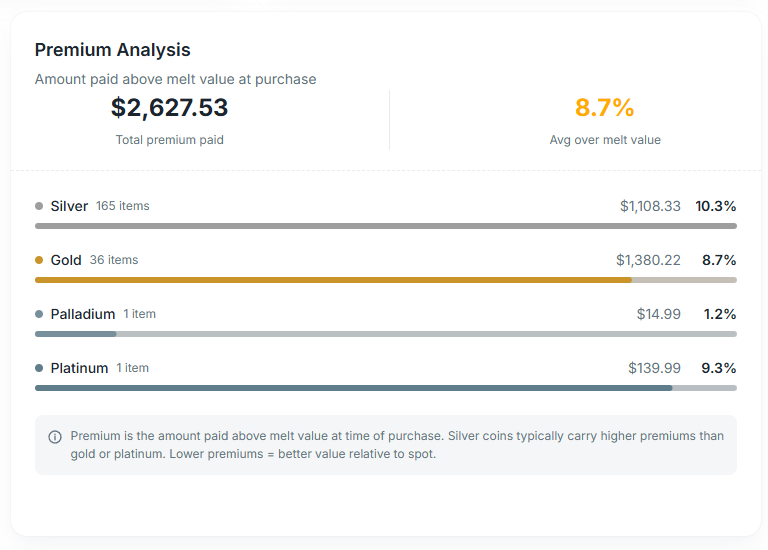
Analytics is on the Pro and Premium plans; the Starter plan still captures per-piece premium on every line but does not include the aggregate card.
Holdings by Form table (by Coin / Bar / Round / Junk)
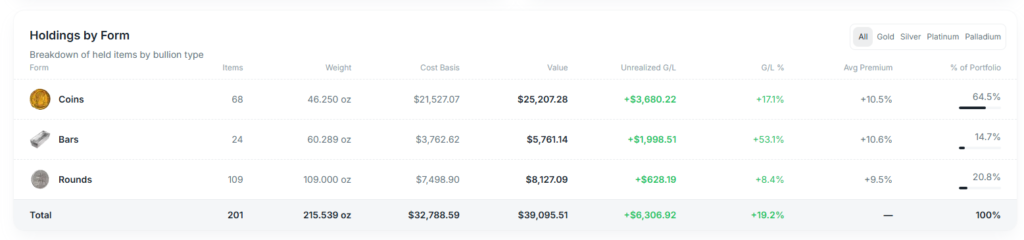
The Holdings by Form table on the same Analytics page breaks holdings down by Coin, Bar, Round, and Junk, with an Avg Premium column among the others. The breakdown answers the in-portfolio version of the product-class question above: across your own holdings, what is the average premium on coins versus bars versus rounds versus junk silver?
The pattern usually matches the published market ranges — coins higher, bars lower, rounds in between — but with the actual numbers from your purchases rather than an industry-average citation. The same metal filter tabs at the top of the table let you slice it down to gold-only or silver-only when the cross-metal averages would otherwise smear the picture.
Common premium mistakes
Five recurring mistakes show up in stacker forums and dealer-pricing comparisons. Each is fixable before the next buy.
Comparing dollar premium without checking the percent
A $4.00 over-spot Eagle at $30 silver is a 13% premium. The same $4.00 over-spot at $80 silver is 5%. The same dealer can look generous or stingy depending purely on where spot is sitting.
Comparing sovereign coins to generic rounds head-to-head
They are different products at different premium tiers for legitimate reasons — sovereign branding, U.S. Mint distribution channel, recognition at resale. The right comparison is sovereign-to-sovereign and generic-to-generic.
Buying retail during a confirmed expansion spike
When American Silver Eagle premiums blow past 30%, every ounce of generic-round silver becomes a disproportionately better per-ounce buy. The lowest-premium silver guide covers the systematic version of the trade-off.
Ignoring fractional premium math
Ten 1/10 oz gold coins at 8% premium each is not the same as one 1 oz coin at 5%. The fixed fabrication cost spreads across more pieces when you go fractional, and the percentage rises accordingly.
Not tracking premium at the moment of purchase
Premium can be reconstructed from receipts and historical spot data, but it is much less work to capture it on the buy. The number you paid is the number that matters at sale; reconstruction years later is a separate project.
