
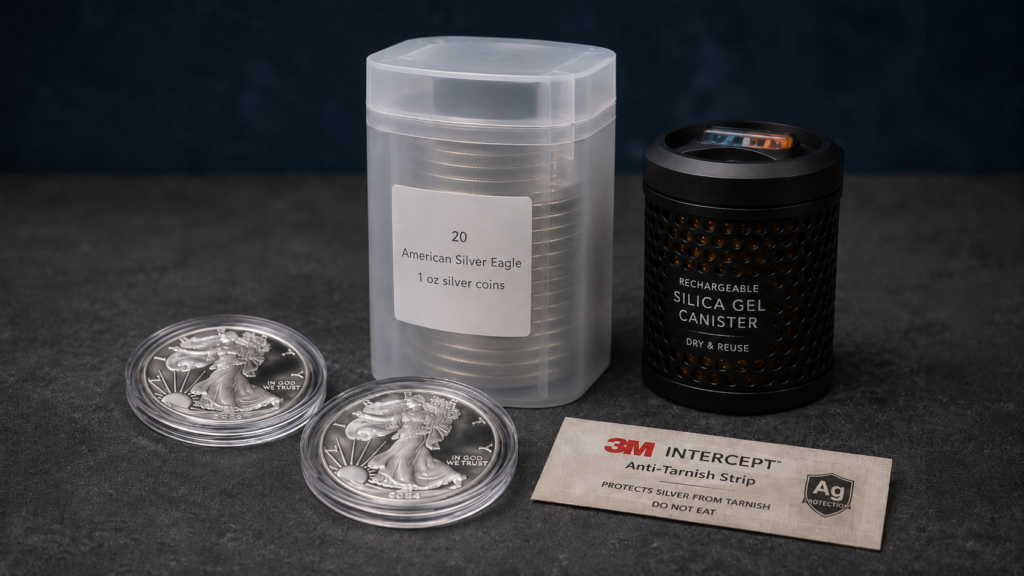
Silver tarnishes because sulfur in the air reacts with it, not because it’s rusting or going bad. The black or rainbow film is silver sulfide; it sits on the surface, and the silver underneath is unchanged. The fix is storage: keep sulfur out, keep moisture down, keep your hands off the surface. Here’s how to keep silver from tarnishing — and what to skip if it already has.
Why Silver Tarnishes (And Why It’s Not Actually Damage)
Silver tarnishes when it reacts with sulfur compounds in the air — mainly hydrogen sulfide — to form a thin layer of silver sulfide on the surface. Tarnish is cosmetic, not corrosive. The silver beneath the film is unchanged, and a tarnished coin’s melt value is the same as a bright one.
A few terms worth glossing. Tarnish on silver is technically sulfidation (silver plus sulfur), not oxidation (silver plus oxygen). Pure silver does not rust. Silver sulfide (Ag₂S) is the dark film you can see. Fineness is the share of pure silver in a piece, expressed as a decimal. 0.999 means 99.9% pure. For the deeper chemistry, see our piece on whether silver, gold, or platinum can rust.
One misconception is worth flagging early. .999 fine silver tarnishes too — often faster than 90% (junk) silver under the same conditions. Higher purity means more chemically available silver to react with sulfur; the alloying copper in junk silver competes for some of that reaction. Fineness doesn’t prevent tarnish. Storage does.
Why does any of this matter if melt value is preserved? For generic rounds and bullion bars sold for melt, tarnish doesn’t affect what you’ll get. For numismatic or graded coins, tarnish — especially uneven or milky tarnish — can drop a grade and the resale price. Once a coin tarnishes, cleaning is usually a worse mistake than the tarnish was; we cover that in our guide on whether to clean silver coins, and the broader context is in our melt value guide.
What Causes Tarnish (The Real-World Sulfur Sources)
Tarnish is a chemistry problem driven by sulfur sources you can control. The biggest offenders:
- Air pollution and household combustion. Natural gas appliances, gas water heaters, and traffic exhaust release trace hydrogen sulfide and SO₂. Urban and gas-heated homes tarnish silver faster than rural and electric ones.
- Foods and kitchen air. Eggs, onions, mustard, mayonnaise, garlic, broccoli, cabbage, and many cheeses contain sulfur compounds. Even sealed cupboards in a kitchen carry enough airborne sulfur to discolor silver over months.
- Wool, felt, and certain rubbers. All contain sulfur. Don’t store silver in a wool sock, a felt-lined drawer, or wrapped in rubber bands.
- Paper and cardboard. Standard cardboard 2×2 “flips” without Mylar inserts can outgas sulfur. PVC plastic is the other major offender — it releases hydrochloric acid as it ages and leaves a greasy green film on silver and copper. Anything you put silver into should be Mylar or PVC-free polypropylene.
- Humidity. Moisture doesn’t cause tarnish by itself, but it accelerates the sulfide reaction. Damp basements and bathrooms are tarnish multipliers.
- Your skin. Sweat is mildly acidic and carries trace sulfur compounds. Fingerprints become permanent etchings on a mirror-finish proof over months. Handle by the edge only, or wear clean cotton or nitrile gloves.
The 6-Step Storage Method
If you take one thing from this article, take this sequence. Each step reduces sulfur, moisture, or contact, and the combination is what actually works.
- Handle clean. Wash and dry your hands, or wear clean cotton or nitrile gloves. Hold coins by the edge only. Don’t breathe directly on a mirror-finish proof — even breath carries moisture and trace sulfur.
- Enclose the piece. Direct-fit Air-Tite capsules for individual coins. Polypropylene coin tubes for bulk bullion of one size (Silver Eagles, rounds, Maples, junk silver). PVC-free Mylar flips (Saflips) for short-term storage. Match the capsule size to the coin; a loose fit lets it slide and scratch.
- Add an anti-tarnish layer. 3M Intercept Anti-Tarnish strips — copper-impregnated paper that absorbs sulfur before it reaches silver — go inside the storage box. One strip per roughly 30 cubic inches, replaced every two to three years.
- Control humidity. Drop a rechargeable silica gel canister (with a color-changing indicator) into the storage container. Target relative humidity under 50%. When the indicator turns pink or clear, recharge in a 200°F oven for a few hours.
- Choose the right location. A climate-controlled interior closet, a bedroom dresser, or a coin safe in a heated and cooled room. Avoid basements, attics, garages, kitchens, bathrooms, and any wall shared with a chimney or furnace.
- Log it. Record what’s in which container, where the container lives, what desiccant and Intercept generation it has, and the date you sealed it. The recordkeeping half of storage is what makes the work pay off six years later — more on that below.
Storage Products Compared: Capsules, Tubes, Flips, and More
The product catalog around tarnish prevention is small and mostly standardized. Here’s what each piece does, when to reach for it, and roughly what it costs.
How the common silver storage products compare.
| Product | What it does | When to use it | Approximate cost |
|---|---|---|---|
| Air-Tite capsule | Airtight, archival direct-fit holder | Single high-value or proof coins | $1–2 per capsule |
| Coin tube (Guardhouse, CoinSafe) | Polypropylene tube for stacked bullion of one size | Silver Eagles, generic rounds, Maples, junk silver | $1–3 per tube |
| Saflip (PVC-free Mylar flip) | Two-pocket Mylar holder | Short-term or in-transit storage | $0.10–0.20 per flip |
| Cardboard 2×2 with Mylar window | Cardboard holder with clear Mylar inserts | Low-value coins, only if acid-free | $0.05–0.15 per holder |
| 3M Intercept Anti-Tarnish strip | Copper-based paper that absorbs sulfur | Inside any sealed storage box | $0.25–1 per strip |
| Rechargeable silica gel canister | Humidity control with color indicator | Any sealed storage container | $10–15 per canister |
| Anti-tarnish cloth pouch | Sulfur-absorbing cloth for larger pieces | Flatware, large bars, jewelry | $5–15 per pouch |
The single biggest material to avoid is PVC. Soft, flexible “flip” pages from older album systems often contain PVC plasticizers. PVC outgasses hydrochloric acid as it ages and leaves a greasy green film on silver and copper. If a flip feels soft and sticky, throw it out. Coin tubes are not gas-tight either, which is why Intercept paper and a desiccant inside the storage box still matter — they protect the tubes’ contents.
Where to Keep Your Storage Container
Location is the variable many people get wrong. Aim for under 50% relative humidity, 60–75°F, and stable conditions. Stability matters more than the exact number; cyclic warm-cool causes condensation inside containers, which accelerates everything tarnish-related.
Avoid basements (humid, often share walls with water heaters), attics and garages (temperature swings and fumes), kitchens (sulfur-heavy air from cooking), bathrooms (humidity spikes during showers), and any space adjoining a chimney or furnace.
Aim instead for an interior closet on a primary living floor, a bedroom dresser drawer (with the storage container inside, not loose silver), or a dedicated coin safe placed in a heated and cooled room. For larger stacks, a residential safe rated for fire and moisture is the next step.
Off-site, a safe deposit box puts the silver in a climate-controlled vault but isn’t insured by the bank or by FDIC; pack Intercept and desiccant before you take a tube to the bank. A private depository — Brink’s, Loomis, Delaware Depository — gives you climate control, full insurance, and IRA compatibility for an annual fee.
See our piece comparing gold depositories and safe deposit boxes. Standard homeowners policies typically cap precious metals at $200 to $2,500; anything beyond that needs a scheduled rider, which we cover in our guide on insuring gold and silver.
Track What You Stored Where
Most collectors can describe their stack in totals — “about 300 ounces, mostly Eagles and Maples” — but can’t tell you, today, which tube holds which coins, which tubes have current Intercept paper, or which year the silica gel was last recharged. That gap matters at insurance-claim time (the adjuster wants a list), at sale (you need to retrieve specific pieces), and at inheritance, when somebody else has to find what you stored.
Record this the moment you seal a container: a container ID, the contents, the date sealed, the Intercept and desiccant generation, the storage location, and a dated photo of the contents before the lid goes on. A dated photo of a tube’s contents is the single highest-leverage piece of inventory work — it’s hard to dispute.
This is why we built Gold Silver Ledger. The ledger lets you tag each item with its storage container and location, holds condition notes, and pulls the whole inventory up on one screen at insurance or sale time.
The moment a piece goes into a tube is the moment to log it. Five years later, nobody remembers what was in tube #7.
What If Your Silver Already Tarnished?
Don’t clean it. For bullion — generic rounds, bars, Silver Eagles sold for melt — tarnish doesn’t affect value; it’s invisible to a buyer’s scale. For numismatic or graded coins, cleaning is the fastest way to drop a grade and a price. “Cleaned” is a permanent mark on a graded coin’s holder and can cut value in half or worse.
A few exceptions. Silver flatware in active use gets a Pacific Silver Cloth and the occasional sparing dip — never the dip on numismatic pieces. Light haze on a bullion bar headed to a refiner is irrelevant; it’ll be melted. Jewelry has its own cleaning rules, outside this article.
For everything else, the work isn’t to clean — it’s to stop further tarnish. Capsule the piece, add Intercept paper, control humidity. Existing tarnish on a stored coin is stable; new tarnish is preventable. For the full case against cleaning, see our guide on how to clean silver coins (hint: usually, don’t).
Frequently Asked Questions
Does .999 fine silver tarnish?
Yes, and often faster than 90% silver under the same conditions. Higher purity means more chemically available silver to react with sulfur. Fineness doesn’t prevent tarnish — storage does.
Does tarnish reduce a silver coin’s value?
For bullion, no — melt-value buyers don’t care. For collector coins, sometimes. Toning can add or subtract value depending on color, evenness, and the grading service’s view. Cleaning to remove tarnish almost always reduces value.
Are coin tubes airtight?
Mostly no. Polypropylene tubes are sulfur-resistant but not gas-tight. That’s why Intercept paper and a desiccant inside the storage box matter — they protect the tubes’ contents. For full airtight protection, use individual capsules.
How long does anti-tarnish paper last?
3M Intercept material lasts about 24 to 36 months once exposed to air, depending on local sulfur load. Replace it on a calendar, not when you see tarnish — by then the paper has been depleted for months.
Can I just vacuum-seal my silver?
It helps, but it doesn’t replace the system. Vacuum reduces sulfur and oxygen contact, but the bag isn’t archival, can puncture, and hides the contents. Use vacuum bags for deep-storage tubes alongside Intercept paper; don’t rely on the vacuum alone.
Does a safe protect silver from tarnishing?
Only if it’s in a climate-controlled room. Safes can trap humidity — a closed metal box swings less, but it does swing. Add a silica gel canister and Intercept paper inside the safe; they matter more inside a safe than outside one.
This article is for informational and educational purposes only. It is not financial, investment, legal, or tax advice. Consult a qualified professional about your specific situation.
