
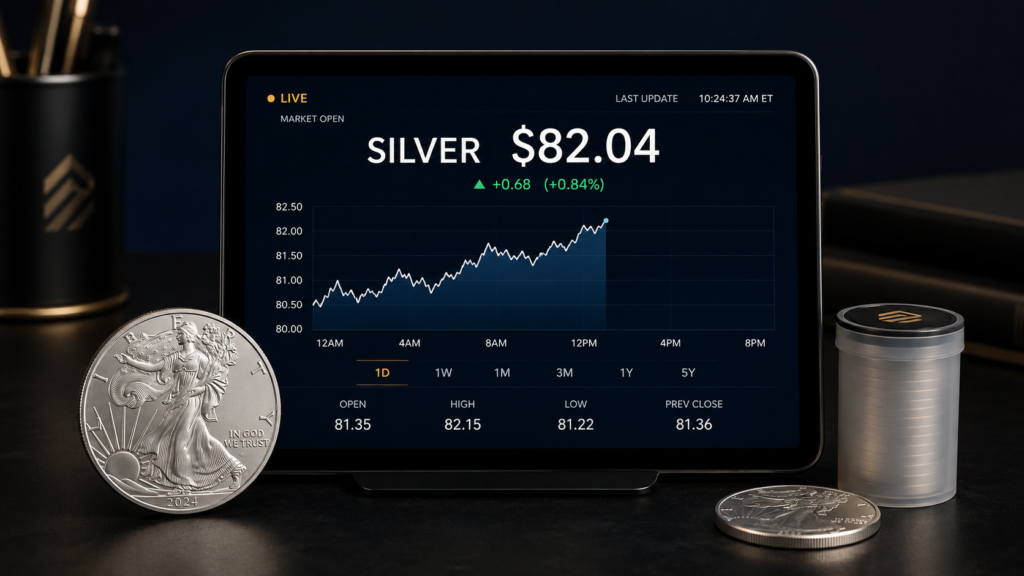
Every dealer page quotes a price as “spot plus a premium.” Spot is the wholesale half of that equation — the live price of one troy ounce of pure gold or silver, set on the futures market and updated through the trading day. Here’s where the number actually comes from, and why your dealer never quotes spot alone.
What Is Spot Price?
Spot price is the live wholesale price of one troy ounce of pure gold or silver — the number that scrolls across financial dashboards and dealer ticker tapes. It is discovered on the futures market and benchmarked twice daily by the LBMA in London. Spot is a price, not a product. You cannot actually buy a coin at spot at retail; you can only buy a coin priced relative to spot.
A few terms in that paragraph need glossing. A troy ounce is the precious metals unit of weight — 31.1 grams, slightly heavier than the avoirdupois ounce on a kitchen scale. The LBMA is the London Bullion Market Association, the trade body that administers the daily wholesale benchmark. And premium is the dealer’s markup over spot — covered in detail further down.
This article is the “what” and “how it’s set.” If you want today’s live numbers, see our live silver spot price and live gold spot price pages. If you want the gap between spot and what a dealer charges, that’s the premium over spot piece. We link out at the right moments below.
Where Do Spot Prices Actually Come From?
There is no single global spot exchange. The number you see labeled “spot” on Kitco, APMEX, or your phone is produced by three venues working in concert: a futures exchange in the U.S., a benchmark auction in London, and the dealer’s own retail feed.
The three venues that produce the spot number a U.S. retail buyer sees.
| Venue | What it is | How it produces a price | When it updates |
|---|---|---|---|
| COMEX (CME Group) | U.S. futures exchange (a division of CME Group), based in Chicago and New York | Continuous price discovery from gold and silver futures contracts; the front-month contract is the de facto spot reference | Tick-by-tick during the COMEX trading window: Sunday 6 p.m. ET through Friday 5 p.m. ET, with a daily 60-minute halt |
| LBMA (London) | Wholesale OTC market run by the London Bullion Market Association | Twice-daily LBMA Gold Price benchmark and once-daily LBMA Silver Price set by an electronic IBA auction | LBMA Gold Price at 10:30 a.m. and 3:00 p.m. London time; LBMA Silver Price at 12:00 noon London time |
| Retail dealer feed | The “spot” quote on APMEX, JM Bullion, Money Metals, and similar retail sites | COMEX-derived feed plus the dealer’s small house spread | Continuously, mirroring COMEX during U.S. trading hours |
Mechanically, COMEX is a futures market — the price relabeled “spot” is the front-month gold or silver contract. Front-month futures are highly liquid and tightly arbitraged with physical wholesale, so the futures price is a reliable proxy for what wholesale buyers actually pay. It is futures-derived rather than physical-derived, but it is not a hidden or fake number.
If you see Kitco at $32.04 and APMEX at $32.07, you’re looking at the same COMEX feed plus two different house spreads — not two different markets.
How the LBMA AM/PM Fix Works
A fix is a single benchmark price set at fixed times each day. Miners, refiners, central banks, and ETFs use it to settle contracts and value reserves. The COMEX feed runs continuously; the LBMA fix is a scheduled photograph of the wholesale price.
The LBMA Gold Price is set twice daily — 10:30 a.m. and 3:00 p.m. London time. These are the AM and PM fixes that show up in the financial press. The LBMA Silver Price is set once daily, at 12:00 noon London time. Both are produced by an electronic auction administered by ICE Benchmark Administration (IBA) on behalf of the LBMA.
If you have heard the term “the London gold fix,” it is the same benchmark under its older name. Until March 2015, the price was set by a panel of bullion banks meeting by phone; regulatory reform replaced that process with the IBA auction.
Most U.S. retail buyers never see an LBMA fix during a transaction — the dealer is quoting COMEX-derived spot. But the fix matters indirectly: ETFs like GLD value their holdings against it, and when the financial press prints “gold closed at $X today,” the number is usually the LBMA PM fix.
Why Dealer Prices Are Always Higher Than Spot
Dealers buy bullion wholesale at or near spot, then add a premium that covers fabrication, distribution, capital cost, and margin. The premium is the gap between spot and your buy price, and it rarely closes to zero at retail.
A worked example. As of May 2026, silver spot trades near $80/oz. A common one-ounce Silver American Eagle retails near $95 from major dealers — a premium of roughly $15 over spot. Treat that as a snapshot, not a prediction; the gap between spot and Silver Eagle retail has run from a few dollars to more than ten dollars per ounce in recent years.
Three structural reasons premium exists:
- Fabrication. Minting a coin or pouring a bar costs money. Government-mint products (Eagles, Maple Leafs) carry higher premiums because the mint charges a fixed surcharge on top of metal cost.
- Distribution and dealer margin. The metal moves from refiner to authorized purchaser to retail dealer to you, and each link adds cost.
- Demand. High-demand products carry higher premiums. In retail surges, premium on Silver Eagles can widen sharply while spot itself barely moves.
Your real cost on a coin is spot at order lock plus premium plus shipping and tax — and only the total counts as cost basis at sale. We cover the breakdown in the premium over spot guide and the cost basis tracking piece.
Spot Price vs. Bid, Ask, Futures, and Melt
Four terms get confused with spot. Drawing the lines once helps you read every dealer page and chart cleanly afterward.
How spot relates to the other prices you’ll see on a dealer page or financial dashboard.
| Term | What it means | Relationship to spot |
|---|---|---|
| Spot price | Live wholesale price of one troy ounce of pure metal | The benchmark itself — a single mid-market number |
| Bid price | What a dealer is willing to pay to buy from you | Always slightly below spot |
| Ask price | What a dealer is asking to sell to you | Always above spot — spot plus the premium for that product |
| Futures price | The price of a contract for delivery on a specific later date (e.g., the December gold contract) | Front-month futures and spot usually trade within cents of each other; longer-dated contracts diverge based on storage and rates |
| Melt value | The metal content of a specific coin times current spot (e.g., 0.7734 ozt × spot for a Morgan dollar) | Spot applied to one item rather than to the metal in general |
The clearest way to picture it: at any given moment there is a bid below spot, a spot mid, and an ask above. The bid–ask gap is the dealer’s working spread on that product; the spot–ask gap is the premium. We dig into the spread in the bid vs. ask in bullion piece, and into melt value calculations in the melt value guide.
What Moves Spot Prices?
Spot prices respond to currency dynamics, interest rates, and physical supply and demand. Five drivers worth knowing:
- U.S. dollar strength. Gold and silver are dollar-denominated globally — a stronger dollar tends to push spot down.
- Interest rates. Higher real rates raise the opportunity cost of holding metal (which pays no yield), pressuring spot lower.
- Inflation expectations. Rising inflation expectations historically support metal prices.
- Industrial demand. More important for silver than gold — solar, electronics, and automotive applications consume real ounces.
- Geopolitics and central-bank flows. Crisis demand and central-bank purchases can move spot quickly. Central banks have been net buyers of gold for over a decade.
Short-term spot tracks futures positioning and macro headlines; long-term trend tracks supply and structural demand. For day-to-day commentary, see our live silver spot price and live gold spot price pages. We don’t forecast where spot is going — the driver list is meant to make the next move legible, not predicted.
How to Read Spot Without Getting Whipsawed
Three rules of thumb keep beginners from over-reacting to a number that updates every few seconds:
- Lock the price at order time: Reputable dealers lock the spot quote when you commit to an order, then settle when you pay. Watching the ticker mid-checkout doesn’t change what you pay — the lock does.
- Treat 0.5–1% intraday moves as noise: Silver routinely swings that much in a single session without news. A 1% move on a $30 ounce is 30 cents — well inside any retail premium and not a signal to act.
- Time the premium more than the spot: Premium on Silver Eagles or fractional gold can move several percent over short windows; spot rarely does. If you’re watching anything for an entry point, watch the premium on the specific product you want.
There’s a tracking corollary. Your real cost is spot at order lock plus premium plus shipping and tax — and most spreadsheets lose that breakdown by the time you sell, when the spot/premium split matters for cost basis. Gold Silver Ledger captures spot and premium separately at purchase, so the math is already done at sale.
Frequently Asked Questions
Who sets the spot price of gold?
No single entity sets the spot. The price is discovered on COMEX futures intraday and benchmarked twice daily by the LBMA Gold Price auction in London — both produced by markets and electronic auctions, not by committees, central banks, or governments.
Why can’t I buy gold at spot price?
Dealers buy at or near spot wholesale and add a premium for fabrication, distribution, and margin. Some products (generic rounds, dealer specials, sealed Monster Boxes) trade close to spot, but at retail you’ll always pay spot plus something. We cover strategies for getting close in our buying silver near spot guide.
What’s the difference between spot price and ask price?
Spot is the mid-market wholesale benchmark. Ask is what a dealer is asking from you for a specific product — spot plus that product’s premium. The bid (what the dealer pays if you sell back) sits below spot.
Is spot price the same as melt value?
Related, not identical. Spot is per troy ounce of pure metal. Melt value applies that price to a specific coin’s silver or gold content — 0.7734 troy oz × spot for a Morgan dollar, 0.1808 troy oz × spot for a pre-1965 quarter. The melt value guide walks the formula.
What time does the spot price update?
Continuously during the COMEX window — Sunday 6:00 p.m. ET through Friday 5:00 p.m. ET, with a one-hour daily halt around 5:00 p.m. ET. Outside that window, displayed spot freezes at the last quoted price.
What is the LBMA gold fix?
A daily benchmark price set by electronic auction at 10:30 a.m. and 3:00 p.m. London time. Major contracts, ETFs, and central-bank settlements reference it. The colloquial name dates from the original phone-based panel that set the price until 2014; the modern process is a regulated IBA auction.
