
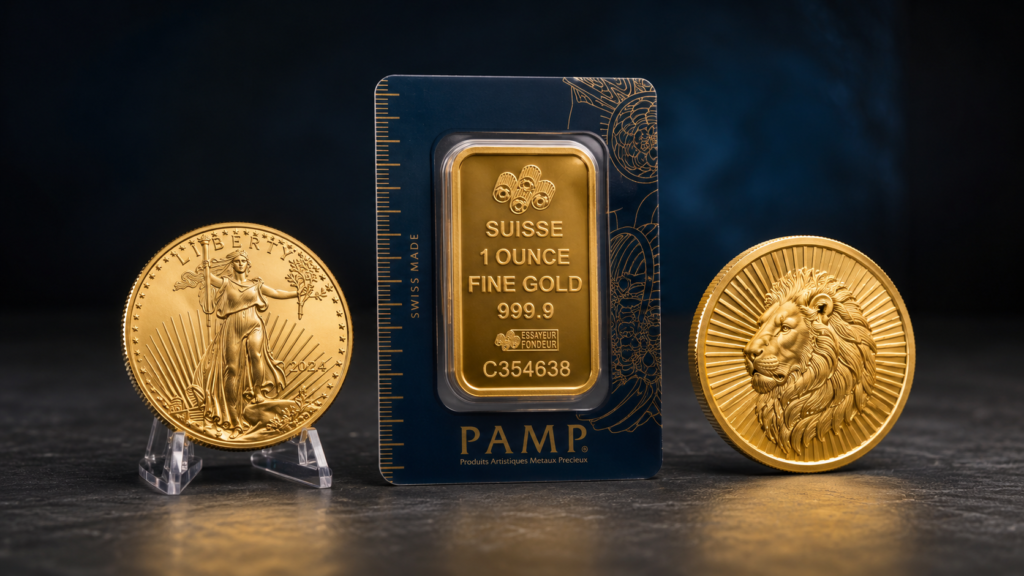
Gold bullion is investment-grade gold — bars, coins, or rounds valued by the weight of metal inside them, not the artistry on the outside. It is the form most people mean when they talk about “buying physical gold,” and it is priced off a single live number plus a small markup. Here is what counts, what doesn’t, and how to start.
What Is Gold Bullion?
Gold bullion is investment-grade physical gold — bars, coins, or rounds — valued primarily by its metal content rather than its design or rarity. It’s priced by weight at the current spot price plus a small dealer premium. Common bullion products run from .9167 fine (Gold American Eagle, South African Krugerrand) up to .9999 fine (Canadian Maple Leaf, Gold Buffalo, modern PAMP and Perth bars
A few terms in that paragraph need glossing. Bullion is the general category for refined precious metals held for investment, regardless of shape. Fineness is the share of pure gold in a piece, expressed as a decimal. 0.999 means 99.9% pure, .9999 means 99.99% pure. Spot price is the live wholesale price of one troy ounce of pure gold, set on the futures market and updated throughout the trading day. A troy ounce is 31.1 grams, slightly heavier than the avoirdupois ounce on a kitchen scale.
This article is the “what / why / how to start” for gold specifically. If you want the broader frame that includes silver, platinum, and palladium, see our guide to what bullion is. The silver-side companion is our guide to silver bullion. Live pricing lives on our gold spot price page.
One misconception is worth flagging up front. Many readers use “gold bullion” and “gold bars” as synonyms. A 1 oz Gold American Eagle is bullion too. The distinction isn’t the shape — it is the basis of value. If a piece of gold trades on its metal content, it is bullion. If it trades on rarity, condition, or design, it is not.
Bullion vs. Numismatic Coins vs. Jewelry
Three categories of physical gold sit next to each other in the marketplace, and beginners conflate them. The differences matter because each is priced on a different basis and resells through a different channel.
How the three categories of physical gold compare on what you’re paying for, premium, and resale.
| Type | What you’re paying for | Premium over spot | Resale liquidity |
|---|---|---|---|
| Bullion (bars, coins, rounds) | Metal content, by weight | Typically 2–8% for common products | High — sells at any bullion dealer |
| Numismatic coins | Rarity, condition, history | 50% to 500%+ above metal content | Lower — requires a numismatic buyer |
| Jewelry | Design, brand, retail markup | Often 100–300% above metal content | Usually melt value or below |
Bullion is the most fungible of the three — a 1 oz Gold Eagle from your dresser drawer is worth the same as a 1 oz Gold Eagle from a dealer’s vault, give or take a few dollars of bid-ask spread. Resale is straightforward at any bullion dealer or major coin shop.
Numismatic coins live in a different market. A common-date Morgan dollar in average condition is worth its silver content. A rare-date Morgan in MS-65 condition can be worth thousands. The pricing reference is rarity and grade, not metal weight. Selling a numismatic piece well usually means finding a numismatic buyer, not a bullion dealer. See our guide to numismatic vs. bullion coins for more on the distinction.
Jewelry is the loosest of the three. The metal content is real, but the retail price reflects design and brand markup, and most jewelry is alloyed to lower fineness for durability — 14-karat is .585 fine, 18-karat is .750 fine. Resale runs at melt value or below. Jewelry is a legitimate form of gold ownership; it is optimized for design rather than investment economics. See our broader piece on premium over spot for how those markups work.
One practical note. Bullion and numismatic items belong on separate valuation tracks in your records — bullion follows live spot; numismatic follows rarity-based markets. Mixing them in one spreadsheet usually means valuing one of them wrong by the time you sell.
The Three Forms of Gold Bullion: Bars, Coins, and Rounds
Once you know a piece is bullion, the next question is what form it takes. The market produces gold bullion in three shapes — bars, coins, and rounds — and the trade-offs between them matter at purchase and at sale.
The three forms of gold bullion and what each is best at.
| Form | Issuer | Typical fineness | Typical premium | Best for |
|---|---|---|---|---|
| Government-minted bullion coins | Sovereign mints (U.S., Canada, Australia, etc.) | .9167–.9999 | 5–8% over spot | Recognition, resale, IRA eligibility |
| Privately minted bars | Refiners (PAMP, Credit Suisse, Valcambi, Perth, RCM) | .999–.9999 | 1–4% over spot at 1 oz+ | Lower premium, larger sizes |
| Privately minted rounds | Private mints (Sunshine, Asahi, Scottsdale, Sunshine) | .999 | 2–5% over spot | Lowest-premium small units |
Bars are the lowest-premium way to acquire gold by weight, especially at 1 oz and larger sizes. They come from refiners and private mints — PAMP Suisse, Credit Suisse, Valcambi, Perth Mint, the Royal Canadian Mint — and most are stamped with serial numbers and tamper-evident assay cards that vouch for weight and purity. Sizes run from 0.5 gram through 400 oz (the wholesale Good Delivery bar). For specs on common sizes, see our piece on gold bar weights, and for a head-to-head on refiners, see the PAMP vs. Credit Suisse comparison.
Coins are the highest-recognition form of bullion. They are issued by sovereign mints, carry a legal tender face value (well below their metal value), and have built-in security features. The market accepts them readily anywhere in the world. Common examples include the Gold American Eagle, the Canadian Gold Maple Leaf, the Gold Buffalo, the South African Krugerrand, and the Austrian Philharmonic.
Coins typically carry a few percentage points more premium than bars because the mint charges a fixed surcharge for the production work. For a deeper look at which coins to consider, see our roundup of the best gold coins to buy, the American Gold Buffalo guide, and the Canadian Gold Maple Leaf guide.
Rounds look like coins but are produced by private mints rather than governments. They have no face value and no legal tender status. The trade-off is premium versus resale: rounds typically sell for less over spot than coins, but they may resell through fewer channels because they lack a government guarantee. For more on the format, see our guide to gold rounds.
If you’re buying your first ounce of gold, a 1 oz government-minted coin (Eagle, Maple Leaf, Buffalo, Krugerrand) is the standard starting point — not the cheapest, but the most recognized and easiest to resell. We treat that as a frame, not a recommendation. The product that fits your situation depends on budget, premium tolerance, and how much liquidity you want at sale.
Understanding Gold Purity: .999, .9999, and 24-Karat
Every gold bullion product carries a fineness mark. Decoding it is part of knowing what you actually own.
| Fineness is the share of pure gold in a piece, expressed as a decimal. .999 means 99.9% pure (“three-nines fine”); .9999 means 99.99% pure (“four-nines fine”); 24 karat means as pure as gold gets, conventionally .999 or higher. |
Common fineness marks on gold products and what they correspond to.
| Marking | Decimal fineness | Karat equivalent | Common products |
|---|---|---|---|
| .9999 | 99.99% pure | 24K | Canadian Maple Leaf, Gold Buffalo, modern PAMP and Perth bars |
| .999 | 99.9% pure | 24K | Older bars, most generic rounds |
| .9167 | 91.67% pure | 22K | American Gold Eagle, South African Krugerrand |
| .750 | 75% pure | 18K | Mid-range jewelry |
| .585 | 58.5% pure | 14K | Common jewelry |
A 1 oz Gold American Eagle is .9167 fine. This trips up almost every new buyer. The Eagle is alloyed with small amounts of silver and copper for durability, which means its total weight is higher than the gold weight inside it. A 1 oz Gold Eagle weighs 1.0909 troy ounces gross — enough alloyed weight to leave a full 1 troy ounce of pure gold underneath. You are not getting less gold than a .9999 Maple Leaf.
You’re getting the same one ounce of pure gold, wrapped in alloy that makes the coin harder to scratch. The South African Krugerrand uses the same convention. The Eagle is also the one statutory exception to the IRS’s .995 minimum fineness for gold in a self-directed IRA — every other IRA-eligible gold product (including the Krugerrand) has to clear .995.
Does fineness matter for value? At the same spot price and same gold content, a .9999 bar and a .9167 Eagle hold the same intrinsic metal value. The differences are in handling, durability, and premium. .9999 gold is softer — it dings if dropped on a hard surface, which is part of why most .9999 bars ship in tamper-evident assay cards. .9167 gold is more durable and tolerates handling. Neither is “better” in the abstract. They are optimized for different things.
For a fuller explanation of the troy ounce unit underneath the math, see our guide to the troy ounce.
How Gold Bullion Is Priced: Spot Plus Premium
Every retail bullion price is built the same way: live spot price for one troy ounce of pure gold, plus a premium that covers fabrication, distribution, and dealer margin. The premium is the gap between spot and what you pay, and it never closes to zero at retail.
A worked example. As of mid-May 2026, gold spot trades near $4,550/oz. A 1 oz Gold American Eagle retails near $4,750 from major dealers — a premium of roughly $200 over spot, or about 4.4%. A 1 oz generic gold bar from a recognized refiner retails near $4,650 — a premium of roughly $100, or about 2.2%. Treat that as a snapshot, not a prediction; premium on government coins can widen significantly in retail surges while spot itself barely moves.
Three structural reasons premium exists:
- Fabrication: Minting a coin or pouring a bar is real labor and capital. Government-minted products carry the highest fabrication surcharge because of the production and security standards.
- Distribution and dealer margin: Gold moves from refiner to authorized purchaser to retail dealer to you, and each link in that chain adds cost.
- Demand: High-demand products carry higher premiums. In retail surges, premium on Gold Eagles can widen sharply while spot barely moves — demand for the specific product is what is moving, not the underlying metal price.
For the live wholesale half of the equation, see our guide to how spot price is set. For a deeper treatment of why premium varies by product, see our piece on premium over spot. The lowest-premium playbook on the silver side, which transfers to gold with adjustments, is covered in our lowest-premium silver guide.
Your real cost on a gold purchase is spot at order lock plus premium plus shipping and tax. Only the total counts as cost basis at sale. Spreadsheets that record only the lump sum lose the breakdown, which becomes a problem at tax time. See our guide on tracking cost basis at purchase for why the split matters.
Government-Minted vs. Private-Mint Bullion
Once you start shopping, you’ll notice that the same one ounce of gold comes from very different issuers. The distinction between government-minted and privately minted bullion is worth understanding before you pick a product.
Government-minted bullion is sovereign-issued. The coins carry a legal tender face value (well below their metal value), and the weight and purity are guaranteed by the issuing government. Most government-issued gold coins are also IRA-eligible. The major examples: the U.S. Mint produces the Gold American Eagle and the Gold Buffalo. The Royal Canadian Mint produces the Gold Maple Leaf. Other recognized issuers include the Perth Mint (Australian Kangaroo), the South African Mint (Krugerrand), the Austrian Mint (Philharmonic), and the British Royal Mint (Britannia).
Privately minted bullion is produced by refineries and private mints. There is no legal tender face value. Weight and purity are guaranteed by the refiner’s hallmark and, for bars, by a tamper-evident assay card. The most respected names in the bar market are PAMP Suisse, Credit Suisse, Valcambi, the Perth Mint (which produces both coins and bars), the Royal Canadian Mint (also bars), and Asahi. For rounds, the main names are Sunshine Minting, Scottsdale Mint, and Asahi.
Resale liquidity follows a predictable pattern. Government coins resell anywhere in the world. Recognized refiner bars (PAMP, Credit Suisse, Valcambi, Perth, RCM) resell almost anywhere. Lesser-known private rounds may need to find a specific dealer who is willing to take them at full premium — not a disaster, but a few extra steps. Premium follows the reverse order: government coins carry the highest premium, recognized bars sit in the middle, generic rounds run lowest.
Authentication is where counterfeit risk creeps in. Government coins have built-in security features: the Gold Eagle’s reeded edge, the Maple Leaf’s micro-engraved radial lines, the Buffalo’s edge lettering. Recognized private bars rely on assay cards, serialized hallmarks, and tamper-evident packaging. Both are difficult to fake well, but counterfeits exist, and the cheaper the channel you buy through, the higher the risk. For the full treatment of how to verify a piece on arrival, see our guide on spotting fake gold.
How to Start Buying Gold Bullion
If this is your first ounce, six steps will keep the process clean.
- Set a budget before you browse. Bullion dealers display every product as “spot plus X%” and a fixed-budget shopper makes better choices than one staring at twenty-line product menus.
- Pick a starting product. A 1 oz government-minted coin — Gold Eagle, Maple Leaf, Buffalo, Krugerrand, or Philharmonic — is the standard first purchase because resale is straightforward and recognition is universal.
- Pick a reputable dealer. The major online dealers include APMEX, JM Bullion, Money Metals, Hero Bullion, SD Bullion, and Kitco. Reputable local coin shops are an option, too. See our guides to how to buy gold and the safest ways to buy gold for vetting criteria.
- Lock the price at order time. Reputable dealers lock the spot quote when you commit to an order, then settle when you pay. Watching the ticker mid-checkout does not change what you pay — the lock does.
- Confirm shipping is insured and signature-required. Any dealer worth using ships gold this way by default. If they don’t, that is a warning sign.
- Verify the piece on arrival. Check the weight on a small jewelry scale (1 oz Gold Eagle = 1.0909 troy oz gross; 1 oz Maple Leaf = 1.0000 troy oz). Inspect edge details, hallmarks, and packaging. Photograph the piece in its packaging before opening it; that record may matter at resale or for insurance.
A note on what not to buy as your first purchase. Don’t lead with numismatic coins — the premium ladder and resale market are different enough that you want to learn bullion economics first. Don’t lead with fractional sizes if a full ounce fits the budget; a 1/10 oz Gold Eagle often carries 12–20% premium against the metal it contains, versus 5–8% on a 1 oz Eagle.
And don’t lead with no-name private rounds when your goal is liquidity — save those for later, when low premium matters more than universal recognition.
For broader timing strategy, see our guides on when to buy gold and how physical gold compares to gold ETFs and mining stocks.
Storing and Tracking Your Gold Bullion
Gold is dense and durable. A 1 oz coin is about the size of a half-dollar; 10 oz of gold fits in a coat pocket. That portability is one of its strengths and also the reason storage and recordkeeping matter more than they do for most assets.
Three common storage paths. Home storage — a quality safe in a discreet location, with appropriate insurance. The cheapest option per ounce, the most flexible, and the most vulnerable to theft or loss; see our guide to home storage of gold for safe selection and insurance considerations. Bank safe deposit box — inexpensive, but not insured by the bank or by the FDIC, and not always accessible during a banking holiday or branch closure.
Private depository — firms like Brink’s, Loomis, and Delaware Depository charge an annual fee, hold gold in segregated or commingled storage, carry insurance, and are compatible with IRA structures. See our piece comparing gold depositories and safe deposit boxes for the trade-offs.
Tracking is the other half of the equation, and it is where many eventually feel friction. The moment you buy a piece is the moment everything is easy to record — the dealer invoice has spot at order lock, premium, shipping, tax, refiner, fineness, and weight all listed in one place. Six years later, when you sell, the IRS doesn’t care that you remember none of it. Without a record of what you paid (especially the premium), you’ll default to the worse cost basis math at sale and overpay tax.
This is the reason we built Gold Silver Ledger. The ledger logs spot at order, premium, shipping, refiner, fineness, weight, for every coin or bar at the moment of purchase, attaches them to the specific piece, and renders the whole inventory in whatever unit you prefer — troy oz, grams, or kilograms.
When you sell, the cost basis math is already done. For the recordkeeping fundamentals, see our guides to tracking cost basis at purchase and inventorying a bullion collection.
One closing thought. The moment a piece arrives is the moment to record it. Everything that is easy at purchase is hard six years later.
Frequently Asked Questions
Is gold bullion a good investment?
Gold bullion has historically held purchasing power across long horizons — it has tracked or modestly outpaced inflation over multi-decade windows. Two caveats. First, it pays no yield (no dividends, no interest), so its return depends entirely on price appreciation. Second, it underperforms equities in strong growth markets. Many investors treat gold as a portfolio diversifier rather than a return engine. For sizing guidance, see our guide on how much gold to own. This article is not financial advice; talk to a qualified advisor about how gold fits your situation.
What’s the difference between gold bullion and a gold bar?
A gold bar is a form of gold bullion. “Bullion” is the category that covers bars, coins, and rounds; “bar” is one of the shapes that category takes. Many people use “gold bar” as shorthand for “physical gold,” but a 1 oz Gold American Eagle is every bit as much bullion as a 1 oz PAMP bar.
Is .9999 gold worth more than .999 gold?
At the same weight, .9999 and .999 gold contain almost identical pure-gold value — a difference of 0.09 percentage points, or about $2 of metal on a $2,300/oz piece. The market sometimes assigns a small additional premium to .9999 bars because of refiner reputation, but the metal value difference is negligible. Choose based on the product and the refiner, not the extra nine.
Can I buy gold bullion at spot price?
Normally not. Dealers buy near spot wholesale and add a premium for fabrication, distribution, and margin. The lowest-premium gold products at retail — 1 oz+ generic bars from recognized refiners, occasional dealer specials, large kilo and 10 oz bars — sit a few percentage points above spot. The same playbook on the silver side is covered in our guide to the lowest-premium silver.
Is gold bullion taxable?
Yes, with a few specifics. When you sell at a profit, capital gains tax applies. The IRS classifies physical gold as a collectible, which means the long-term capital gains rate on bullion is capped at 28% — not the 15% or 20% that applies to most other assets. Sales tax on bullion at purchase varies by state: many states exempt bullion above a threshold, some don’t. See our piece on whether gold coins are tax-free for the state-by-state picture, and our guide on cost basis for why your records matter. None of this is tax advice; consult a CPA for your situation.
What’s the smallest piece of gold bullion I can buy?
Most major dealers sell down to 1 gram — about 1/31 of a troy ounce. Common sizes you’ll see: 1 g, 2.5 g, 5 g, 10 g, 20 g, 1 oz, 10 oz, kilo (32.15 oz), and 100 oz. Premium-per-gram is steepest at the smallest sizes (a 1 g bar can carry 20–30% over spot) and lowest at 1 oz and above. If your goal is to maximize gold per dollar, save up to buy in 1 oz increments rather than buying small fractions.
Does gold bullion lose value over time?
The piece itself does not. Physical gold does not tarnish, rust, or degrade under normal storage conditions — see our piece on whether gold and silver corrode for the chemistry. Its market value moves with the gold spot price, which fluctuates daily and which has, over the long term, generally tracked or modestly outpaced inflation. The piece is durable; the price is not constant.
This article is for informational and educational purposes only. It is not financial, investment, legal, or tax advice. Consult a qualified professional about your specific situation.
