
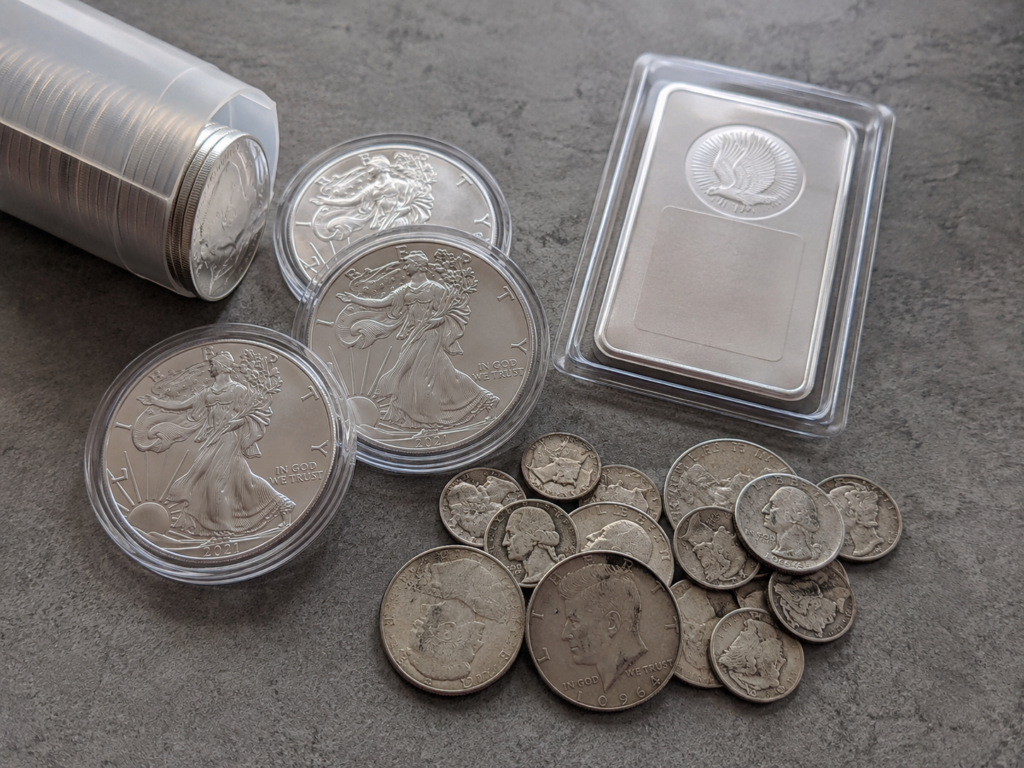
Silver stacking is buying physical silver — coins, bars, or rounds — gradually over time as a long-term store of value. It is not a get-rich-quick trade, and it’s not a fringe survivalist practice. It is a long-term savings habit in a tangible asset, the same way some people save in real estate or index funds. Here is how it actually works.
What is silver stacking?
Silver stacking is the practice of accumulating physical silver bullion over time as a long-term store of value. Stackers buy silver coins, bars, or rounds gradually — often monthly — with the intent to hold for years or decades. The metal is bought for its weight content rather than as a short-term trade.
Two words from this article do most of the work in stacker conversations. A stacker is someone who does this. A stack is the accumulated holding. Both terms came out of precious metals forums in the early 2010s and are now standard usage across the community.
Three more terms come up throughout. Bullion is metal sold by weight at its melt value rather than for collector value — covered in our guide to bullion as a category. Spot price is the live wholesale price of one troy ounce of pure silver — the number that scrolls across financial dashboards. Premium over spot is the markup a dealer adds to cover fabrication, distribution, and margin. Every retail silver price is spot plus a premium.
Stacking is not numismatic coin collecting — that hobby is driven by rarity and condition, a different market entirely. It’s not silver ETF buying either — those are paper instruments that track the silver price rather than physical metal you possess. And it is not short-term trading. Stacking assumes a multi-year holding horizon, usually decades.
Why do people stack silver?
People stack for different reasons, and most stackers care most about one or two. The list below is the honest set, framed as things some people value — not as things you should value.
A long-term store of value
Silver has held purchasing power across centuries, which is what draws long-horizon savers to it. A 90% silver dime that bought a loaf of bread in 1955 roughly buys one today. The pattern is historical and worth knowing about; it is not a forecast.
Portfolio diversification
Precious metals correlate weakly with stocks and bonds, so a small physical metals position can reduce overall portfolio volatility. How much is “small” is a personal call we touch on in a section below.
An inflation hedge over long horizons
Silver has historically tracked inflation over multi-decade periods, even though short-term performance can diverge sharply from CPI in either direction. The phrase “silver is an inflation hedge” is too strong for short windows and roughly correct for very long ones.
A tangible asset with no counterparty risk
Physical silver in your possession is not a claim on a financial institution. It does not depend on a bank or brokerage staying solvent. Some stackers like having a portion of their savings outside the financial system for that reason.
Generational handoff
Physical silver is straightforward to gift, inherit, or pass on as a discrete physical object. Many stackers think of the stack as a long-horizon transfer to children or grandchildren, which is a use case financial assets handle differently.
A lower entry price than gold
Silver lets a saver start a precious metals position with $30–$50 instead of the $300+ required for a 1 oz gold coin. That practical reason rarely shows up in investment-thesis writing but is a real driver of who actually stacks. The relative price between the two metals is a topic in itself — see our discussion of the gold-to-silver ratio.
Most stackers do not agree with all six reasons, and you do not need to. The point of going through them is to be honest about what stacking does and does not do.
What do silver stackers actually buy?
Stackers buy silver bullion in three forms — government-minted coins, privately minted bars, and privately minted rounds — plus a fourth category: pre-1965 U.S. junk silver. Each has its own premium pattern and trade-offs, and most experienced stackers end up holding a mix of all four.
Our complete guide to silver bullion goes deeper on the products; the short version below is enough to start.
Government coins
The American Silver Eagle (.999 fine, 1 troy oz, $1 face value, produced by the U.S. Mint since 1986) and the Canadian Silver Maple Leaf (.9999 fine, 1 troy oz, C$5 face value, produced by the Royal Canadian Mint since 1988) cover most U.S. retail demand. Premium runs 15–30% over spot on the Eagle and 10–20% on the Maple. Both resell at any reputable dealer in the country without questions. These are the standard first-purchase coins.
Silver bars
Privately minted (or sovereign-minted) ingots from PAMP, the Royal Canadian Mint, Sunshine Minting, JM Bullion, Asahi, A-Mark, and others. Sizes run from 1 oz up to 100 oz, with a 1 kilo bar at 32.15 troy oz. Premium drops sharply with size: a 10 oz bar sits 7–12% over spot, a 100 oz bar sits 5–8%. The trade-off is divisibility — a 100 oz bar sells whole, not piecemeal. Our coins versus bars decision piece walks through the form-factor choice.
Silver rounds
Privately minted 1 oz pieces, .999 fine, with no face value and no government backing. Recognized brands (Sunshine, Asahi, Scottsdale) produce them in generic designs like the Buffalo or Walking Liberty. Premium runs 5–12% over spot — the lowest 1 oz tier. Rounds give up legal-tender status and a small amount of universal resale acceptance in exchange for the lower premium. Many stackers use them as the “working capital” layer of the stack.
Junk silver
Pre-1965 U.S. dimes, quarters, and half dollars struck in 90% silver. Bought by face value × multiplier × spot for melt value, not for collector premium. A dollar of face value contains 0.715 troy oz of silver. Junk silver is common in stacker mixes because of divisibility (a single dime is small change, literally) and recognition — every American has handled a pre-1965 quarter at some point. Our junk silver guide covers the math and the buy-side details.
How to start silver stacking
These eight steps cover a first purchase from budget to logbook. Treat them as a starting checklist, not a script.
- Set a monthly budget you can sustain. Stacking works because it is repeated. Start with what you can put aside every month without dipping into emergency funds. Even $50 a month builds a meaningful position over a few years.
- Pick your first product. Most stackers start with one or two 1 oz Silver Eagles or Silver Maples for recognition, plus a few generic 1 oz rounds at a lower premium. Avoid fractional silver (1/10 oz, 1/4 oz) as a first purchase — premium per gram is brutal.
- Pick a reputable dealer. APMEX, JM Bullion, Money Metals, SD Bullion, Hero Bullion, and Kitco are the most-used online dealers; reputable local coin shops are also fine. Avoid social media ads, eBay individual sellers without strong feedback, and unsolicited direct messages.
- Lock the price at order time. Online dealer prices hold for a short window once the order is placed. Silver spot moves; the price you saw browsing is not the price you pay if the cart sits for two hours.
- Confirm shipping is insured and signature-required. This is a default for established dealers, but check the order page. Do not have silver dropped on an unattended porch.
- Verify the piece on arrival. Check weight (a 1 oz Silver Eagle is 31.1 g), dimensions, edge details, and packaging. Silver is non-magnetic, so a magnet test is a useful first check. Our guide on how to spot fake gold and silver covers the rest of the authentication playbook.
- Decide on storage. Most beginner stacks live at home in a small safe — covered in detail below. Bank safe deposit boxes and private depositories come into play once the stack is larger or the threat model changes.
- Log the purchase, then repeat. Write down what you bought, when, at what spot price, and for what total cost. This sounds boring; it matters at sale time. Then schedule the next buy. Stacking is a cadence, not a single event.
Do not try to time silver spot. New stackers spend more energy waiting for a “good price” than the price savings would ever be worth. A monthly buy at whatever spot is doing on the day is the boring, effective approach. The math behind that is in our piece on dollar-cost averaging into silver.
How much silver should you stack?
There is no universal answer. Financial commentators who include precious metals in portfolio discussions typically reference 5–15% of total investable assets across all precious metals combined (gold and silver together).
Silver-specific allocation within that range is personal — some stackers lean heavier silver because of the lower entry price, others lean heavier gold for storage efficiency. Those numbers are reference points from the literature, not our recommendation.
The factors that matter more than any percentage are time horizon, existing financial position, and emotional tolerance. Stacking only makes sense if the holding period is years, not months. No stacker should be funding a stack from credit-card debt or emergency-fund reserves.
And the right amount is the amount you can hold through a 30% paper drawdown without selling. There is more depth on allocation in our piece on how much gold you should own. This article is not financial advice — talk to a qualified professional before making allocation decisions.
Storing your silver stack
Storage matters more for silver than for gold because volume per dollar is meaningfully higher. A $10,000 silver position is roughly 300 troy ounces; a $10,000 gold position is roughly 5. That difference drives the storage decision for serious stackers.
Home storage
Most beginner and intermediate stacks live at home. The standard setup is a small safe in a discreet location — not the obvious bedroom closet. Consider fire rating, weight (a heavy safe deters opportunistic theft), and basic environmental control. Silver tarnishes from sulfur in air, so airtight tubes or capsules slow tarnish meaningfully — tarnish is cosmetic, not a loss of silver content, but it does affect resale on near-mint pieces. Our guides to storing silver at home and preventing silver tarnish cover both topics in detail.
Bank safe deposit box
Cheap ($50–$200/year), highly secure, and physically off-site. The trade-offs: boxes are not FDIC-insured, the bank’s insurance does not cover contents, and access is limited to bank hours. Silver also takes up real space in a box — 100 oz of silver is roughly the size of two paperback novels stacked. Fine for a portion of a stack; not great for a kilo bar collection.
Private depository
Brink’s, Loomis, Delaware Depository, and IDS of Texas are the names that come up most. Fees typically run 0.5–1% of holdings per year, the holdings are fully insured, and private depositories are required for silver held inside an IRA. They are usually the right choice once a stack passes a few thousand ounces. Our overview of private gold and silver depositories walks through the options.
The right storage answer depends on stack size, threat model, and how much friction you want between yourself and the metal. Many stackers use more than one — some at home, some in a depository.
Tracking your silver stack
Stacking is, by definition, a long-term repeated practice. A stacker buying once a month for five years has 60 purchase events. Each one has a different spot price, a different premium, a different shipping cost, possibly a different dealer, and a different sales tax outcome depending on the state.
Spreadsheet stackers will tell you the spreadsheet works fine for the first ten or fifteen purchases and starts breaking around purchase forty. By purchase eighty, nobody remembers what the 2024 lot cost. This is a real problem, not a hypothetical.
The recordkeeping matters most at sale. When the stack comes apart — for a home purchase, a generational handoff, or a portfolio rebalance — the taxable gain on each piece is computed against its cost basis (the original purchase price, including premium and applicable adjustments).
Without per-piece records, the stacker is forced to either over-report (and overpay tax) or scramble for receipts. The IRS treats silver bullion as a collectible, taxed at up to 28% on long-term gains rather than the lower 15%/20% on most assets, so the math is meaningful. This is not tax advice; consult a qualified tax professional for your situation.
Gold Silver Ledger replaces the spreadsheet the moment the spreadsheet stops working. A Holdings page shows every coin and bar in the stack, total cost basis, and current value side by side, gain or loss per piece and across the whole portfolio, and search, filter, and tag controls that scale past 50 purchases. It is built for people who plan to stack for a decade or two, not for traders moving in and out weekly.
A silver stacker’s glossary
The vocabulary of stacking community comes up often enough that a quick reference helps. Twelve terms a beginner will see in the first month.
- Stacker: Someone who accumulates physical silver (or gold) over time as a long-term holding.
- Stack: The accumulated holding of physical silver. “My stack” means your personal collection.
- Spot price: The live wholesale price of one troy ounce of pure silver, set continuously on global futures and over-the-counter markets.
- Premium over spot: The markup a dealer charges above spot, covering fabrication, distribution, and margin. Expressed as a percentage.
- Troy ounce: The standard unit of weight in precious metals. One troy ounce equals 31.1 grams (slightly heavier than a regular ounce).
- Fineness: The share of pure silver in a piece, written as a decimal. .999 means 99.9% pure (“three nines”); .9999 means 99.99% (“four nines”).
- ASW: Actual Silver Weight. The pure silver content of a piece, used most often for circulating coinage (a 1964 quarter has 0.1808 troy oz ASW).
- Junk silver: Pre-1965 U.S. dimes, quarters, and half dollars struck in 90% silver. Traded for melt, not collector value.
- Monster box: A sealed case of 500 sovereign-mint coins (typically Silver Eagles or Maples), shipped and sold as a unit.
- DCA: Dollar-Cost Averaging. Buying a fixed dollar amount on a fixed schedule regardless of price, which averages cost basis over time.
- FOMO / FUD: Stacker forum shorthand. FOMO is fear of missing out (price-chasing behavior); FUD is fear, uncertainty, and doubt (rumor-driven selling). Both are descriptions of bad reasons to act.
- Numismatic: The collector market for rare and graded coins. Distinct from bullion stacking, which is about metal content rather than rarity.
Frequently asked questions
Is silver stacking worth it?
Silver stacking has historically functioned as a long-term store of value and a portfolio diversifier, with real trade-offs: no yield, storage responsibility, and a wider buy-sell spread than most financial assets. Whether it is “worth it” depends on goals and time horizon — a stacker holding for decades sees a different return profile than someone trying to flip in 18 months. Allocation is a personal call, not a universal recommendation.
How much silver should a beginner start with?
A common starting pattern is one or two 1 oz Silver Eagles or Silver Maples plus three to five generic 1 oz silver rounds — roughly $200–$500 at typical premiums. Smaller is fine; the practice is the point, not the size of the first buy. Form-factor questions for the next few buys after the first are covered in the coins-versus-bars comparison referenced earlier.
Can I start stacking silver with $100?
Yes. One hundred dollars typically buys two to three 1 oz government coins or a small group of generic 1 oz rounds at typical premiums. Many long-time stackers started with a single Silver Eagle and added one a month for a year. Cadence matters more than starting amount.
Is silver stacking the same as buying a silver ETF?
No. Silver stacking is buying physical silver — coins, bars, or rounds — that you take possession of and store. A silver ETF is a paper instrument that tracks the silver price; the ETF holder does not own specific metal. The two have different liquidity profiles, different tax treatment, and different counterparty exposure, all of which we cover in our breakdown of physical silver versus ETFs and mining stocks.
How long should you stack silver?
Silver stacking is structured as a long-term practice — most stackers hold for years or decades, and the strategy assumes a multi-year minimum holding period. Short-term silver positions are subject to high premium drag (you buy retail and sell to a dealer at a spread) and meaningful spot volatility, so short holding periods are economically punishing.
Is silver stacking legal?
Yes. Buying, owning, and storing physical silver is legal in the United States and in virtually every Western country. Dealer-side 1099-B reporting kicks in on certain large bulk sales — see the ICTA Reportable Items List for the current thresholds — and capital gains are taxable, but the practice itself is unambiguously legal. State sales tax on bullion varies; see our notes on state sales tax on bullion for the patchwork.
What’s the difference between a stacker and a coin collector?
A stacker buys silver for its metal content (weight × purity × spot), with form factor chosen for premium efficiency and resale. A coin collector (numismatist) buys for rarity, condition, and design, often paying many multiples of metal value for a single piece. The two markets are distinct and serve different goals.
Should I stack silver or gold?
Most stackers eventually hold both, and the right mix depends on budget and goals. Silver costs less per ounce (which means a meaningfully lower entry price) and tends to be more volatile; gold is denser, easier to store at scale, and historically less volatile per dollar of position. The relative pricing between the two — and what that pricing has historically meant — is in our piece on the gold-to-silver ratio, linked above.
Every stacker needs a ledger
If you take one thing from this article, take that. A stack you cannot account for at sale time is a stack that costs you tax dollars or hours of receipt-hunting. Start tracking for free.
This article is educational, not financial or tax advice. Talk to a qualified professional before making investment or tax decisions.
